
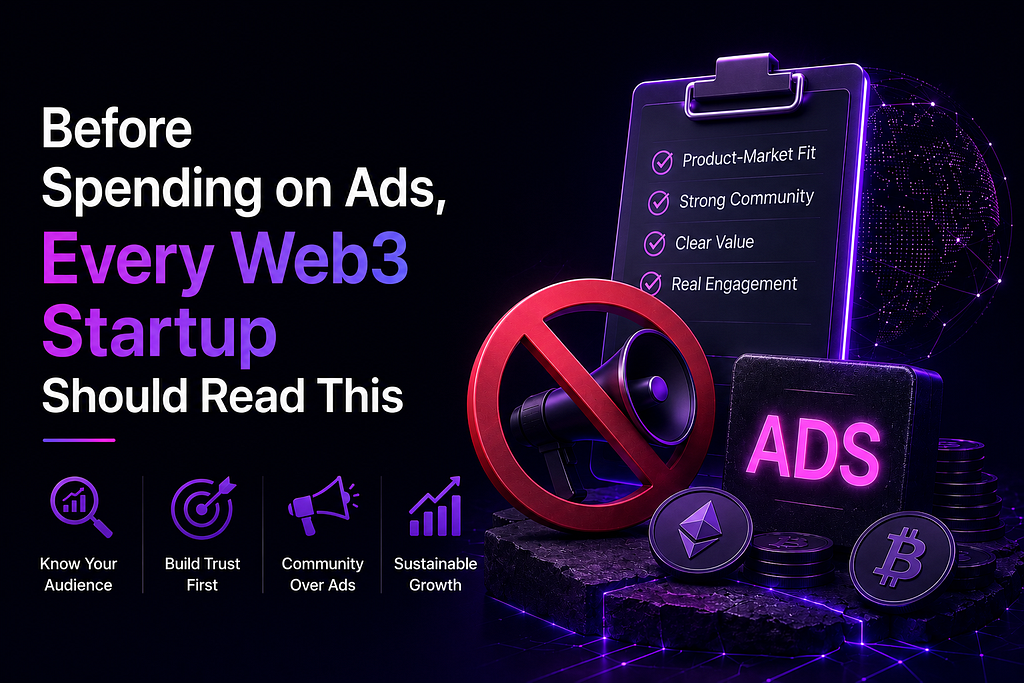
The wallet-targeted CPA looks great in the deck. The problem is what happens after the click and most Web3 teams find out too late that no one was ready to catch it.
Web3 Marketing
It’s an easy trap to fall into. There’s a treasury line item marked “marketing,” a media buyer on the other end of a call, and a launch date circled in red. So the instinct is to open a dashboard and start spending. But in 2026, a Web3 ad dollar is judged by a colder metric than impressions: did it produce a wallet that actually stuck around. Industry benchmarks put crypto CPM between $2 and $15 on most networks, climbing to $20–$40 for wallet-targeted premium inventory, with CPA for an actual token purchase landing anywhere from $20 to $200 or more depending on the value of the conversion. Those numbers aren’t the risk. The risk is spending them on a project that hasn’t done the unglamorous work first. Before an ad account gets funded, seven things need to already be true.
What Skipping the Audit Actually Costs
The gap between a prepared campaign and an unprepared one shows up immediately in cost per acquisition. A 2026 study tracking 1,200 crypto campaigns across 14 countries found that short-form video promotion delivered an average CPA of $6.14, compared to $22.80 for the same budget spent on static banner ads nearly a 4x difference driven almost entirely by whether the creative, landing page, and community were ready to receive that traffic. Compare that to bidding directly on branded crypto search terms, where keywords like “crypto exchange” can exceed $15–$25 per click on Google Ads before a single wallet has connected. Paid media doesn’t fail because the network is bad. It fails because the budget arrives before the foundation does.
The 5 -Point Pre-Ad Ledger
Think of this as the audit a serious treasury lead runs before releasing budget not a wishlist, a gate. Each line item is something that should already be true before a single ad set goes live.
01/ Utility survives a one-sentence test
If your team can’t explain what the product does not what the token might be worth in a single plain sentence, an ad won’t fix that. 2026’s most credible projects lead with demonstrated function: fractional real estate liquidity, cheaper cross-border settlement, verifiable on-chain yield. Utility-first messaging now consistently outperforms speculation-led messaging, and it’s free to fix before you pay to amplify it.
02/ A community that exists without the ad budget community
Token-gated Discord servers, governance forums, and members-only channels are where 2026’s most durable Web3 brands are built — and they need to show signs of life before paid traffic arrives. An ad that lands a new wallet in a silent server converts once and churns. An ad that lands them in an active one converts and compounds.
03/ Organic content and search groundwork are already live SEO / AEO
Docs-led SEO, protocol comparisons, and founder-driven technical commentary are outperforming generic blog content in 2026, and they’re also what AI answer engines pull from when someone asks “is [project] legitimate” before clicking your ad. If that groundwork isn’t published yet, paid traffic is arriving to check a reputation that doesn’t exist online.
04/ KOL and KOC relationships that predate the campaign
The most effective 2026 approach pairs KOLs for reach with KOCs smaller, highly engaged creators for grassroots trust. These relationships take weeks to build properly and cannot be assembled the same week a campaign launches. Agencies running KOL marketing at scale exist specifically to have this bench ready before budget needs to move.
05/ Wallet-level attribution is wired up before dollar one on-chain data
Tools like Spindl, Formo, and Addressable, alongside Dune and Nansen for on-chain verification, can trace a click all the way to a wallet’s subsequent behavior. Without this in place, “it drove impressions” is the only story an ad campaign will ever be able to tell and impressions don’t justify treasury spend to a DAO or an investor.
What the 2026 Spending Data Actually Shows
Look at where the money is already proving out, and the order writes itself. Instagram and Facebook jointly account for 58% of ROI-focused crypto campaigns, while TikTok has overtaken YouTube in total crypto-related video views for the first time 38.4 billion versus 29.7 billion in a single quarter. None of that reach converts on its own. It converts when it lands on a community, a landing page, and an attribution stack that were built before the campaign, not during it.
The best-performing Web3 campaigns in 2026 aren’t the ones with the biggest ad budgets they’re the ones where the ad budget was the last thing turned on, not the first.
Frequently Asked Questions
Should a Web3 startup run paid ads before building a community?
No. Paid traffic that lands in an inactive Discord or a silent X account converts once and disappears. Community activity should exist before ad spend begins, not launch alongside it.
What’s a realistic CPA for a crypto ad campaign in 2026?
Expect roughly $5–$50 for a wallet connection and $20–$200+ for an actual token purchase, depending on the network and how qualified the traffic is. Short-form video creative currently runs far cheaper per acquisition than static banner ads.
Why do micro-influencers outperform macro-influencers in Web3 marketing?
Micro-influencers with 10K–100K followers are currently delivering roughly 8.3x ROI compared to 3.1x for macro-influencers, largely because their audiences trust their recommendations as genuine rather than sponsored reach.
What is wallet-level attribution and why does it matter before spending on ads?
It’s the ability to trace a user from an ad click all the way to the wallet address and on-chain actions that follow. Without it, a campaign can only report impressions and clicks not whether it produced real holders or usage, which is what most treasuries and investors now expect to see.
Before Spending on Ads, Every Web3 Startup Should Read This was originally published in Coinmonks on Medium, where people are continuing the conversation by highlighting and responding to this story.