
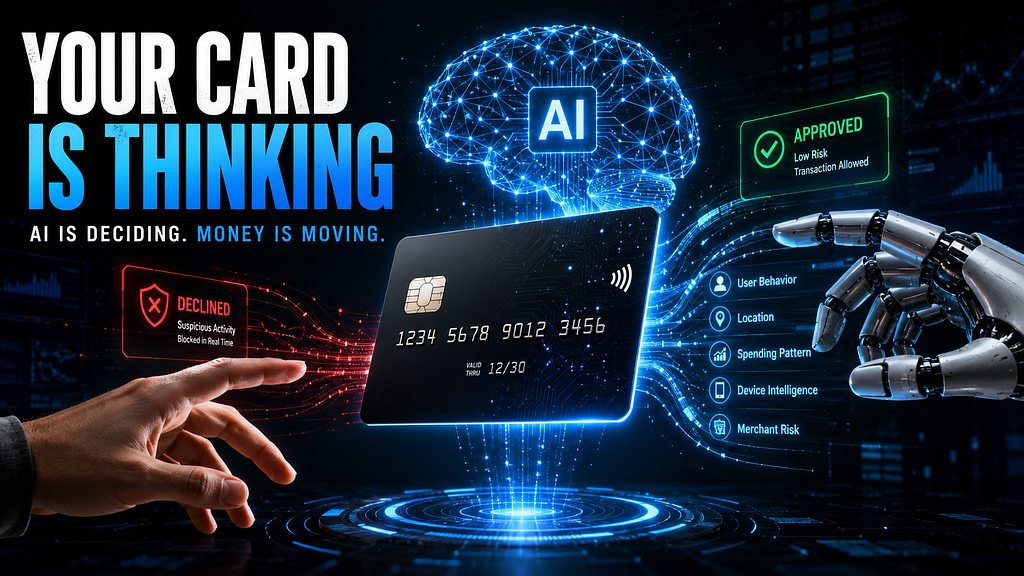
The Card Is No Longer Just a Payment Tool
It’s Becoming a Decision Engine
For years, a card did one simple thing:
You swipe.
Money moves.
That’s it.
But something is changing.
Quietly.
When AI integrates with Cards-as-a-Service…
the card stops being passive.
It starts making decisions.
Image Generated by ChatGpt
First, Understand What Changed
Cards-as-a-Service (CaaS) already transformed fintech.
It allowed companies to:
issue cards without becoming bankslaunch in weeks instead of yearscontrol spending rules via APIs
Instead of building infrastructure…
you plug into it.
That alone was powerful.
But AI adds something deeper:
intelligence on top of infrastructure.
What AI Actually Does Behind the Scenes
Let’s remove the hype.
AI in cards doesn’t mean a “smart card.”
It means smarter systems behind it.
For example:
detecting unusual spending patternspredicting fraud in real timeanalyzing behavior across transactions
In simple terms:
The card starts understanding usage, not just processing it.
The Shift: From Payments → Decisions
Here’s where things get interesting.
Before AI:
rules were staticlimits were predefinedhumans reviewed exceptions
After AI:
limits can adjust dynamicallytransactions can be approved or blocked in real timerisk is evaluated instantly
So instead of:
“Did this payment happen?”
The system asks:
“Should this payment happen?”
The Rise of Programmable Money
CaaS already made cards programmable.
You could:
set spending limitsrestrict merchant categoriesissue virtual cards instantly
But AI makes this dynamic.
Now:
limits can change based on behaviorcards can adapt to contextspending rules evolve in real time
It’s no longer:
rules you set once.
It’s:
rules that learn.
The Most Powerful Shift: Autonomous Spending
This is where things start to feel different.
AI agents can now:
request cardsreceive scoped accessexecute transactions without human input
A new model is emerging:
cards designed for machines, not humans.
These cards:
have strict limitsexpire automaticallyoperate within defined policies
Think about that.
We’ve moved from:
Humans using cards
to
systems using cards on behalf of humans
The Invisible Layer: Control Without Friction
From the outside, nothing changes.
You still:
tap your cardpay onlineuse your app
But underneath:
fraud is blocked before you noticelimits adjust without you askingrisk is constantly recalculated
The experience feels smoother.
Because the complexity is hidden.
The Trade-Off Nobody Talks About
More intelligence means more data.
To work well, AI systems need:
transaction historybehavioral patternscontextual signals
Which raises real questions:
Who controls that data?How are decisions made?Can you challenge them?
Because when AI declines a transaction…
it’s not always clear why.
The Illusion of Simplicity
CaaS makes launching cards look easy.
AI makes them feel smart.
But behind that simplicity:
compliance still existsrisk still existsoperational complexity increases
As one insight puts it:
The complexity doesn’t disappear — it shifts from technical to operational.
And AI accelerates that shift.
The Real Transformation: Who Controls Money Flow
This is the part most people miss.
Cards-as-a-Service was never just about issuing cards.
It was about:
controlling the last mile of money movement
AI strengthens that control.
Because now, control isn’t just:
where money goes
It’s also:
whenwhywhether it should go at all
What This Means for the Future
We’re moving toward a system where:
payments are automateddecisions are delegatedmoney flows with minimal human input
Not in theory.
In practice.
And slowly, this becomes normal.
The Subtle Question You Should Be Asking
When your card declines a payment in the future…
or approves one instantly…
Ask yourself:
Did I decide that?
Or did the system decide it for me?
Final Thought
AI doesn’t change what a card is.
It changes what a card does.
From:
A tool that executes your decisions
To:
A system that helps make them
And once that shift happens…
you’re no longer just spending money.
You’re interacting with a system
that is quietly deciding
how money should move.
What Happens When AI Meets Cards-as-a-Service was originally published in Coinmonks on Medium, where people are continuing the conversation by highlighting and responding to this story.