
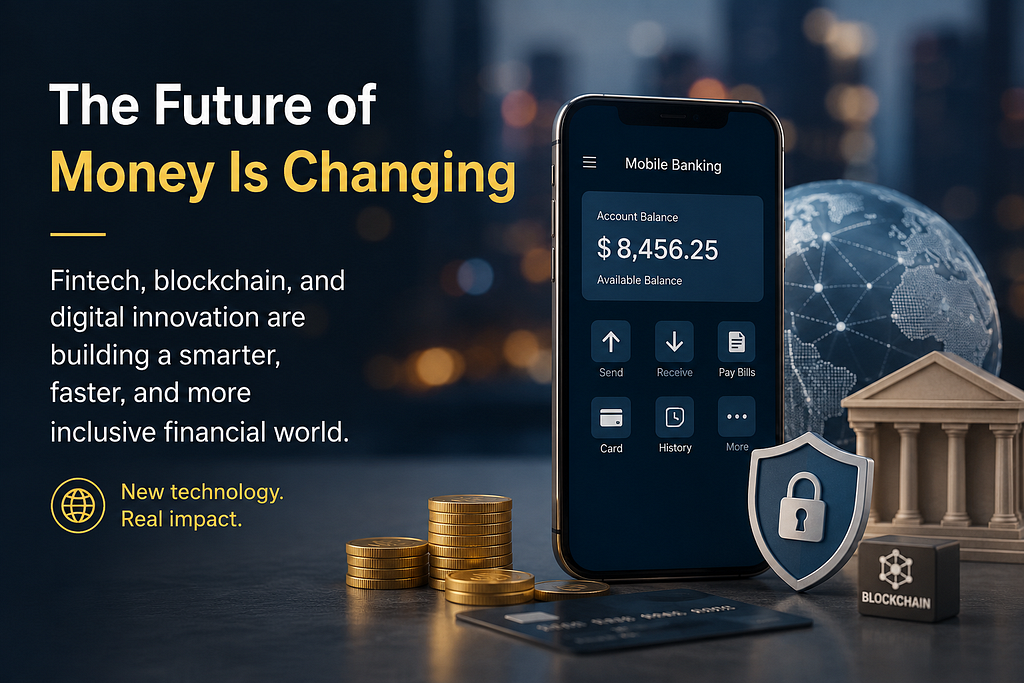
AI isn’t just changing how we work, it’s quietly transforming how money is created, moved, protected, and experienced. As AI, fintech, blockchain, and digital assets converge, a new financial infrastructure is emerging, and the businesses paying attention today may define the next decade.
Artificial intelligence has become the defining technology conversation of this decade. Every day brings new discussions about AI replacing repetitive tasks, improving productivity, or changing the future of work. While these conversations are important, they often overlook a transformation happening beneath the surface one that could have an even greater impact on businesses and consumers alike.
AI is beginning to reshape money itself.
Not the physical currency in our wallets, but the systems that move it, protect it, verify it, lend it, invest it, and make it accessible. The financial world has always evolved alongside technology, from ATMs and online banking to digital payments and mobile wallets. Today, AI is accelerating that evolution in ways that many people have yet to fully recognize.
The most significant financial innovations rarely arrive with dramatic headlines. They become part of everyday life before people realize how much has changed. Contactless payments, digital banking, QR codes, and instant transfers all followed this pattern. AI appears to be following the same path, quietly becoming part of the infrastructure that powers modern finance.
One of the biggest changes is happening in payments. Traditional payment systems have relied on predefined rules for decades. AI introduces something fundamentally different. Instead of simply processing transactions, payment systems can now identify suspicious activity in real time, optimize transaction routing, reduce failed payments, and adapt to customer behavior almost instantly.
This shift improves both efficiency and security. Fraud detection becomes more accurate because AI learns from evolving transaction patterns rather than relying solely on static rules. At the same time, customers experience faster approvals and fewer unnecessary payment declines, creating smoother digital experiences.
Banking is undergoing a similar transformation. Financial institutions are no longer using AI only to automate customer support. They are increasingly applying it to credit assessments, risk management, compliance monitoring, portfolio analysis, and operational efficiency. Many routine decisions that once required extensive manual review can now be supported by intelligent systems that analyze thousands of variables in seconds.
This does not eliminate the need for human judgment. Instead, it allows professionals to focus on more complex decisions while reducing operational bottlenecks.
Another major shift is taking place in financial inclusion. Millions of individuals and small businesses still struggle to access traditional banking because they lack conventional financial histories. AI creates opportunities to evaluate creditworthiness using broader patterns of financial behavior rather than relying exclusively on traditional credit scores.
For entrepreneurs and small businesses, this could open access to financing that was previously unavailable, particularly in emerging markets where financial infrastructure is still developing.
The convergence of AI and blockchain introduces another layer of transformation. Blockchain provides transparency, security, and immutable records. AI adds intelligence by interpreting data, identifying trends, automating processes, and improving decision-making.
These technologies are often viewed separately, but together they complement one another. Blockchain establishes trust in data, while AI extracts value from that trusted information. Whether supporting cross-border payments, digital identity, trade finance, or tokenized assets, the combination has the potential to create more efficient financial ecosystems.
Digital assets are also entering a new phase. For years, much of the conversation around cryptocurrencies focused on price volatility and speculation. Today, attention is gradually shifting toward practical applications such as programmable payments, tokenized real-world assets, decentralized financial infrastructure, and faster international settlements.
AI can enhance these systems by improving compliance monitoring, identifying risks, automating reporting, and helping organizations manage increasingly complex financial operations.
Perhaps the most overlooked change is occurring behind the scenes. Businesses are increasingly embedding financial services directly into their products rather than directing customers to separate banking platforms. Whether it is integrated payments, digital wallets, lending, insurance, or financial management tools, embedded finance is becoming part of the customer experience.
AI makes these services smarter by personalizing recommendations, detecting unusual activity, streamlining onboarding, and improving customer support without disrupting the user journey.
Consumers may not even notice this transformation because it feels seamless. They simply experience faster services, better recommendations, stronger security, and more personalized financial products.
Regulation will play a defining role in determining how quickly these innovations scale. Financial systems depend on trust, transparency, and accountability. As AI becomes more deeply integrated into financial infrastructure, governments and regulators will continue to develop frameworks that balance innovation with consumer protection.
Organizations that invest in responsible AI, strong governance, cybersecurity, and regulatory compliance will likely be better positioned for long-term success than those focused solely on rapid deployment.
The financial industry has experienced several defining moments over the past fifty years. Electronic banking digitized financial services. The internet connected global markets. Smartphones placed banking into people’s pockets. Cloud computing modernized financial infrastructure.
AI represents the next stage of that progression.
Its impact will not be measured only by chatbots or automated assistants. It will be measured by how efficiently money moves, how accurately risks are assessed, how securely transactions are processed, and how accessible financial services become for individuals and businesses around the world.
The companies leading this transformation are not simply adopting AI as another software tool. They are rethinking financial infrastructure from the ground up, combining artificial intelligence with fintech innovation, blockchain technology, digital payments, and modern compliance systems to create more resilient and intelligent ecosystems.
History often remembers breakthrough technologies through the products consumers use every day. Yet the most profound changes usually happen much deeper within the infrastructure that supports them.
That is exactly where AI is beginning to reshape finance.
While much of the world continues debating what AI means for jobs, content creation, or productivity, another story is quietly unfolding. It is changing how money moves, how trust is established, and how financial services are delivered.
The next financial revolution may not begin with a new currency or a new bank.
It may begin with intelligence built into every financial transaction.
Everyone Is Talking About AI. Almost No One Is Talking About What It’s Doing to Money. was originally published in Coinmonks on Medium, where people are continuing the conversation by highlighting and responding to this story.