
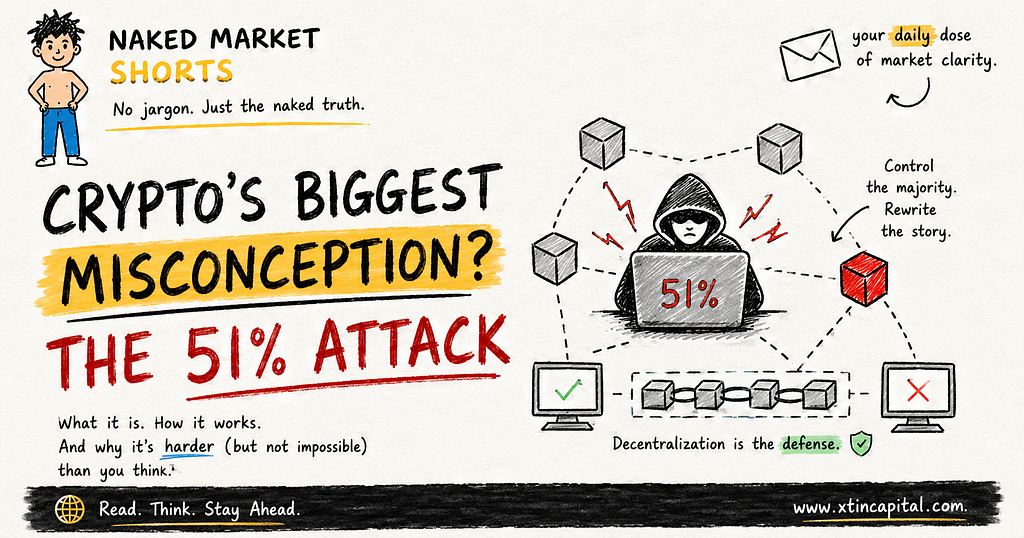
In 2025 a $300-million project quietly seized control of a $6-billion blockchain and still couldnt steal a single coin it didnt already own.
Naked Market breaks down macro finance, blockchain infrastructure, AI systems, and automated trading to help you understand the future of global finance before the mainstream catches up.
Last year, the strangest takeover in crypto played out almost entirely in public.
A little-known project called Qubic — market value around $300 million went hunting for Monero, a privacy coin worth roughly twenty times as much. It didnt hack anything. It simply paid Moneros miners better than anyone else, bribing them to switch sides, until it quietly controlled more than half the network. Then it did the thing everyone is terrified of: it reached into Moneros history and rewrote it, reversing more than a hundred already-confirmed transactions in a single go.
The headlines did what headlines do. “Monero compromised.” “51% attack.” “Privacy coin broken.”
And yet — here is the part that should stop you — not one coin that wasnt already Qubics got stolen. The cryptography was never cracked. Nobodys wallet was drained. The rules werent rewritten. A $300 million minnow swallowed a $6 billion fish, and still couldnt pick a single pocket it didnt already have the keys to.
That gap, between what a 51% attack sounds like and what it actually does, is one of the most misunderstood things in all of crypto. Weve walked right up to it twice in this series — once explaining how strangers agree without a boss, and again last week mapping where crypto money actually gets stolen, where it sat as the one doorway into the vault nobody bothers with. Today we open that door. No code. No jargon you cant follow.
The myth: “they own the chain now”
Say the words “51% attack” and most people picture the same disaster movie. A shadowy group breaks the unbreakable math. They drain every wallet on the network. They conjure coins out of thin air. They become, basically, god of the ledger — able to do anything they like to anybodys money.
Every single piece of that is wrong.
A 51% attack isnt a break-in through the vault wall. Its something much weirder, and to see why, you have to remember one idea from how these chains agree on truth in the first place.
What it actually is: winning the vote on recent history
A blockchain has no boss deciding whats true. Instead as we walked through in the agreement piece — thousands of machines race to extend the chain, and the rule for “what really happened” is almost insultingly simple: the real history is whichever version has the most work stacked behind it. Usually thats just the longest chain. Nobody votes. Agreement just emerges, because everyone keeps building on the heaviest branch they can see.
Now you can see the whole attack in one sentence. If the heaviest chain wins, then whoever can build faster than everyone else combined gets to decide which version of recent history becomes the official one. That is all “51%” means — controlling more than half of the chains block-making power, so your version of events out-muscles everybody elses.
But notice the limit baked right into that. You can only out-build the others going forward, on recent blocks. You won the race to write the last few pages. You did not become the author of the whole book.
The one real power: the double-spend
So what do you actually do with the ability to rewrite the last few pages? You spend the same money twice.
Heres the move, step by step. You take some coins you genuinely own and send them somewhere useful — say you deposit them on an exchange and trade them out for cash, then withdraw the cash. On the public chain, that payment is right there for everyone to see. Looks final.
Except, the whole time, youve quietly been building a secret version of the chain on the side — one where that deposit never happened. Because you control the majority of the power, your secret chain piles up work faster than the public one. The moment your cash has cleared, you release your heavier secret chain. The network follows its own rule — heaviest chain wins and switches to yours. The deposit vanishes from history. You keep the cash and the coins.
Thats it. Thats the prize. Not “steal everyones money” just “take back a payment I myself just made, after Ive already pocketed what I bought with it.” You can also bully the network the cheaper way: simply refuse to include other peoples transactions, freezing them out. Censorship, not theft. This exact double-spend is how the famous victims — Bitcoin Gold, Ethereum Classic, Verge, Vertcoin actually lost money. The chains didnt break. They worked perfectly. They just faithfully obeyed an attacker who, for a window, owned the majority.
What a majority simply cannot buy
Now the part the disaster movie always skips — the three things all that hashpower still cant touch, no matter how much of it you rent.
It cant take coins that arent yours. Ownership isnt decided by the miners — its decided by a private key, a signature only you can produce. A majority of the network can reshuffle the order of history, but it still cant forge your signature. It can never sign a transaction for you. Your coins, sitting in your wallet, are untouchable to it.
It cant counterfeit money or rewrite the rules. Every honest machine on the network independently checks each block against the rulebook. Try to pay yourself a billion coins from nowhere, or quietly raise the supply, and every honest node rejects that block — no matter who mined it. You can out-race the others on the ordering of valid transactions. You cant out-vote the rules themselves.
It cant rewrite deep history. Every block buried under newer ones is exponentially harder to redo, because youd have to re-build all the work stacked on top. You can tear up the last few pages. You cannot rewrite the book. This is the one asterisk on why a blockchain cant be secretly rewritten and as youll see, its an asterisk that barely dents the promise.
So put the real picture next to the myth. A 51% attacker isnt the chains new god. Hes a time-traveler who can nip back and tear up his own recent receipts and nothing more.
Powerful, yes. But narrow and, on any chain worth attacking, far more expensive than its worth.
So why doesnt this happen to Bitcoin?
If a 51% attack is just a matter of out-building everyone else, why has Bitcoin — the single juiciest target on the internet never suffered one in sixteen years?
Because the only thing standing between a chain and a 51% attack is a price tag. And on Bitcoin, the price is absurd. To out-mine the entire honest network you would need a mountain of specialised hardware and power. One credible 2025 estimate put the cost of dominating Bitcoin for a single week at around $6 billion — roughly $4.6 billion in machines, a billion-plus to house them, and the electricity on top. Per hour, the bill runs into the hundreds of millions.
And it gets worse for the attacker. Spend that fortune, pull off the attack, and you would crash the price of the very coin youre stealing and turn your own warehouse of mining gear into scrap. You burn billions to steal millions, and torch your own loot on the way out. The math never closes. So nobody tries. As the agreement piece put it: the truth on a chain is simply the version too expensive for anyone to overturn.
Ethereum makes the trap even sharper. Since 2022 it runs on proof-of-stake, where your “mining power” is just money you lock up as a deposit. To attack it youd need to control more than half of all staked ether — tens of billions of dollars, somewhere north of $100 billion at recent prices. And the protocol has a nastier card: if you use that stake to cheat, it burns your deposit. They call it slashing.
Read that again. To attack Ethereum, you first hand the network a hundred billion dollars of hostages, then watch it destroy them the instant you misbehave. Its not just unprofitable. Its financially suicidal. Neither Bitcoin nor Ethereum has ever been 51%-attacked — and the gap between them and everyone else is the whole story.
Where it actually happens: the small chains
Because the moment you step down from the giants, that astronomical price tag shrinks fast and on a small enough chain, it becomes a weekend project. Which brings us back to Monero.
Qubics method was almost elegant. It never built a single mining rig of its own. It just ran a “pay-to-switch” campaign, offering Monero miners around three times the going rate to point their machines at Qubics pool instead. From under 2% of the network in May 2025, it climbed past 51% by August. In September it triggered an eighteen-block reorganisation that reversed roughly 117 confirmed transactions — the deepest rewrite in Moneros history, blowing straight through the ten-block cushion the network assumed was safe. Sustaining that dominance was estimated to cost about $75 million a day. Exchanges like Kraken froze Monero deposits. A $300 million chain was openly riding a $6 billion one.
And yet, tellingly, Qubic mostly didnt loot. It called the whole thing a “stress test.” Part of the reason is pure economics — Qubic was earning by selling the Monero it mined, so torching Moneros price would have torched its own revenue. The same disincentive that protects Bitcoin was quietly tugging at a far smaller chain. But the damage didnt need a double-spend. Confidence cracked, the price fell, exchanges pulled back and on a network, a reputational collapse is just as real as a technical one. Monero is one in a long line: Ethereum Classic in 2020, Bitcoin Gold back in 2018 and again in 2020, and others, all hit by the same playbook.
How chains fight back
Every real defence against this turns out to be a way of raising the price. The simplest: just wait. The deeper a transaction is buried under newer blocks, the more impossible it gets to reverse which is why exchanges make you wait for confirmations, and why they crank that number way up on shaky chains. Depth is armour.
The rest are variations on the same theme. Proof-of-stake adds slashing, so cheating destroys your own money. Ethereum adds “finality” after about thirteen minutes a block is locked so hard that reversing it would require a third of all staked ether to be burned at once. Small chains can merge-mine, borrowing a giant chains hashpower to protect their own. And the bluntest fix of all: get big enough that the price tag alone keeps everyone honest. (Its also why it pays to know whether youre even looking at a real public chain or a private database wearing the word — the guarantees are completely different.)
The takeaway: the Price-Tag Test
So heres the tool to keep. Next time a headline shouts that some coin got “51%-attacked,” dont picture broken cryptography and drained wallets. Run it through three questions instead.
1. Whats the bill? What would it cost to rent or buy a majority of this chains power for long enough to matter? Bitcoin: billions a week. A tiny coin: an afternoon on a hash-rental site. Security here isnt a yes-or-no. Its a number.
2. Would the loot beat the bill? Even if an attacker can pay, a serious attack craters the coins price and destroys their own rigs or staked deposit. On a big chain the math never closes. On a small one, it sometimes does — and thats exactly where attacks happen.
3. How deep is your payment? A majority can only rewrite recent history. The more confirmations sitting on top of your transaction — or the closer it is to true finality — the more impossible it becomes to erase. Shallow and fresh is exposed. Deep and final is safe.
Costly to attack, pointless to loot, deep enough to be final. Run those three and youll know in about ten seconds whether a chain deserves your trust — and youll never read a “51% attack” headline the panicked way again.
Why this actually matters
Zoom out, because this is bigger than any one coin getting roughed up.
The worlds money is steadily moving onto these rails — stablecoins settling across borders, tokenised treasuries, central-bank digital currencies, even AI agents holding their own wallets. As that happens, the question stops being academic: can this be trusted to carry serious value?
And the honest answer the 51% lens gives you is the reassuring one — just not in the way the hype crowd means. The cryptography almost never breaks. What actually keeps a chain safe is something more mundane and more durable: being too expensive to overpower. Thats why value keeps gravitating to the few base layers that genuinely are, and why a credible shared settlement layer for the planet — the One Earth, One Currency direction this newsletter keeps tracing — has to be built on economic security at a scale no nation, no cartel, no $300 million upstart can rent its way past.
So the next time someone tells you a blockchain “cant be hacked,” or that some coin just “got 51%-attacked,” you wont need to take either side. Youll just ask the only question that ever mattered.
What would it cost to overpower this chain — and is that more than whats inside?
Answer that, and youre already reading these systems the way the people building them do.
If you want to keep reading finance this way — the structure under the headlines, before it gets obvious — subscribe.One clear breakdown at a time.Subscribe to Naked Market →
Keep going
Start here → One Planet, 180 Currencies — the whole thesis in one readThe Biggest Innovation in Blockchain Isnt Money. Its Agreement. — how the “heaviest chain wins” rule worksEveryone Says Blockchain Cant Be Hacked. Theyre Wrong. — the four floors where money actually gets stolenWhy a Blockchain Cant Be Secretly Rewritten — and the one asterisk on that promiseThe New Rails: Blockchain as Infrastructure — where all of this is headingNew here? Start with the pinned welcome — One Planet, 180 Currencies. And if a friend still thinks “51% attack” means the math got cracked, forward this along. The conversation continues over in the community: t.me/MarketXtin.
For educational and informational purposes only — not investment, financial, legal, or tax advice, and not a recommendation to buy, sell, or hold any asset. Figures are drawn from public reporting as of the time of writing and change continuously. Always do your own research.
© 2026 Naked Market · chetandugar.substack.com
Crypto’s Biggest Misconception? The 51% Attack was originally published in Coinmonks on Medium, where people are continuing the conversation by highlighting and responding to this story.