
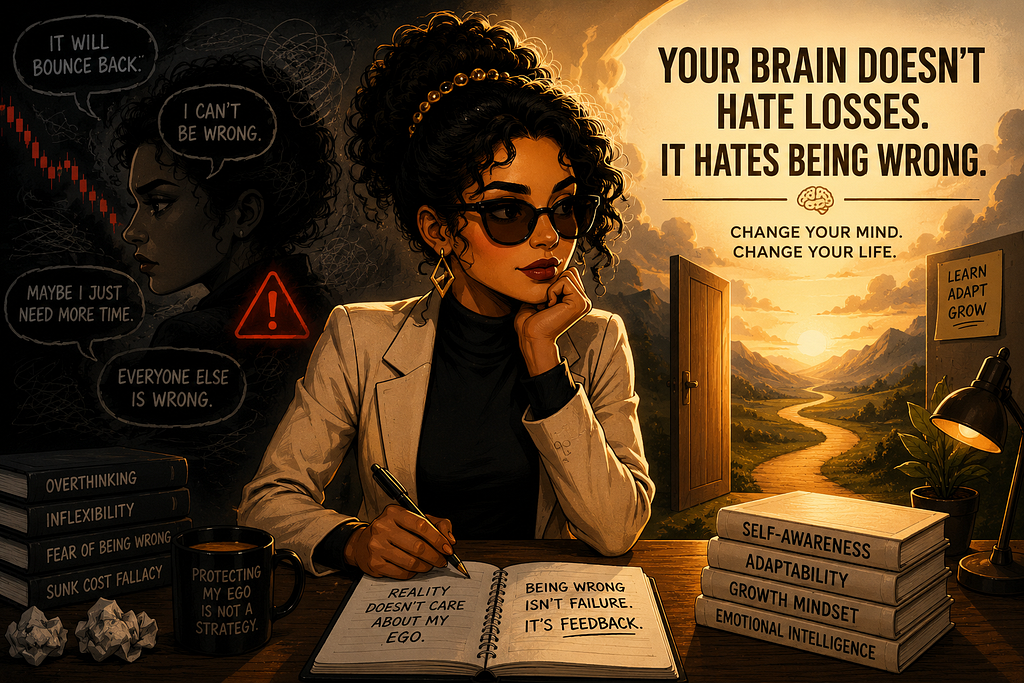
AI Image
The biggest mistakes in life rarely begin with bad decisions. They begin with our refusal to admit a decision was wrong.
I always thought losing was the hardest part. I was wrong.
The hardest part wasn’t watching my account turn red.
It was admitting that I had been wrong.
That realization changed far more than the way I traded.
It changed the way I looked at almost every decision I make.
The Lie We Tell Ourselves
The first time I moved a stop loss, I convinced myself I was being rational.
“The market is overreacting.”
“It just needs a little more room.”
“Nothing has really changed.”
At least, that’s what I told myself. Looking back, none of those reasons were true. The market hadn’t changed. My analysis hadn’t changed. Only one thing had changed.
I had become emotionally attached to being right.
We Think We’re Protecting Money
We’re usually protecting something else.
Our identity.
Admitting a losing trade isn’t just accepting a financial loss.
It feels like admitting we made a bad decision.
And our brain hates that feeling.
So it does something clever.
It starts writing stories.
“Maybe it’ll bounce.”
“Maybe everyone else is wrong.”
“Maybe I just need to wait a little longer.”
The goal quietly shifts. It stops being about making the best decision. It becomes about avoiding the sentence: “I was wrong.”
The Pattern Isn’t Limited To Trading
Once I noticed it, I couldn’t stop seeing it.
People stay in unhealthy relationships because leaving feels like admitting they ignored the warning signs.
Companies continue failing projects because canceling them would mean accepting years of wasted effort.
Professionals remain in careers that no longer fulfill them because changing direction feels like admitting they chose the wrong path.
The circumstances change.
The evidence changes.
But the decision stays the same. Not because it’s still the best decision. Because changing it hurts our ego.
Your Brain Wants Consistency More Than Truth
We like to believe we’re objective.
We’re not.
Once we’ve committed to something, our brain starts collecting evidence that supports our choice.
Conflicting evidence becomes uncomfortable.
Confirmation becomes addictive.
Without realizing it, we stop asking: “What’s true?”
And start asking: “How can I prove I was right?”
Those are two very different questions.
One leads to growth.
The other leads to expensive mistakes.
The People Who Grow The Fastest
The most impressive people I’ve met aren’t the ones who are always right.
They’re the ones who become comfortable being wrong.
They change their minds when new information appears.
They don’t see admitting a mistake as losing.
They see it as updating reality.
Their confidence doesn’t come from always being correct.
It comes from knowing they can adapt.
One Question Changed Everything
Now, whenever I feel myself defending a decision, I ask one simple question: If I hadn’t already committed to this choice, would I make the same decision today?
Sometimes the answer is yes. Surprisingly often…It isn’t.
That question has saved me from far more bad decisions than any strategy ever has.
Final Thoughts
Most of us don’t struggle because we make bad decisions.
We struggle because we become emotionally attached to the decisions we’ve already made.
The moment our identity depends on being right, learning stops.
Growth begins when being wrong no longer feels like failure.
Because the smartest people aren’t the ones who never change their minds.
They’re the ones who know exactly when they should.
Your Brain Doesn’t Hate Losses. It Hates Being Wrong was originally published in Coinmonks on Medium, where people are continuing the conversation by highlighting and responding to this story.