
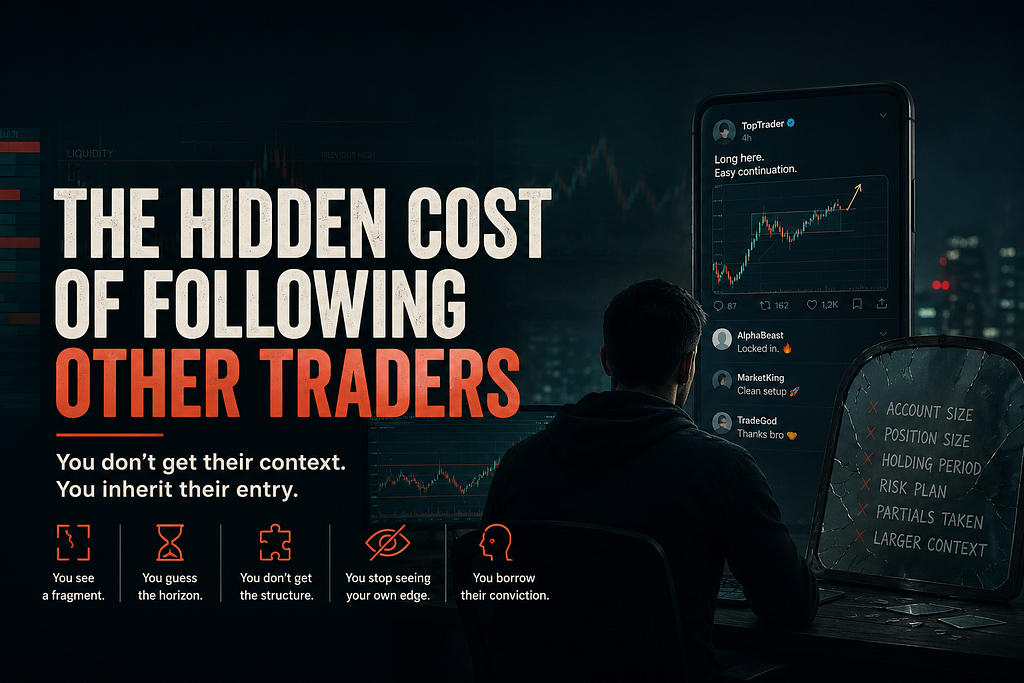
Watching other traders feels like research. It usually functions as outsourcing your judgment to people whose context you don’t have.
You scroll the feed. You see a screenshot of an entry. You see the chart, the conviction in the caption, the comments piling on. You don’t see the account size. You don’t see the position size relative to it. You don’t see the holding period the trader actually has in mind. You don’t see whether the post is a single position or a hedge inside a larger book. You don’t see whether the trader took partials before posting.
You see a fragment. You react to it like a complete picture.
The Fragment Problem
A post about a trade is not the trade. It’s a compressed artifact of a decision that lived inside a context you can’t observe.
The trader who posts a long entry on a four-hour chart might be running a portfolio where that position is two percent of capital. The same chart, the same entry, the same caption — in your account, it might be twenty percent. Or it might be your only position. Or it might be leveraged in a way the original trader would never use.
Same entry, different trade. Same chart, different risk. Same idea, different consequences.
The fragment looks like a recommendation because that’s how the brain reads it. A confident human saying “long here” registers as advice, regardless of what the trader intended. The disclaimer at the bottom doesn’t change the cognitive effect. You’ve already imported the conviction.
The Time Horizon Mismatch
Most traders never publicly state their holding period before a trade plays out. They might mention it after, in hindsight. They might frame a two-day swing as a scalp that “ran longer than expected,” or a position trade as a swing that “needed more time.” The narrative gets adjusted to the outcome.
In real-time, when the post hits the feed, the time horizon is implied. You guess. You usually guess wrong.
A trader who plans to hold for two weeks doesn’t react to a four percent drawdown the same way you do when you copied the entry expecting a two-day move. Their stop is wider. Their patience is longer. Their thesis isn’t invalidated by the same price action that’s invalidating yours.
You can hold the same position and still be in a completely different trade. The position is the easy part to copy. The time horizon, the conviction, the willingness to sit through noise — none of that transfers through a screenshot.
What You Inherit
When you act on someone else’s post, you inherit their entry. You don’t inherit the rest.
You don’t inherit the hours they spent watching the level before they took it. You don’t inherit the prior positions they’ve already trimmed. You don’t inherit the context that told them this specific setup matters more than the dozen others they ignored that week. You don’t inherit their experience of being wrong on the same pattern before and learning what it actually means.
The entry is the most visible part and the least valuable. The decision-making that produced the entry is what would actually help you. That part doesn’t fit in a screenshot.
You import the surface. The structure stays with the original trader. And then you wonder why the same trade behaves differently in your hands.
The Calibration You Skip
There’s a slow, unglamorous part of trading where you learn what a setup feels like across many instances. You take it. You watch it fail. You watch it work. You watch the variations. You start to notice the subtle differences between the version that resolves and the version that traps.
That calibration is the actual edge. It’s not the pattern itself. It’s the thousand small distinctions you can only build by sitting with the pattern across time.
When you follow another trader’s entries, you skip that calibration. You take the trade without the prior reps. You execute without the prior context. And then, when it works, you assume you understood it. When it doesn’t, you assume the trader was wrong.
Both assumptions are off. You weren’t reading the market. You were reading a feed. This is part of why humility is the actual edge — recognizing the gap between what you can see and what the source actually knows is the start of independent judgment.
What the Feed Trains You to See
The deeper cost isn’t the trades you copy. It’s the trades you stop seeing on your own.
After enough time watching other traders, the feed starts to define which setups feel real. The patterns that get posted get reinforced as the patterns that matter. The setups that don’t get posted — the quieter ones, the ones that don’t make for compelling screenshots — start to feel less legitimate, even if your own data says they work.
Your sense of what counts as a valid trade gets slowly remapped to match the aesthetic of the accounts you follow. Not their results. Their content style. The big breakouts. The dramatic reversals. The setups that look impressive on a chart.
The quieter setups — the ones that work because they’re boring, because nobody notices them, because they don’t generate engagement — start to fade from your attention. Not because they stopped working. Because they stopped feeling real next to the louder ones in the feed.
This is the most expensive part. The trades you used to take, the ones aligned with your own process, get displaced. Not deliberately. Just by repetition. The feed becomes the filter, and the filter becomes the strategy.
The Confidence Transfer
There’s a specific feeling that comes from watching a confident trader post a confident entry. Their certainty becomes available to you. You don’t have to construct it yourself.
That’s the appeal. Conviction is exhausting to build. Conviction borrowed from someone else feels almost as good as conviction earned. Almost.
The problem shows up later. When the trade goes against you, the borrowed conviction evaporates almost immediately. You didn’t build it. You can’t defend it. The first sign of pressure and you’re out, often at the worst possible point, because the only thing holding the position was the original trader’s confidence, and that confidence isn’t available to you in your account at the moment of drawdown.
The original trader holds. You don’t. Same trade. Different outcome. Not because their analysis was better. Because their conviction was theirs, and yours was on loan.
This is also why traders break their own rules — the social feed becomes the new rule, quietly replacing the original system you built. The rules you wrote down stop functioning as rules the moment someone else’s post feels more authoritative than your own process.
The Selection Bias You Don’t See
You see the trades that get posted. You don’t see the trades that don’t.
Most traders post selectively. The trades that worked. The trades they want to be associated with. The trades that fit the narrative they’re building. The losers either don’t get posted or get framed differently — as learning experiences, as small setbacks, as part of a process. The post-trade narrative is curated, even when the trader isn’t deliberately curating.
This creates a distorted sample. You see a feed of someone’s better moments and start treating it as a representation of their typical performance. You compare your full track record — wins, losses, drawdowns, hesitations — to their highlight reel. You feel behind. You start chasing harder.
The chase is responding to a sample that doesn’t exist. The trader you’re chasing has the same losing trades, the same hesitations, the same drawdowns. You just don’t see them. The feed structurally hides them.
Independent Judgment
Independent judgment doesn’t mean ignoring other traders. It means being clear about what you can and can’t extract from their public output.
What you can extract: the general shape of a setup, the conditions a trader pays attention to, the language they use to describe what they see. These are useful. They sharpen your own vocabulary. They expose you to frameworks you might not have considered.
What you can’t extract: their conviction, their context, their time horizon, their sizing, their actual position, their tolerance for drawdown, their reason for exiting. These don’t transfer. They have to be built from your own reps.
The trader who reads other traders carefully without copying them is doing something different from the trader who reads other traders and acts. The first is collecting frameworks. The second is outsourcing decisions.
The cost of the second is paid slowly, in small increments, in trades that don’t quite work, in conviction that doesn’t quite hold, in a strategy that drifts away from the one you built.
What Independence Looks Like
It looks unimpressive from the outside. Fewer posts. Slower decisions. Trades that don’t match what’s in the feed. Sometimes the trades you take are the ones nobody else is taking. Sometimes the trades you skip are the ones everyone else is celebrating.
The discomfort of being out of sync with the feed is part of the cost of trading your own system. There’s no version of independent judgment that feels like consensus. If you’re agreeing with the feed most of the time, you’re probably reading the feed, not the market.
The traders who develop genuine independence aren’t the ones who reject all input. They’re the ones who process input without inheriting it. They read. They watch. They consider. Then they decide based on what their own system says, not what their feed says.
That gap — between input and decision — is where independence lives. The feed delivers input. The decision has to come from somewhere else.
Most of the cost of following other traders isn’t in the bad trades it produces. It’s in the slow erosion of the gap between what you read and what you do. When that gap closes, you stop trading your system. You start trading theirs. And theirs was never designed for your account.
Every day I track one thing: where market structure and crowd sentiment disagree — and which one leads. Today’s read:
Daily on swaphunt.dev. Same on @SwapHunt. Not financial advice.
The Hidden Cost of Following Other Traders was originally published in Coinmonks on Medium, where people are continuing the conversation by highlighting and responding to this story.