
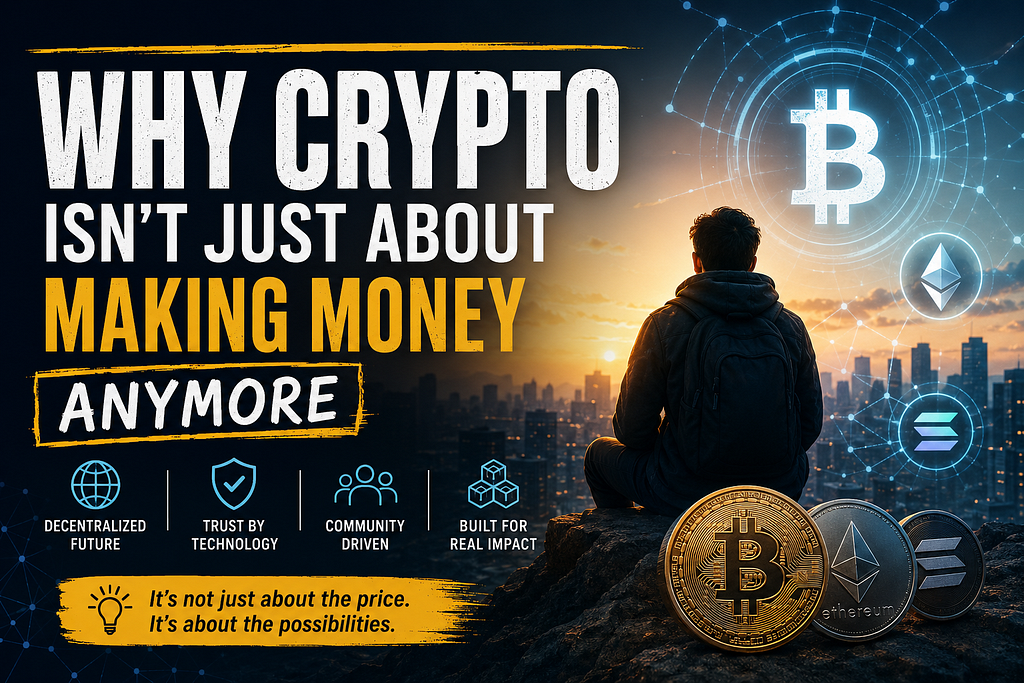
“I came for the profits. I stayed because I realized something much bigger was happening.”
Image generated by using ChatGPT
If you had asked me a few years ago what cryptocurrency was, my answer would have been simple: Bitcoin, trading, and people getting rich overnight.
Like millions of others, my first introduction to crypto wasn’t through blockchain technology or decentralized finance. It was through headlines.
“Bitcoin hits a new all-time high.”
“Teenager becomes millionaire after investing early.”
“Crypto crashes 60%.”
Every story seemed to be about price.
Green candles meant excitement. Red candles meant panic.
It felt less like a technological revolution and more like the world’s most unpredictable casino.
Then something changed.
The more I learned, the more I realized that crypto isn’t really about digital coins. It’s about changing how trust works on the internet.
And that’s a much bigger story.
The Internet Solved Information. Blockchain Is Trying to Solve Trust.
Think about how we use the internet today.
We can send emails across continents in seconds.
We can stream movies instantly.
We can video call someone thousands of miles away.
Information moves almost effortlessly.
But when it comes to value — money, ownership, contracts — we still rely heavily on intermediaries.
Banks verify transactions.
Payment processors approve transfers.
Governments issue currencies.
Platforms decide who owns digital assets.
These systems work remarkably well most of the time, but they also introduce costs, delays, restrictions, and sometimes single points of failure.
Blockchain technology asks a bold question:
“What if people could exchange value online without needing to trust a central authority?”
That simple idea has sparked one of the most fascinating technological experiments of our generation.
The First Time Crypto Felt Real
I remember making my first crypto transaction.
It wasn’t a huge amount.
I double-checked the wallet address.
Then I checked it again.
After clicking “Send,” I waited nervously.
Within minutes, the transaction was confirmed.
No bank.
No paperwork.
No business hours.
No approval email.
Just mathematics, cryptography, and a decentralized network doing exactly what it was designed to do.
That moment made blockchain feel real.
Not because I had made money.
But because I had experienced a different way of transferring value.
Beyond Bitcoin: A Growing Ecosystem
When people hear “crypto,” they often think only about Bitcoin.
But today’s blockchain ecosystem has expanded far beyond digital currency.
Developers are building decentralized applications that allow people to lend, borrow, trade, play games, create digital art, and even participate in community governance.
Stablecoins are making international payments faster.
Tokenization is opening new possibilities for ownership.
Smart contracts automate agreements without requiring manual execution.
Some projects succeed.
Many fail.
That’s normal for an emerging technology.
Remember the early internet?
Thousands of websites disappeared.
Hundreds of companies went bankrupt.
Yet the internet itself transformed the world.
Innovation is rarely a straight line.
Why Volatility Isn’t the Whole Story
Let’s be honest.
Crypto is volatile.
Prices can rise dramatically and fall just as quickly.
This volatility attracts traders but scares away many people who might otherwise be interested in the technology.
It’s important to separate the market from the innovation.
Stock prices fluctuate.
That doesn’t mean the internet disappears.
Similarly, crypto prices may swing wildly while blockchain infrastructure continues to improve behind the scenes.
Developers keep building regardless of whether markets are bullish or bearish.
Some of the most significant innovations in crypto have emerged during market downturns, when attention shifts away from speculation and back toward solving real problems.
Trust Is Becoming Programmable
One concept that fascinated me was the idea of programmable trust.
Traditionally, agreements depend on institutions.
A contract often requires lawyers.
Payments require banks.
Escrow requires third parties.
Blockchain introduces smart contracts, code that automatically executes when predefined conditions are met.
Imagine renting an apartment where your deposit is released automatically once both parties confirm the property was returned in good condition.
Or imagine freelancers getting paid instantly when work milestones are completed.
No chasing invoices.
No waiting weeks.
No unnecessary intermediaries.
Of course, smart contracts aren’t perfect.
Code can contain bugs.
Security remains essential.
But the concept opens entirely new possibilities.
The Human Side of Crypto
Despite all the technology, crypto is ultimately about people.
I’ve met developers who spend nights building open-source tools simply because they believe financial systems should be more accessible.
I’ve seen artists discover entirely new ways to connect directly with collectors.
I’ve watched entrepreneurs create payment solutions for regions where traditional banking is limited.
These stories rarely make headlines.
Price charts generate more clicks.
But behind every blockchain project are communities trying to solve practical challenges.
Sometimes they succeed.
Sometimes they don’t.
But innovation requires experimentation.
Regulation Is Part of Growing Up
For years, crypto existed in a regulatory gray area.
That created uncertainty.
It also allowed bad actors to take advantage of inexperienced investors.
Today, many governments are working toward clearer frameworks.
Some countries are embracing blockchain innovation.
Others remain cautious.
Finding the right balance won’t be easy.
Too little regulation creates risk.
Too much regulation can slow innovation.
The goal should be protecting consumers while still allowing new ideas to develop.
As the industry matures, responsible companies are increasingly focusing on compliance, transparency, and security.
That’s a positive sign.
What Crypto Taught Me
Interestingly, crypto taught me lessons that have very little to do with cryptocurrency.
It taught me to question assumptions.
Why should international payments take days?
Why do creators lose large percentages of their income to intermediaries?
Why can’t ownership exist natively on the internet?
These questions extend beyond blockchain.
Innovation begins when people challenge what everyone else accepts as normal.
Whether crypto becomes the foundation of future finance or simply influences existing systems, it has already encouraged millions of people to rethink how digital economies work.
The Future Isn’t Guaranteed
It’s important to stay realistic.
Not every blockchain project will survive.
Not every token has value.
Not every promise will become reality.
We’ve already seen scams, speculation, failed projects, and unrealistic expectations.
Healthy skepticism is necessary.
Research matters.
Risk management matters.
Technology alone doesn’t guarantee success.
But dismissing crypto entirely because of its failures would be like dismissing the internet in the late 1990s because many early websites disappeared.
The technology deserves to be evaluated separately from the hype.
Final Thoughts
I no longer see crypto as a shortcut to wealth.
Instead, I see it as an ongoing experiment in how humans coordinate, exchange value, and build trust in a digital world.
Will blockchain replace traditional finance completely?
Probably not.
Will it influence how financial systems evolve over the next decade?
I believe it already is.
The most exciting part isn’t whether Bitcoin reaches another record price.
It’s watching developers, entrepreneurs, regulators, and everyday users collectively shape a new layer of the internet — one where ownership, identity, and value can move as freely as information does today.
The next chapter of crypto won’t be written only by investors.
It will be written by builders.
And that’s a story worth following.
Why Crypto Isn’t Just About Making Money Anymore was originally published in Coinmonks on Medium, where people are continuing the conversation by highlighting and responding to this story.