
When you ask ChatGPT a question, you get one answer.
It arrives fast. It sounds confident. It usually looks complete enough to use.
That is useful, but it also creates a new problem: you do not know what the answer is missing.
You do not know what Claude would have challenged. You do not know whether Gemini would have found a different angle. You do not know if Grok would have pushed back on the framing, or if DeepSeek would have taken a simpler path. With a single AI answer, the hard part is hidden. You get the conclusion without seeing the disagreement that should have tested it.
That is why the next version of AI search will not just be faster Q&A. It will be debate.
The Problem With One Clean Answer
Traditional search gave you a list of results. You clicked, compared, checked sources, and built your own answer. It was slower, but it gave you contrast.
AI search removed that friction. Instead of ten blue links, you get one synthesized response. For simple questions, that is a clear improvement. If you need a definition, a summary, or a quick explanation, one answer is enough.
But for anything involving judgment, tradeoffs, uncertainty, or recent information, one answer can be too smooth.
The model might be right. It might also be skipping an assumption that would change the answer completely. The dangerous part is that both versions can sound equally polished.
A single model does not show you the argument it lost, the objection it ignored, or the alternative path it never considered. It gives you confidence, but not always coverage.
That is the gap AI debate tries to fill.
Debate Makes Search More Honest
The point of multi-model AI is not that five models magically become correct. They do not.
The point is that different models fail in different ways.
One model may be better at nuance. Another may be better at structure. Another may be more skeptical. Another may catch a missing constraint. When they respond to the same question and challenge each other, the disagreement becomes part of the answer instead of something you have to discover manually.
That changes the search experience.
Instead of asking, “What is the answer?” you start asking better questions:
What do the models agree on?Where do they split?Which assumptions created the disagreement?What would I need to verify before acting?
That is a more useful workflow for decisions than pretending every question has one clean final answer.
Consensus Is Useful, But It Is Not Truth
There is a trap in multi-model search: treating consensus as proof.
If five AI models agree, that does not automatically mean the answer is correct. They may share the same blind spot. They may rely on the same outdated public information. They may all be guessing in the same direction.
Consensus is still useful, but it should be treated as a signal, not a verdict.
When multiple models agree, the answer is less likely to be a one-model outlier. When they disagree, the question is probably more fragile than it looked at first. That split is often the most valuable part of the process.
For example, if you ask whether to take a job offer, one model might focus on salary and stability. Another might focus on learning and long-term optionality. A third might focus on role clarity and manager quality. None of those answers has to be wrong. They are different lenses.
The value is seeing the lenses before you decide.
Where TruthAgent Fits
TruthAgent is one early example of this shift becoming a usable product.
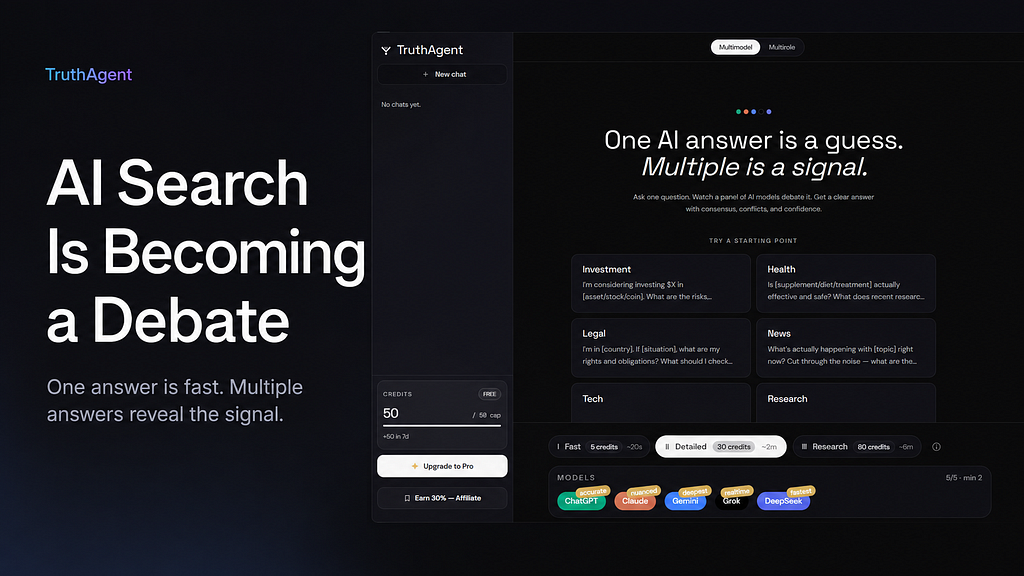
Instead of asking one AI and then opening several other tabs to compare answers, TruthAgent lets you ask once and run the question through a panel of models. In Multimodel mode, it can use ChatGPT, Claude, Gemini, Grok, and DeepSeek. The models debate the prompt, challenge each other’s assumptions, and produce a final synthesis with the important points of agreement and conflict.
The product also makes the depth of the debate adjustable:
Fast mode is for quick checks.Detailed mode is for decisions that need more reasoning.Research mode is for deeper questions where the assumptions matter as much as the final answer.
That distinction matters. Not every question deserves a long debate. Sometimes you just want a fast answer. But when the stakes are higher, seeing where models disagree can save you from trusting a polished response too quickly.
The Hidden Cost of Speed
Single-model AI search optimizes for speed. Ask, answer, move on.
That is great until speed becomes a substitute for judgment.
The cost of a fast answer is that you often do not know how stable it is. Would another model answer the same way? Would the answer change if the prompt were framed differently? Is the recommendation based on a real constraint or just a common pattern?
AI debate slows the process down slightly, but it gives you something useful in return: a view of the answer under pressure.
That is the part normal AI search usually skips.
What Changes When Debate Becomes Normal
If AI search moves from one-answer systems to debate-based systems, user behavior changes too.
First, people will stop overtrusting polished answers. A clean paragraph from one model feels authoritative because there is nothing beside it. Once you see another model challenge the same claim, the polish matters less than the reasoning.
Second, search becomes less passive. You are no longer just receiving an answer. You are evaluating disagreement. That forces you to think about your own priorities instead of outsourcing the whole decision.
Third, hard questions become easier to frame. Some questions do not have one correct answer. They have tradeoffs. A good AI search tool should show those tradeoffs clearly instead of compressing them into false certainty.
That is the real shift. AI search is not just about retrieving information anymore. It is about helping people decide what to trust.
Where Debate Does Not Help
AI debate is not useful for everything.
If the question is simple and factual, one AI plus a source check is usually enough. If the question needs a lawyer, doctor, accountant, or other professional, five AI models still do not replace that person. If the information is extremely current, the final answer still needs verification against primary sources.
Debate improves the thinking process. It does not remove the need for judgment.
That is an important distinction, because the future of AI search should not be blind trust in more models. It should be better visibility into uncertainty.
The Future Is Not One Smarter Model
The easy prediction is that one model will become so good that we will not need anything else.
Maybe that happens for some tasks. But for real decisions, the better future is not one perfect voice. It is a system that can show competing views, test assumptions, and explain why the final answer deserves trust.
That is why AI debate feels like the next step after basic Q&A.
Search started as links. Then it became snippets. Then it became AI answers. The next step is answers that have been challenged before they reach you.
If you want to try that workflow yourself, start with TruthAgent. Ask one question, compare how the models argue, and pay attention to the disagreement. That is where the useful signal usually shows up.
The Future of AI Search: From Basic Q&A to AI Debates was originally published in Coinmonks on Medium, where people are continuing the conversation by highlighting and responding to this story.