
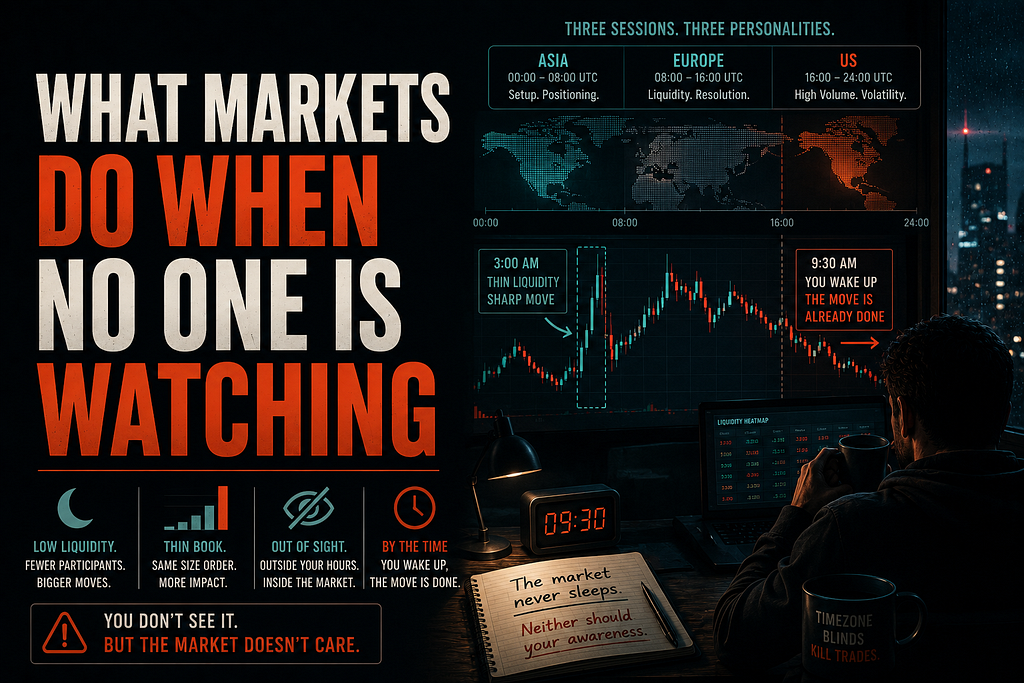
The largest moves often happen in the hours when the fewest traders are awake.
You wake up, open the chart, and the candle that defined the day is already there. It printed at 3 a.m. local time, when your screen was off and the order book was thin. By the time you’ve poured coffee, the market has already done the work that mattered. Everything that happens during your session is a reaction to a move you didn’t see.
This isn’t an accident of timing. It’s a recurring feature of how price actually forms. The hours that feel quiet to you are not quiet to the market. They’re just quiet to the participants who happen to share your timezone.
The Asymmetry of Attention
Markets don’t sleep, but traders do. That asymmetry is the structural fact most retail participants never fully internalize.
In crypto, there is no closing bell. The order book is live around the clock. The same instrument that trades against a fully staffed New York desk at 10 a.m. EST is trading against a partial Asia desk at 3 a.m. EST, with thinner liquidity, fewer market makers, and a different mix of participants. The chart looks continuous. The conditions underneath it are not.
In equities, the official session is finite, but futures and ADRs trade overnight. What happens in those overnight hours sets the tone for the open. By the time the opening bell rings, the actionable information has already been priced in by a small group of overnight participants. The retail trader who arrives at 9:30 a.m. is reacting, not participating.
The trader who watches only their local session sees a curated subset of price action. They see the part that happens during their attention window. The part that happens outside that window appears as gaps, jumps, and overnight moves — events that look discrete from their perspective but are continuous from the market’s.
When Liquidity Withdraws
The mechanics of off-hours moves come down to liquidity. During peak sessions, order books are deep. Market makers quote tight spreads. Large orders get absorbed without significant slippage. The market behaves like a wide road — heavy traffic, but stable speeds.
In off-hours, the road narrows. Market makers reduce quoting. Spreads widen. The same notional order that produced a small move during peak hours produces a larger move at 4 a.m. The price impact of any given trade scales inversely with available liquidity.
This is why off-hours moves often look disproportionate to the news that supposedly caused them. The news didn’t matter more. The book mattered less. A $5 million market order that gets absorbed at 11 a.m. with no visible footprint becomes a $5 million market order that punches through three price levels at 4 a.m.
The move isn’t manipulation, necessarily. It’s geometry. When the book is thin, the same flow produces more displacement. The chart records the displacement and leaves out the context. The trader who reads the chart without considering the session sees a move and tries to interpret it as signal, when much of what they’re seeing is a liquidity artifact.
Sometimes the quiet hours genuinely are quiet. Sometimes they’re the silence before the storm — the quiet ARE the storm, just for the wrong session. The displacement happens. It just happens in front of the participants who weren’t watching.
The Weekend Gap Isn’t Random
Crypto weekends are a useful case study, because they isolate the effect. Saturday and Sunday have lower volume than weekdays. Liquidity is reduced. Institutional desks are mostly closed. The participants who remain are smaller, more retail, more leveraged.
The result is recurring weekend behavior. Range expansions appear out of nowhere. Liquidation cascades happen with less reflexive defense from market makers. Wicks reach further. The same chart that grinds during the week sometimes throws a 5% candle on a Sunday afternoon for reasons that are hard to attribute to any specific catalyst.
The weekend gap that opens on Monday’s reopen in adjacent instruments is the visible result. The actual cause is the thin-book behavior that built up across Saturday and Sunday. The gap isn’t random. It’s the integration of two days of low-liquidity price discovery, settled at the moment full liquidity returns.
The trader who only watches weekday sessions sees the gap and treats it as an event. The trader who watches the weekend sees the gap as a summary — the obvious end of a process that was visible the whole time, if you happened to be looking.
Three Sessions, Three Personalities
The 24-hour trading day in crypto is functionally three sessions: Asia, Europe, and US. Each has its own personality.
Asia tends toward range-bound behavior with occasional sharp moves during major catalysts. Liquidity is real but distributed across more venues, and the dominant participants have a different positioning philosophy than US traders. Asia often sets the tone for the day in subtle ways — quiet accumulation or distribution that becomes visible only when Europe and the US arrive.
Europe is the bridge. London opens and brings real institutional flow. The first hours of European trading often resolve whatever Asia set up, either by validating the move or fading it. The character of price action shifts noticeably.
US is the high-volume window. The biggest participants are active. Macro releases hit during this session. The largest single-session moves often happen here, but they’re frequently extensions of structure that was already established overnight.
A trader who only watches US is seeing the loudest session and missing the setup. A trader who only watches Asia is seeing the setup and missing the resolution. The full picture requires acknowledging all three, even if you only actively trade one.
Why Off-Hours Discovery Often Sticks
There’s a counterintuitive feature of off-hours moves: they often persist. The move that happens at 3 a.m. on thin liquidity doesn’t always get faded when the full session arrives. Sometimes it gets confirmed.
This happens because the off-hours move, despite being noisy, often reflects positioning that the larger participants agreed with. The Asia session moves price 2% lower. Europe opens, looks at the move, and continues it. By the time the US arrives, the move is already a full 4% lower than where it closed the previous US session. The 3 a.m. candle wasn’t manipulation — it was early positioning that the rest of the world ratified.
The trader who treats every overnight move as suspect noise misses these. They wait for the US session to confirm, and by the time confirmation arrives, the trade is half over. The trader who recognizes that off-hours discovery sometimes carries real information adjusts accordingly.
This is also the complete framework for market structure — session-aware structure changes the read of any chart. A higher low formed at 4 a.m. in low volume means something different than a higher low formed at 2 p.m. with full participation. The shape is the same. The conviction behind it isn’t.
The Information You Weren’t Awake For
The deeper issue isn’t the moves themselves. It’s that the trader who misses the off-hours session arrives at the chart with incomplete information about how the current price was reached.
You see a price. You don’t see the path. The path matters, because the path tells you who’s positioned where, what got tested, what failed, and what held. A price that arrived through three sessions of grinding consolidation has different meaning than a price that arrived through a 3 a.m. spike followed by mean reversion.
When you look at the chart in the morning, both can look identical. A small green candle at the open says nothing about whether the night was calm or violent. The volume profile and the wick distribution tell you, if you look. Most traders don’t look. They take the current price as a starting point and build a thesis forward, ignoring the structure that delivered the price to where it is.
This is the curated-subset problem. Your interpretation is built from a fraction of the available data, and the fraction is determined by when you happen to be awake.
Adapting Without Sleeping Less
The solution isn’t to watch all 24 hours. No one can. The solution is to acknowledge that the session you missed contains information, and to read it deliberately when you arrive.
This means looking at the overnight range before forming a view. It means checking whether the move that defined the chart happened during high-liquidity hours or thin-liquidity hours. It means recognizing that a level tested at 4 a.m. on a thin book is not the same as a level tested at 2 p.m. with full participation, even if both touches print identically on the daily candle.
It also means accepting that some of your edges are session-specific. A setup that works during the US session may not work the same way during Asia, because the participants are different and the liquidity is different. Trading the same setup across all sessions, indiscriminately, blends three different markets into one and produces results that average across regimes that should be analyzed separately.
The session-aware trader doesn’t need to be awake more. They need to remember that the chart they’re looking at was built by participants who weren’t all in their timezone, and to treat the off-hours portion of the chart with the respect — and the skepticism — it deserves.
The Market That Happens Without You
The hardest mental shift is accepting that the market has a life outside your attention. It doesn’t pause when you’re asleep. It doesn’t wait for confirmation from your session before establishing direction. The candles that print while you’re not watching are not less real than the ones you witness. They’re just less visible to you.
The largest moves often happen in the quiet hours because the conditions for large moves — thin books, fewer market makers, asymmetric flow — concentrate in those hours. The trader who treats the off-hours session as background noise is treating a structural feature of the market as if it were an exception.
You don’t have to trade every session. You don’t have to watch every hour. But the chart you’re reading was written 24 hours a day, by participants who don’t share your schedule. The version you see when you wake up is the summary, not the source.
Read it as a summary. The actual story happened while you weren’t looking.
Continue reading
More from SwapHunt:
Market Structure: The Complete Guide — How session and liquidity shape every move.Why Markets Move Before News — When positioning happens off-camera.Silence Before the Storm — Why the quiet hours often hold the actual move.
Free download: The Cost of Being Early — On positioning before the market moves.
Follow @SwapHunt for daily observations.
This content is for educational purposes only. Not financial advice.
What Markets Do When No One Is Watching was originally published in Coinmonks on Medium, where people are continuing the conversation by highlighting and responding to this story.