
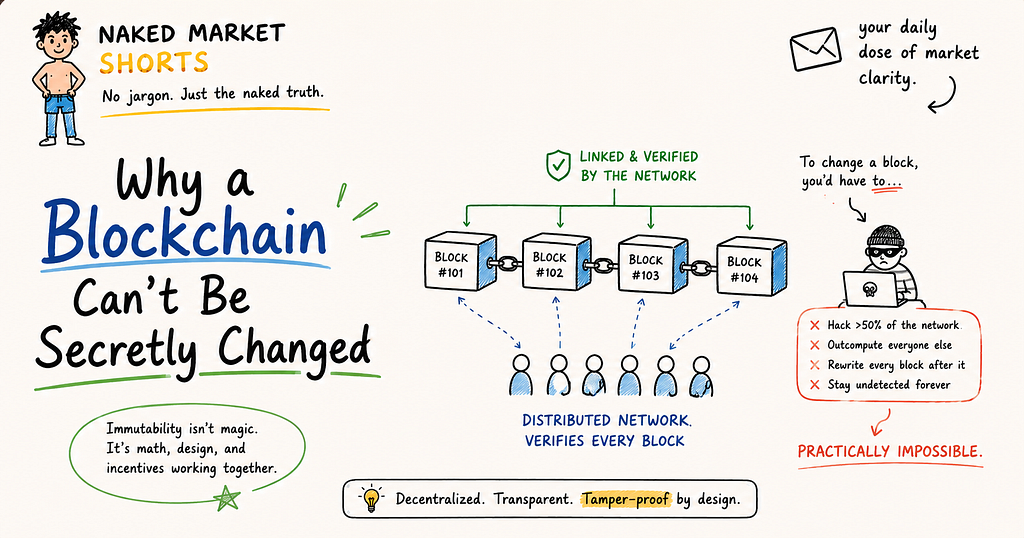
Banks can edit your balance. Governments can revise a record. This is the one digital ledger that even its owners cant secretly rewrite and the reason a shared global money system is even possible.
Naked Market breaks down macro finance, blockchain infrastructure, AI systems, and automated trading to help readers understand the future of global finance before the mainstream catches up.
Pull up your banking app and look at the number. Your balance.
Now sit with an uncomfortable truth: that number is just a row in a database somewhere, and the bank can change it. Not should. Can. A few keystrokes from an admin and the row says something different.
Same with the property record at your local registry. Same with a post on a platform that quietly disappears. Same with a “permanent” government file that gets revised between one year and the next.
Almost every record that runs your life is editable by whoever owns the database. Thats the default state of digital information. It can be changed, and usually youd never know.
There is one exception. One kind of record where even the people who built it, who run it, who profit from it, cannot secretly go back and rewrite what already happened. And the entire idea of money moving onto shared global rails — one planet slowly agreeing on one set of pipes depends on that single strange property.
Lets pull it apart.
First, kill two lazy words
Most people file blockchain under “secure because its encrypted” or “safe because its decentralized.” Both phrases are basically noise. Theyre the kind of words you nod at without really understanding.
Heres the actual thing. A blockchain isnt hard to change because of some magic password. Its hard to change because of how its built and because changing it secretly is both instantly visible and stupidly expensive.
Not impossible. Visible, and expensive. Keep those two words, they do all the work.
To see why, you only need three moving parts. Most explainers drown you in jargon (we built one of these from the inside in an earlier issue). Here, we are just going to use a notebook.
Part one: every page gets a fingerprint
Theres a piece of math called a hash function. Feed it anything — a word, a paragraph, an entire ledger of transactions and it spits out a short string of characters. Bitcoin uses one called SHA-256 that always returns 64 characters, no matter how much you put in.
Two things make it useful. Same input always gives the exact same output. And the output looks random, so you cant work backwards from it to the input.
Think of it as a fingerprint for data. Change the data even slightly, and the fingerprint changes. And not a little. Completely.
Type “hello” and you get one fingerprint. Type “hellp” one letter off and you get a totally different one. Not similar. Unrecognisable. So you cannot make a small quiet edit to data without the fingerprint screaming about it. Thats lock number one.
Part two: every page carries the page before it
Picture the notebook again. Transactions get grouped into pages, in this world we call them blocks. Heres the clever bit: every block stores the fingerprint of the block right before it.
So block 100 contains, written inside it, the fingerprint of block 99. Block 101 contains the fingerprint of block 100. On and on. Each page stapled to the last one not with glue, but with math. That staple is why its called a chain.
Say you want to quietly change one transaction in block 100. Maybe erase a payment you made. The second you touch it, block 100s fingerprint changes (remember the avalanche). But block 101 is still carrying the OLD fingerprint. They dont match anymore. The chain is broken, right there, in the open.
To cover your tracks, youd have to redo block 101 so it points at your new fingerprint. But that changes 101s own fingerprint, which breaks 102. So you redo 102. Which breaks 103. Youre now rewriting every single block from your edit all the way to the present, pull one thread and you have to re-knit the whole sweater.
On a small notebook, annoying but doable. Which brings us to the part that actually matters.
Part three: there isnt one notebook. There are thousands
A blockchain isnt stored in one place. Thousands of independent computers around the world called nodes, each hold a full copy of the entire history, and constantly check each others copies.
So now your secret edit has a real problem. Its not enough to re-knit your own copy. Youd have to force your rewritten version onto a majority of those thousands of machines, faster than the rest of them are adding fresh blocks, and keep doing it forever so your fake version stays ahead.
This is the famous “51% attack.” To rewrite history you essentially have to out-run the entire honest network combined not for a moment, but permanently. The rest of the world keeps stapling new pages. You have to staple yours faster than all of them put together, or your version falls behind and gets ignored.
How expensive is permanently out-running everyone? For Bitcoin, comically expensive.
Bitcoins network now runs at somewhere around 950 to 990 exahashes per second — a quantity of computing power with no useful real-world comparison. One 2025 estimate from a Duke finance professor put the cost of dominating the network for a single week at roughly $6 billion in hardware, data centres and electricity. Other estimates put a one-hour attack in the billions too.
And heres the punchline: the moment people saw it happening, the price of the thing youre attacking would collapse so youd be spending billions to steal an asset you are simultaneously destroying. The math doesnt just say “hard.” It says “why would you.”
The other lock: skin in the game
There is a second way to secure a chain that doesnt burn electricity, and its worth knowing because a lot of the system is heading there.
Instead of proving you did expensive work, you put money on the line. This is proof of stake the model Ethereum switched to. Validators lock up funds for the right to confirm blocks. Try to confirm two conflicting versions of history, and the network does something brutal: it destroys part of your locked-up stake and kicks you out. They call it slashing. If lots of validators try it together, the penalty scales up — a coordinated attack can wipe out the entire deposit.
The system is designed so honesty is the cheapest move and cheating sets your own money on fire.
As Ethereums own documentation puts it, the incentives pay for honesty and punish bad actors. You dont have to trust that validators are good people. You only have to trust that they dont want to torch their own capital.
Now the part the cheerleaders skip
“Cant be changed” is really “too expensive and too visible to be worth changing” and that protection is only as strong as the network behind it.
Small chains get rewritten. It happens. In September 2025, Monero — a large, well-known privacy coin suffered its deepest rewrite ever. A mining pool called Qubic quietly gathered more than half the networks power, built a longer chain in private, then released it. The network, following its own rule that the longest chain wins, swallowed it. Eighteen blocks of history rolled back. Around 118 confirmed transactions briefly un-happened.
No funds were ultimately stolen, but the lesson landed: when a networks cost-to-attack gets cheap enough to rent, immutability goes soft. Bitcoin Gold, Ethereum Classic, Vertcoin same story in earlier years. Security isnt a switch you flip on. Its bought, continuously, with the cost of attacking you. Which is exactly why size and decentralisation arent vanity metrics. Theyre the budget that keeps the past frozen.
And what about the thing everyone keeps bringing up — quantum computers?
Heres the nuance the headlines mangle. The looming quantum threat is mostly aimed at ownership, not at immutability. A powerful enough quantum machine could one day crack the signatures that prove a wallet is yours — letting someone forge your key and move your coins. Thats serious. As of 2026 the industry estimates a rough three-to-five-year window to migrate to “post-quantum” cryptography, and standards bodies have already published the replacement algorithms.
But rewriting the ledger itself? One academic estimate reckoned attacking Bitcoins mining with a quantum computer would need the energy output of a star. The chains memory stays hard. Whats fragile is the lock on your front door, not the record of who lives there. Two different problems worth never confusing again.
The takeaway: the Tamper Test
So here is the tool to walk away with. Next time anyone with a coin, a “blockchain” startup, a government pilot, a tokenised-asset pitch tells you their records cant be tampered with, run them through three questions.
Is it linked? Does changing the past break the present, the way a broken fingerprint breaks the chain or is it just a normal database with marketing on top? If you can edit row 4,000 and nothing else notices, its not immutable. Its a spreadsheet.Is it copied? How many independent parties hold a full copy and check each other? One companys private “blockchain” that only they can see is just their database wearing a costume. Real tamper-resistance needs many eyes.Is it costly to cheat? What would it actually cost to rewrite history and would everyone see it happen? If the answer is “a weekend and a rented server,” treat its permanence as a suggestion, not a guarantee.
Linked, copied, costly. Three questions. Most things claiming to be “on the blockchain” fail at least one and now you can tell which.
Why any of this matters
Step back and the bigger picture clicks into place.
For money to move onto shared global rails — for 8 billion people and 180-odd governments to ever touch the same financial record, you need a record that no single one of them can secretly edit when it suits them. Not the most powerful nation that decade. Not the biggest bank. Not whoever happens to control the servers.
The whole reason a borderless money system is even thinkable is that immutability lets strangers who dont trust each other share one ledger anyway. Youre not trusting the people. Youre trusting the math, and the cost of breaking it.
Thats the quiet foundation under the One Earth, One Currency idea this newsletter keeps circling back to. Not a coin. Not a logo. A property: a shared book of record that the powerful cant rewrite in the dark. Everything else stablecoins, tokenised treasuries, digital currencies, AI agents that settle their own payments is built on top of that one floor.
Get the floor, and the rest of the building stops looking like hype and starts looking like plumbing.
Signal over noise. Structure over price.
If you want to understand the architecture of where global money is heading before it becomes obvious — subscribe. One clear breakdown at a time.
Keep going
One Planet, 180 Currencies: Somethings Broken Start here — the whole thesis in one read.How Blockchain Actually Works, From the InsideWe build a chain piece by piece.What Is a Blockchain Ledger, Really?The shared book of record, and who controls it.The New Rails: Blockchain as InfrastructureWhy money is quietly re-plumbing onto shared pipes.
-More Soon
Why a Blockchain Cant Be Secretly Changed was originally published in Coinmonks on Medium, where people are continuing the conversation by highlighting and responding to this story.