
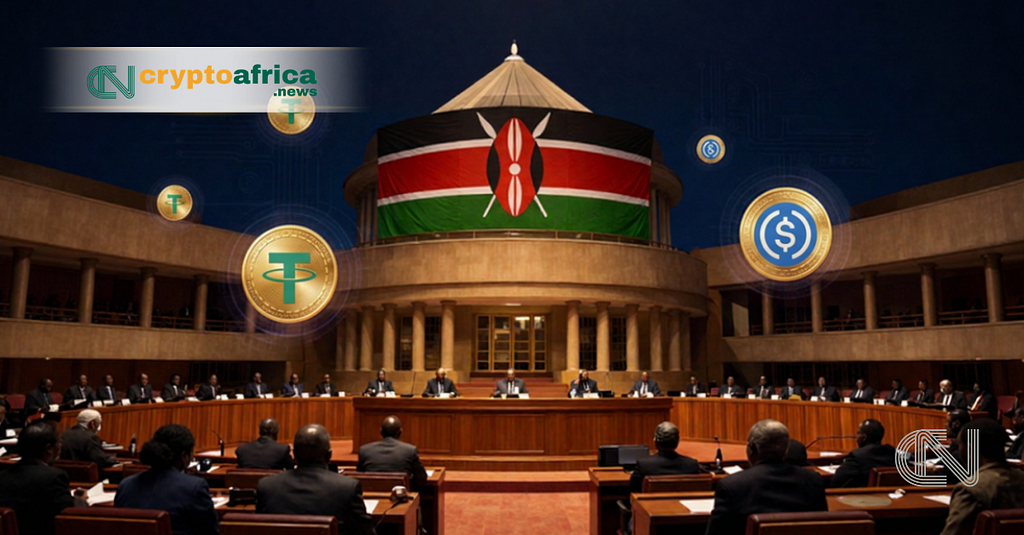
Kenya’s Parliamentary Committee on Delegated Legislation has raised concerns about proposed stablecoin regulations drafted by the National Treasury.Lawmakers warned some provisions could discourage innovation and drive crypto businesses to competing jurisdictions.MPs questioned a proposal requiring stablecoin issuers to hold 30% of reserves in Kenyan banks.The committee also challenged vague redemption requirements that require stablecoins to be redeemable “at any time.”Parliament is seeking broader industry consultation before the regulations advance further.
Kenya’s lawmakers are pushing back on the country’s proposed stablecoin rules.
The National Assembly’s Committee on Delegated Legislation raised concerns over the proposed stablecoin regulations on Thursday, June 18th.
During a consultative meeting with representatives from the virtual asset industry, the chair of the committee, Hon. Samuel Chepkonga, raised questions about several provisions in the draft. He argued that certain provisions were not in touch with global practice and the technical realities of virtual assets.
In his words, “If we make laws that are in one hole here and have no relation with the global practice, then we will be a laughing stock to the entire world.”
The lawmaker also explained that some of the provisions could interfere with Kenya’s plan to become a regional centre for innovation and drive investment to other countries.
The 30% Reserve Requirement Under Fire
One of the provisions that the committee criticised was a proposed rule requiring stablecoin issuers to hold a significant portion of their reserves in local Kenyan Banks.
Under Regulation 74, stablecoin issuers would be required to hold at least 30 percent of funds received in exchange for stablecoins in accounts at commercial banks in Kenya.
One of the lawmakers on the committee, Mathare MP Anthony Oluoch, asked, “What’s the purpose of the reserve? Is it not to protect the person within the Kenyan jurisdiction against a foreigner?”
The question is pointed. If a foreign stablecoin issuer faces financial difficulties, a 30% domestic reserve requirement may provide limited recourse for Kenyan users. The compliance burden created by that provision alone could deter global operators from entering the market altogether.
The Redemption Rules Create Legal Ambiguity
The committee’s concerns extended beyond reserves. Regulation 68 also came under scrutiny from the committee.
Upon request by a holder of a stablecoin, the issuer of that stablecoin shall redeem it, at any time and at par value, by paying the monetary value of the stablecoin held to the holder of the stablecoin.Regulation 68
Lawmakers argue that the phrase “at any time” is too broad and could create consumer uncertainty. Kathiani MP Robert Mbui also warned that the phrase could be misinterpreted in ways that disadvantage investors.
“At any time means when? Even next year is any time. If I refuse to redeem, I can tell you, ‘Redeem it next year,’ and next year still falls under ‘any time’.”
The committee is calling for operational clarity. It is difficult to enforce legislation if its phrasing is not well defined.
Without defined redemption timelines or procedures, consumers may lack meaningful protection, and issuers may interpret their obligations inconsistently.
Kenya’s Fintech Hub Ambitions Are on the Line
Between July 2023 and June 2024, data from Chainalysis reveals that Kenyans moved an estimated 426.4 billion ($3.3 billion) in stablecoin transaction volume.
Between July 2024 and June 2025, Sub-Saharan Africa’s broader crypto market grew 52%, reaching more than $205 billion in on-chain value. Kenya ranked among the top five countries with the highest adoption rates worldwide.
Kenya is one of Africa’s premier fintech markets. The rise of M-PESA and other mobile money innovations, along with a strong startup ecosystem, makes it a go-to hub for innovation on the continent.
This, alongside its crypto transaction volume, could explain why the committee is wary of regulations and provisions that seem restrictive.
Overly restrictive stablecoin regulation could erode Kenya’s position and push projects, capital, and jobs that come with them offshore.
Parliament Calls for Industry Input
Rather than rejecting or advancing the draft regulations as written, the committee signalled a preference for further engagement.
Committee Vice Chairperson Robert Githinji urged the committee to invite National Treasury officials back for further discussions. He pointed out that they could have technical justifications for the contested provisions.
His words;
As we engage industry players, we also need to call back the Treasury to explain because they might have a more professional understanding in this area.
His remarks indicate the committee’s unwillingness to approve complex digital asset regulations without deeper engagement from both the industry and the regulator.
While this engagement could slow the pace at which these crypto regulations become law, it could lead to better, more well-rounded provisions.
A Global Debate Playing Out Locally
Kenya’s stablecoin challenges are not unique. Across Africa and the globe, regulators are trying to introduce regulations without being overly restrictive.
There is a proven case of stablecoin adoption on the continent, along with increased development of stablecoin-based infrastructure.
All of this has increased the need for more developed regulation across the continent. Recently, the IMF urged Nigeria to be cautious about stablecoins and their impact on the country’s monetary sovereignty. A warning that came right as Nigeria works on its own regulatory framework.
The questions of monetary sovereignty, how to set meaningful reserve requirements without imposing prohibitive capital demands, and how to guarantee redemption rights without creating liquidity crises for issuers are not unique to Kenya.
The broader regulatory framework Kenya is developing would operationalise the Virtual Asset Service Providers Act, which took effect on November 4, 2025.
That framework splits the regulation and management of the crypto industry between the Central Bank of Kenya and the Capital Markets Authority.
The Central Bank of Kenya would license and supervise stablecoin issuers, while the Capital Markets Authority would oversee exchanges, tokenisation services, and other investment-related activities.
The committee’s concerns do not suggest opposition to regulation, but a desire to get the details right. The EU’s MiCA framework, Nigeria’s evolving VASP legislation, and South Africa’s stablecoin discussions have all grappled with similar tradeoffs between investor protection and market competitiveness.
What Happens Next
The coming weeks will test how responsive the National Treasury is to parliamentary and industry concerns.
Key questions include whether the 30% reserve requirement will be revised or removed, whether redemption language will be tightened with specific timelines, and how much weight industry feedback will ultimately carry in the final text.
Kenya’s stated ambition is to become a gateway into Africa for crypto platforms. Discussions are reportedly already underway with exchanges including Binance and Coinbase.
Realising that ambition will require regulations that are credible to international operators. African governments are increasingly moving toward regulating digital assets rather than restricting them.
The focus now is shifting toward the quality of regulation, not just its existence. Kenya’s handling of reserve requirements, redemption standards, and industry consultation may yet become a model for stablecoin policymaking across the continent.
Originally published at https://cryptoafrica.news on June 22, 2026.
Kenyan Lawmakers Challenge Stablecoin Rules Over Innovation Concerns was originally published in Coinmonks on Medium, where people are continuing the conversation by highlighting and responding to this story.