
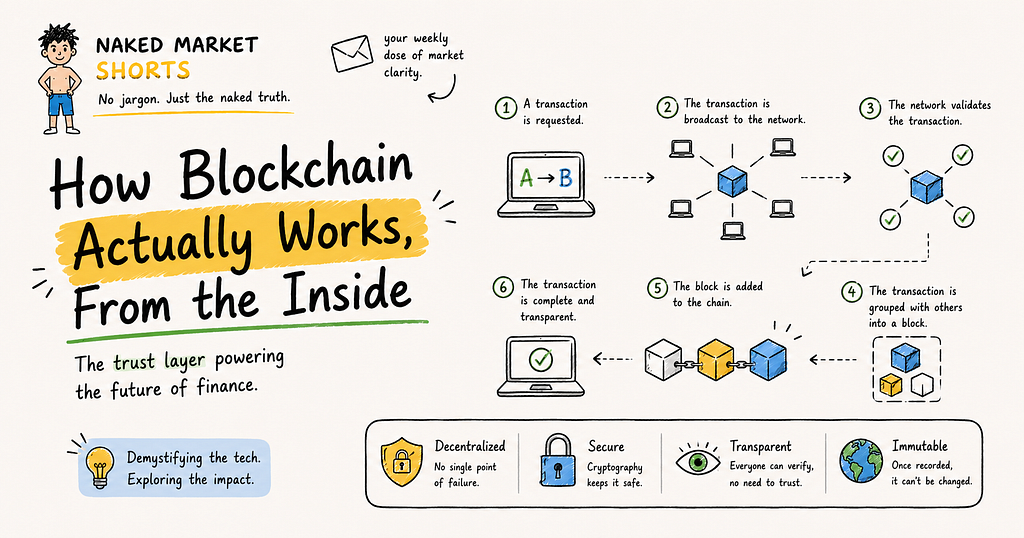
Youve heard the word a thousand times. But could you explain whats happening inside the machine? Forget the jargon its a shared notebook. Heres the whole thing, opened up, in plain English.
New here? This is foundational reading for everything else we write — because nearly the entire new financial system is being built on the machine were about to open up. The big-picture version is pinned here: One Planet, 180 Currencies.
Naked Market breaks down macro finance, blockchain infrastructure, AI systems, and automated trading to help you understand the future of global finance before the mainstream catches up.
Heres a quiet little test. Say the word “blockchain” out loud, then try to explain what actually happens inside one. Most people cant, even people who own crypto.
And thats fine, because the way its usually explained is useless. Either its dumbed down to “its a digital ledger” (which tells you nothing), or its drowned in jargon hashes, nodes, Merkle trees, consensus algorithms until your eyes glaze over and you quietly decide its not for you.
So lets do something different. Lets actually open the box and look inside the machine. Im going to build it up with you, one piece at a time, using nothing scarier than a notebook and a fingerprint. By the end, the “magic” will be gone and in its place youll have something better: you will understand the thing the entire new financial world is being built on.
Start with the problem it solves
To understand any machine, first understand what it was built to do. Blockchain exists to solve one very specific, very old problem: how do strangers who dont trust each other agree on who owns what without a boss in the middle?
Think about digital money for a second. A digital dollar is just information — a number on a screen. And information can be copied. So whats stopping you from sending the exact same digital dollar to two different people at once? Nothing, really. Its called the double-spend problem, and its the reason digital cash didnt work for decades.
The old solution is the one you already live with: put a trusted middleman in the centre. A bank keeps the one official list of who has what. When you pay someone, the bank checks its list, moves the number, and updates the list. It works but it means you have to trust the bank completely, play by its hours, pay its fees, and accept that it can freeze you out. Blockchain asked a wild question: what if we didnt need the bank in the middle at all?
Step 1 — everyone holds the same notebook
Heres the first move, and its the big one. Instead of one official list locked inside one bank, imagine a notebook that everyone has an identical copy of. Every payment ever made is written in it. And whenever a new payment happens, everyone updates their copy at the same time.
Thats the “distributed” part of a distributed ledger. Theres no single master copy to hack, bribe, or shut down, because there are thousands of copies spread across the planet. If you tried to secretly change your own copy to say you had more money, everyone elses copy would simply disagree with you, and yours would be ignored. The crowd is the source of truth. But this raises an obvious problem if everyone is writing in the same notebook, how do you stop chaos and cheating? Thats where the clever trick comes in.
Step 2 — payments get bundled into a block
Rather than writing every single payment into the notebook the instant it happens, the network gathers up a batch of recent payments and writes them as one page. That page is a block.
So a block is nothing exotic. Its a page listing a bunch of transactions: this person paid that person this much, and so on. Simple. The interesting part is what happens to the page once its full.
Step 3 — each block gets a fingerprint
This is the clever trick the whole system hangs on, so go slow here. When a block is full, you run all the information inside it through a piece of math that spits out a short, unique code — a string of letters and numbers. Think of it as the blocks fingerprint. (The technical word is a “hash,” but fingerprint is exactly the right picture.)
Two things make this magic. First, the same block always produces the same fingerprint. Second and this is the key if you change even a single letter, comma, or digit inside the block, the fingerprint comes out completely different. Not slightly different. Totally unrecognisable. Which means the fingerprint is a tamper-detector. If the block and its fingerprint dont match, you know instantly that someone meddled with the page. The seal is broken.
Step 4 — the blocks get chained together
Now we connect the pages, and you finally see why its called a block-chain.
Every new block doesnt just contain its own transactions. It also writes down the fingerprint of the block before it. So block 847 carries block 846s fingerprint. Block 848 carries 847s. Each page is glued to the one before it by that code.
Tamper with one old page, and its fingerprint changes which breaks the next page, which breaks the next, all the way down. You cant quietly rewrite history. You can only break the whole chain in plain sight.
This is what people mean when they say a blockchain is “immutable.” Its not that the data is physically locked. Its that changing anything in the past instantly shatters every block that came after it, in front of thousands of witnesses. Editing history isnt impossible because its forbidden — its impossible because it would be glaringly obvious.
Step 5 — who gets to write the next page?
Theres still one gap. If everyone shares the notebook and theres no boss, who actually gets to add the next block? You cant have thousands of strangers all scribbling at once. The network needs a fair, cheat-proof way to take turns. This is called consensus, and there are two main flavours you keep hearing about.
The first is proof of work, also called mining. To earn the right to add the next block, computers race to solve a hard, pointless math puzzle, which costs real electricity. The winner adds the block and earns a reward. Faking blocks would mean out-spending everyone elses electricity bill combined wildly expensive. This is what Bitcoin uses, and it has kept Bitcoins ledger unbroken since 2009. The catch is the power bill: Bitcoins network now uses roughly as much electricity in a year as a mid-sized country.
The second is proof of stake, also called staking. Instead of burning electricity, you lock up a chunk of your own money as a deposit. Get a turn to add a block, behave honestly, earn a small reward. Cheat, and the network destroys your deposit. Ethereum switched to this model in 2022 and cut its energy use by around 99.95% overnight. Same goal make cheating ruinously expensive — achieved with money at risk instead of electricity burned.
Step 6 — why you can’t just fake it
Pull it together and you see why a big blockchain is so hard to attack. Every one of those thousands of copies, each computer running the network is called a node independently checks every new block against the rules and against each other. A block only sticks if the majority agree its valid.
To force through a fake version of history, youd need to overpower more than half of the entire network at the same instant out-muscle all that honest electricity, or all that staked money. On a large chain, the cost runs into the billions, with little hope of success. Thats the famous “51% attack,” and its precisely why size equals security here. The more participants, the harder the system is to corrupt. No vault, no security guard just a crowd too large and too watchful to fool.
The whole thing, end to end
So heres the complete machine in one breath. You send a payment. It gets broadcast to the network. It gets bundled with others into a block. The network does its consensus dance to validate that block and chain it to the last one. Everyones notebook updates. Done final, in seconds, with no bank anywhere in the loop.
Why any of this matters
Step all the way back now, because the point of opening the box was never the gears. Its what the machine removes.
Every system you know runs through a trusted middleman sitting in the centre — a bank, a clearing house, a platform taking a cut, setting the hours, holding the power, and asking you to just trust them. Blockchain dissolves that centre. It replaces “trust the institution in the middle” with “anyone can verify it themselves.” That is the entire revolution in one sentence, and its why this matters far beyond crypto prices.
Because once you can move and record value with no trusted middleman instantly, all day, anywhere on earth you can rebuild the plumbing of finance itself. That is exactly the shift weve been mapping issue after issue: blockchain not as a casino, but as the new rails underneath money, and the reason settlement can finally become instant instead of taking days through a stack of intermediaries.
What’s already running on this machine
This isnt theory humming away in a lab. The machine you just opened up is what nearly everything we cover actually runs on. The digital dollars called stablecoins live on these rails. The trillions of real-world assets being tokenized — bonds, funds, property are recorded on them. The AI agents now paying each other do it here too. And the worlds biggest banks, the ones youd least expect, are quietly building on the same technology: Your Bank Is Already Using DeFi. Understand the machine, and every one of those stories suddenly clicks into place, theyre all just different things being written into the same kind of unfakeable notebook.
The honest limits
Now the part the hype-merchants skip, because this newsletter would rather you understood the machines flaws than worshipped it.
First and most important: a blockchain guarantees that a record is real and unchanged but it does not guarantee that whats written is true. If someone records a lie, the blockchain will faithfully preserve that lie forever. Garbage in, permanent garbage. Second, it can be slow, and proof-of-work chains burn serious energy. Third and this is the one most people miss in the excitement — most things dont need a blockchain at all. If a single trusted party can just keep the records, a normal database is cheaper, faster, and better. The machine is only worth its cost when no neutral middleman exists and many distrustful parties must share one tamper-proof record.
So you never get confused again
Forget every technical word you just learned if you like. Keep only this one picture, and youll understand blockchain better than most people who talk about it for a living.
And if you ever want to cut through someones blockchain pitch in ten seconds, just run it through three questions:
Do several parties who don’t trust each other need to share one record? If only one trusted party keeps the books, you don’t need a blockchain you need a database.Is there no neutral middleman they all already accept? If a trusted referee exists and works fine, the machine is solving a problem you don’t have.Does the record need to be tamper-proof and permanent? If yes to all three, a blockchain genuinely adds something. If no to any, someone is probably selling you buzzwords.
Thats the machine, from the inside. A notebook everyone holds. A fingerprint that exposes any tampering. A chain that seals the past. A crowd too large to fool, taking turns to write the next page. No magic, no boss, no maths degree just a genuinely clever way for strangers to agree on the truth without anyone in charge.
Most people will keep treating blockchain as a black box they never bothered to open nodding at the word, never grasping the thing. You just opened it. And in a decade where the entire financial system is being rebuilt on this exact machine, understanding how it works from the inside is the difference between being rich chasing whatever token is loud today and being wealthy: seeing clearly how the new world is wired, so you can stand where the value will flow. Wherever you are on earth, that clarity is the edge that compounds and its the whole reason this fragmented old system has a real cost: What 180 Currencies Actually Cost.
The box is open. Now nothing built on it can mystify you again.
We open up the machinery of money one piece at a time — the rails, the assets, the AI, and the incentives the headlines miss. Join readers around the world who’d rather understand the machine than be mystified by it.Subscribe to Naked Market
Keep going
Start here → One Planet, 180 Currencies (the whole thesis)
The New Rails: Blockchain as Infrastructure
What “Settlement Layer” Really Means
Stablecoins: How a Casino Chip Became the Dollars Newest Export
Tokenization: The $16 Trillion Shift Coming
– More soon
How Blockchain Actually Works, From the Inside was originally published in Coinmonks on Medium, where people are continuing the conversation by highlighting and responding to this story.