
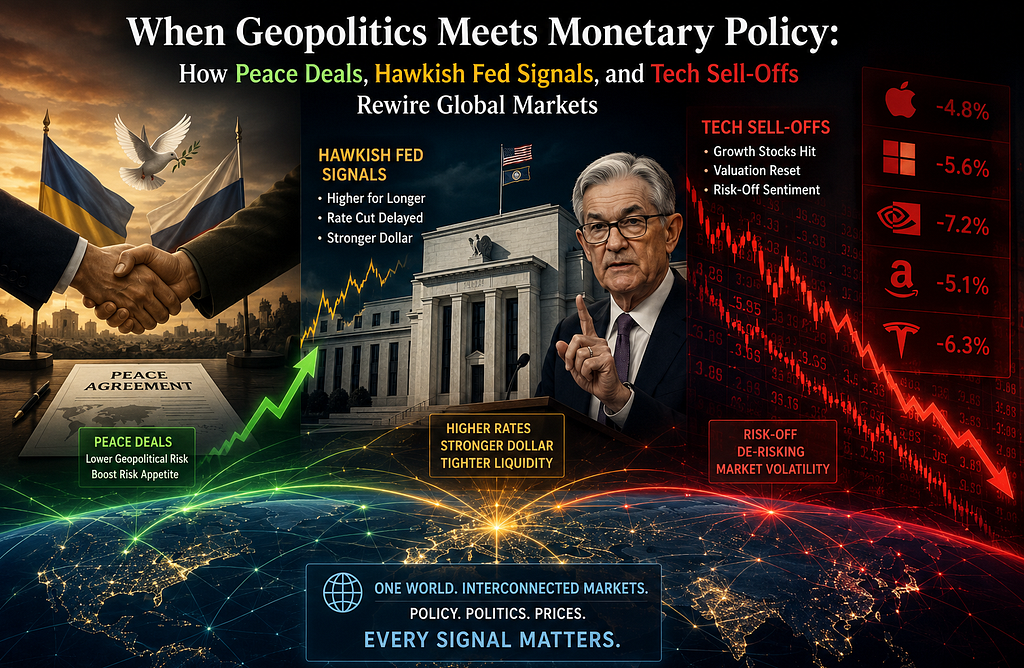
When Geopolitics Meets Monetary Policy: How Peace Deals, Hawkish Fed Signals and Tech Sell-Offs Are Changing Global Markets
In todays markets things can change fast. One moment people who invest money are worried about problems with energy because of tensions between countries. The moment a surprise peace deal makes the prices of things like oil go down and the stock market goes up. Add to that the Federal Reserve being more cautious and a big drop in the value of technology stocks and you have a situation where the big picture is changing quickly and it is hard to predict what will happen.
Now in mid-2026 it is not about steady trends. It is about different forces coming together and changing things in time.
Image Generated By ChatGPT
The Geopolitical Thaw: When Peace Becomes a Thing for Markets
The recent peace agreement between the US and Iran and the promise to keep the Strait of Hormuz safe made the global markets feel better away.
After months of fighting that made energy prices go up and people worry about inflation the news of the peace agreement made the price of oil go down sharply. The global bond market did well. Risky investments like stocks in Europe and Asia went up.
The reason for this is simple: when energy prices are lower it helps reduce the pressure of inflation. This gives banks the chance to change their policies without making things tighter.
This change has effects:
Companies that sell things to consumers are happy because their costs are lowerIndustries are relieved because they spend money on transportation and energyGlobal supply chains are more stable after being disrupted for a long time
But people are not too optimistic. Peace agreements in areas where countries do not get along can be fragile. If something goes wrong it can quickly change the story. Make things volatile again.
The Hawkish Fed: A Regime of Higher Interest Rates
While the peace agreement brought some relief the monetary policy is being more careful.
The Federal Reserve under leadership is being very cautious. They did not change the interest rates. The way they talk about it has changed. They are not as optimistic about the future. They said they might raise the interest rates later in 2026 if inflation is still a problem.
Almost half of the committee members think that the interest rates might go up later in 2026. They are worried that inflation is not going away even after the Federal Reserve tried to control it
This change is important.
Higher interest rates for a time change the way people value different investments:
Stocks of companies that are growing fast are not as valuable because the interest rates are highInvesting in bonds is more attractive because the interest rates are goodThe quality of the cash flow is more important when valuing investments
The Federal Reserve’s also not giving as much guidance about what they will do in the future. This makes it harder for markets to predict what will happen. They have to react more to the news and data.
The result is a volatile and less predictable situation.Tech Sell-Offs: The Reality Check for Artificial IntelligenceMeanwhile the technology sector is going through a change.
After a time of being very excited about artificial intelligence markets are starting to differentiate between the story and the reality. The value of technology stocks went up much and the companies need to spend more money on infrastructure for artificial intelligence than they are making from it.
The recent problems in the semiconductor and infrastructure sectors have highlighted some concerns:
It is taking longer than expected to make money from intelligence investmentsThe cost of capital is going up faster than the companies can make money from intelligenceCompanies are issuing stocks to fund their expansionSome parts of the software sector are seeing their profits go down
This is not the end of the intelligence cycle. It is just becoming more mature.
What is happening is that markets are moving from being optimistic about everything to being more selective. Markets are rewarding companies that have plans for making money and they are punishing companies that are growing too fast or are too much in debt.
The Interconnection Effect: Why Everything is Connected
What makes this situation complex is the way these forces are connected.
When there is peace and the price of oil goes down it can help reduce inflation. This can make the Federal Reserve less likely to raise the interest rates.. If the technology sector is slowing down it can affect the whole economy and make it harder for the Federal Reserve to make decisions.
This creates a loop:
Peace makes inflation go downLower inflation makes the Federal Reserve less likely to raise the interest ratesThe interest rates affect the value of stocksThe stock market affects the sentiment and the growth expectations
The result is not a direction but a lot of different things happening at the same time.
Some companies are doing well like those in the energy sector, defense sector and some industrial sectors.. Companies that are growing too fast are facing problems.
Being Able to Adapt is More Important than Predicting
If there is one thing that defines this market it is how fast things are changing.
Peace agreements can happen quickly. The Federal Reserve can change their tone without warning.. The technology sector can go from being very popular to being scrutinized in a short time.
In this environment being able to adapt is more important than trying to predict what will happen.
To be safe portfolios should be diversified across:
countriesDifferent types of investments that are sensitive to the big pictureDifferent sectors, like growth or cash-flow stabilityDifferent themes, like intelligence infrastructure or application-layer risk
The most important thing is not to be convinced about one thing but to be able to change when the situation changes.
Join the Conversation
Where do you see the opportunity in this changing landscape?
Is it the peace agreement the Federal Reserves tone or the change, in the technology sector?Share your thoughts in the comments and lets talk about how these forces are changing the global markets together.
When Geopolitics Meets Monetary Policy: How Peace Deals, Hawkish Fed Signals and Tech Sell-Offs Are… was originally published in Coinmonks on Medium, where people are continuing the conversation by highlighting and responding to this story.