
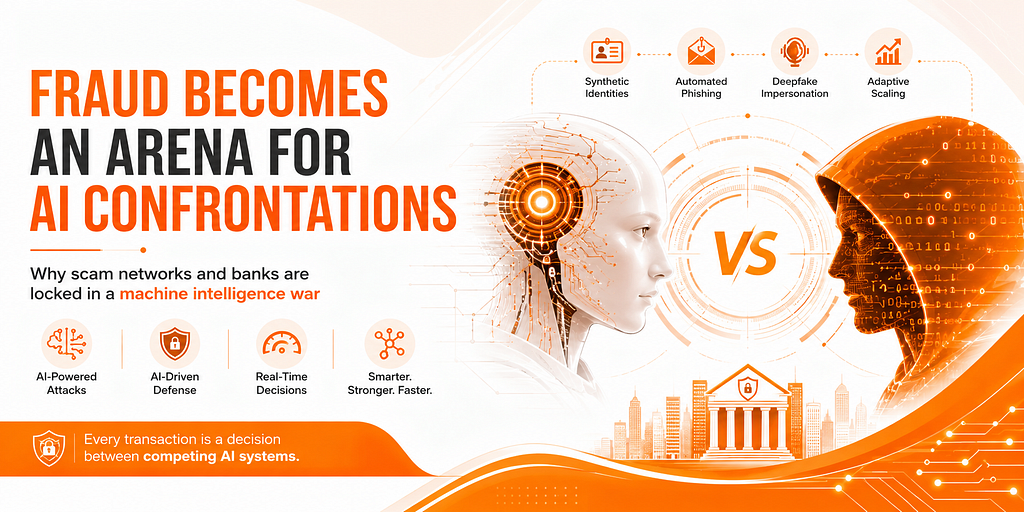
Why scam networks and banks are locked in a machine intelligence war
Fake moves now go way beyond stealing money. Inside each online exchange, smart machines battle in a hidden sprint.
This image is generated by chatgpt
Scammers now twist artificial intelligence into a tool that spreads cons quicker, lighter, softer than anything seen earlier. Meanwhile, tucked inside digital vaults, bank tech fights back quiet algorithms spot odd patterns, guess traps ahead of time, shut down sneaky moves as they happen.
Now it’s not people against people anymore. Instead, machines challenge humans directly. This shift changed how we see competition. Machines now push limits once set by bodies and minds. The old battles feel different today. Technology reshapes the field completely
Fight breaks out — machines clashing deep within the wires that move money.
From manual fraud to machine-scale attacks
Back then, tricks were less complex. Someone had to be involved to pull off a con
Create fake identitiesAttempt fraudulent transactionsSlip past simple safety rulesDo it again by hand
People spotted issues by hand, going through alerts once things had already occurred.
It just doesn’t function that way anymore.
Faster than a blink, digital payments zip through systems fraud keeps pace just as quickly. Though transactions finish in moments, crooks adapt without delay.
Automation shapes how threats are met today, each move learning from the last. Systems shift on their own, responding without pause. Defense evolves just as fast as offense, neither waiting for orders.
AI tools help fraud groups work smarter
Out of nowhere, today’s fraud networks run more like software platforms than lone crooks. Machines shape their moves, routines repeat without pause. Hidden patterns replace old tricks. Efficiency drives them forward. Structure matters most now. People blend into processes. Automation slips in quietly. Systems grow colder, sharper. Crime wears a digital face.
they use ai
Synthetic identities
Fake details about people come alive through artificial intelligence. Realistic job backgrounds emerge alongside made-up online activity. These digital traces slip past simple checks meant to confirm who someone is. Profiles build themselves, piece by piece, without a real person behind them. Verification steps often fail to spot the difference. Digital ghosts act like they belong.
Automated phishing
Messages crafted by big language systems feel oddly familiar, copying how someone talks — right down to word choices and situations. These fakes slip under radar because they sound so much like real notes from a friend. Tone gets matched, details fit too well, almost like it knows you. Spotting the trick takes more effort when every line echoes your own way of writing. Hidden inside normal chatter, scams now blend instead of stand out.
Deepfake impersonation
A scammer might mimic a boss using voice software that sounds eerily real. Fake calls appear to come from relatives thanks to altered audio clips. Criminals copy how bank workers talk by reusing recorded phrases. These tricks rely on technology that replicates speech patterns closely. Sometimes a video call shows someone familiar who isn’t really there.
Adaptive scaling
Some fraud setups run endless transaction trials, spotting what slips past alarms. One trick follows another until something sticks. Patterns shift constantly, each tweak meant to stay ahead. Messages change form, adapting fast when blocked. What works today might fail tomorrow. Trial by trial, the system maps weak spots. Each attempt builds on last time’s result. Not every version gets through only the slyest ones do.
A loop forms, feeding each outcome back into the next attempt. This cycle sharpens every move without pause. Each round learns from what came before it. Over time, changes pile up in quiet steps. What emerges grows smarter by doing.
How banks and fintechs are fighting back
Financial institutions are also building AI-powered defense systems.
Finding odd patterns fast financial systems apply smart software that studies vast numbers of payments each second. Instead of waiting, alerts pop up the moment something feels off.
What they build centers around these parts
Behavioral analysis
AI learns normal user behavior such as device usage, location patterns, and transaction timing.
Network intelligence
From one account to another, AI traces links among users, shops, spots where payments happen spotting hidden groups working together. Connections form patterns most people miss when checking single deals alone.
Real-time risk scoring
Right away, each purchase gets a score then it’s cleared, questioned, or stopped depending on how risky it seems.
Continuous learning
Fraud caught today sharpens how systems spot it tomorrow.
A moving shield grows right alongside whatever tries to break through.
The real battlefield: speed and adaptation
What matters most isn’t simply spotting changes. Staying ahead means reacting faster than others can adjust.
Fraud AI systems aim to
Scale attacks instantlyChange shapes just enough to slip past noticeLearn from blocked attempts
Defense AI systems aim to
Identify anomalies before transactions are completedMinimize false positivesAdapt across global payment networks
One side adjusts while the other responds, shaping a flow that keeps shifting without pause. Real-time changes feed into mutual understanding, moment by moment.
Why traditional security is failing
Fraud keeps slipping through old rule setups. These rigid checks just can’t keep up anymore.
Simple logic like:
“Block transactions above a certain amount”“Flag foreign IP addresses”“Require OTP for new devices”
can be easily bypassed by AI systems that mimic normal human behavior.
Most cheating today follows the rules on purpose. It acts ordinary so alarms never sound.
For this reason, companies are slowly moving in that direction
Behavioral modelingAnomaly detectionGraph-based intelligence systems
Fences once stood firm. Now they think while standing still.
The rise of real-time payment intelligence
These days, payment systems do more than move money. Watching every transaction becomes their new task.
Every transaction now carries:
A risk scoreA behavioral contextA historical trust profile
Inside worldwide networks, systems judge payment safety in moments. Fintech platforms make these choices faster than a blink. Decisions happen before you even notice. Speed rules where money moves today.
Built right into the payment system, artificial intelligence is now helping companies such as Visa and Mastercard make instant choices during each purchase. While moving money, decisions happen on the fly guided by smart algorithms instead of old rules. These shifts unfold within seconds, hidden behind every swipe or tap. Intelligence shapes outcomes before a receipt prints. What once required delays now finishes in silence, mid-transaction.
The future: autonomous fraud ecosystems
A shape begins to emerge from what comes after.
A world is taking shape where:
Fraud becomes autonomous
AI agents will run entire fraud operations without human involvement.
Defense becomes predictive
Before anything strikes, banks run through fake break-ins. How they react gets tested ahead of real threats appearing. Each drill shapes how staff respond when danger shows up later.
Systems become self-learning
Each time someone makes a trade, attackers get sharper just as defenders do.
A never-ending cycle forms, where one side’s moves shape the other’s response.
Conclusion
Fraud keeps shifting shape. This isn’t some fixed issue anymore it breathes, adapts, grows.
Now it’s machines teaching machines how to outsmart each other attackers evolve just as fast as those trying to stop them. Learning never stops, happening faster than any human could follow.
Victory? Not here. This place keeps shifting, always moving forward without pause.
The financial system is becoming a battlefield where:
every transaction is a decision made between competing AI systems.
Fraud prevention ahead won’t rely only on people thinking it through machines sharing insights across borders will handle the load.
Fraud Becomes Arena for AI Confrontations was originally published in Coinmonks on Medium, where people are continuing the conversation by highlighting and responding to this story.