
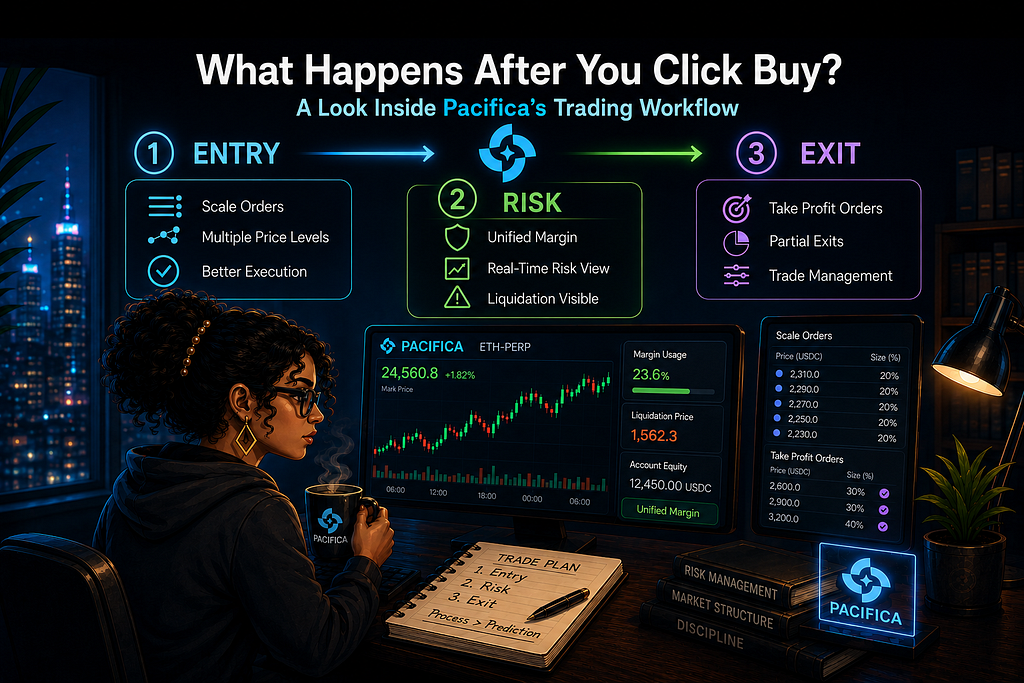
Most traders think a trade begins when they click Buy. They’re wrong.
That’s simply the moment the work starts.
The entry is only the first decision.
What happens next determines whether the trade succeeds or fails.
Every trade lives through three stages:
EntryRiskExit
Most traders focus on the first.
Professional traders manage all three.
Stage 1: Entry
Traders obsess over finding the perfect entry.
The perfect setup.
The perfect price.
The perfect moment.
But markets rarely reward perfection.
They reward execution.
This is why professional traders often build positions rather than entering all at once. A trade isn’t always a single click. Sometimes it’s a process.
One feature I appreciate on Pacifica is Scale Orders. Instead of relying on a single entry, traders can distribute orders across multiple price levels. The goal isn’t to predict the exact bottom or top. The goal is to manage uncertainty.
That’s a very different mindset.
Stage 2: Risk
The moment a trade opens, another price becomes important. Not the entry price. The liquidation price. This is where many traders fail.
They know where they entered.
They know where they hope to exit.
But they never ask: “How much room does this trade actually have?”
Risk isn’t something that appears later.
Risk exists from the very first second.
One thing Pacifica does particularly well is keeping risk visible throughout the entire trading process.
Margin usage.
Liquidation levels.
Position exposure.
Collateral allocation.
These numbers aren’t hidden behind additional menus.
They’re part of the workflow.
That matters because risk management isn’t a separate activity.
It is trading.
Stage 3: Exit
Most trading content focuses on entries. Professional traders spend far more time thinking about exits. A good trade still needs a plan.
Where will profits be taken?
Will part of the position remain open?
What happens if momentum disappears?
What happens if the market moves faster than expected?
The market doesn’t care about your original idea.
Execution matters more than intention.
That’s why exit management is often the difference between a good trade and a profitable one.
The Hidden Problem Most Traders Never Notice
There’s another part of trading that receives surprisingly little attention: Capital efficiency.
Imagine holding assets you don’t want to sell.
On many platforms, those assets sit idle while you separately fund trading positions. Capital becomes fragmented. Part invested. Part collateral. Part waiting.
Over time, that friction adds up.
Pacifica approaches this differently through Unified Margin.
Instead of forcing traders to separate assets from trading collateral, the platform allows capital to work together inside a single system.
The result isn’t necessarily more leverage. It’s better capital efficiency. Less idle capital. Less friction. A cleaner trading workflow.
Why Pacifica Connects All Three
What stands out to me isn’t any individual feature. It’s the philosophy behind them.
Scale Orders improve execution.
Risk tools keep liquidation and exposure visible.
Unified Margin improves capital efficiency.
Take Profit tools improve trade management.
Together they form a workflow built around managing trades rather than simply opening them.
Most platforms focus on helping traders enter positions.
Pacifica focuses on helping traders manage the entire life cycle of a trade.
That’s a very different approach.
Final Thoughts
Most traders think a trade begins with an entry.
The best traders know a trade is a process.
Every trade has three prices:
Entry PriceLiquidation PriceExit Price
And every stage requires a decision.
Because the most important part of a trade isn’t clicking Buy.
It’s everything that happens afterwards.
What Happens After You Click Buy? A Look Inside Pacifica’s Trading Workflow was originally published in Coinmonks on Medium, where people are continuing the conversation by highlighting and responding to this story.