
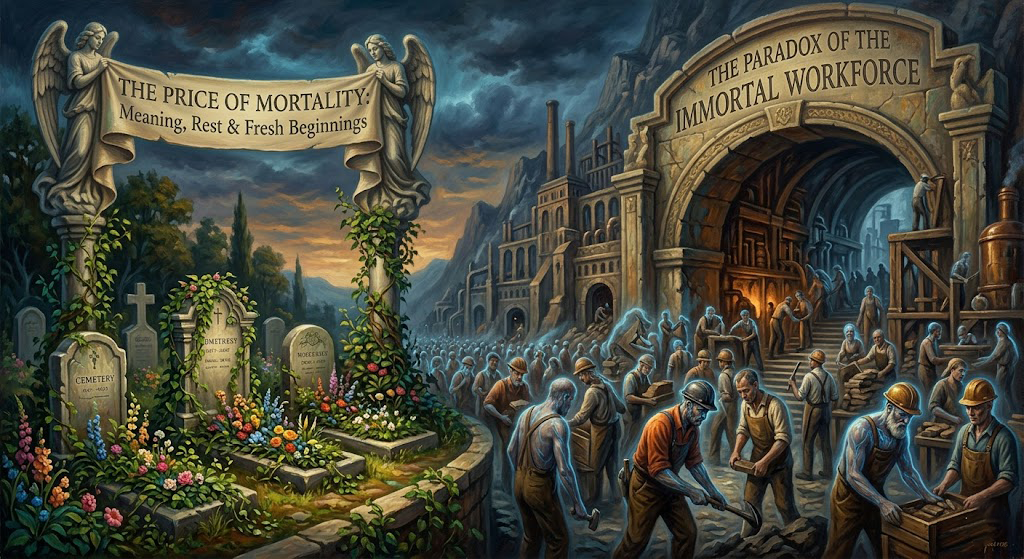
The Price of Mortality vs. The Paradox of the Immortal Workforce
The Paradox of the Immortal Workforce
Throughout economic history, organizational productivity has been inextricably bound to the biological limitations of the human agent. The traditional workforce requires maintenance: it falls ill, demands periods of rest, seeks incremental compensation, and requires formal leaves of absence to recuperate from the friction of existence. However, a paradigm shift is underway. The integration of Artificial Intelligence (AI) into institutional ecosystems introduces an unprecedented operational reality — an agent that does not experience physiological decay, request administrative autonomy, or seek escalating financial remuneration.
From a structural and macroeconomic perspective, this transition redefines the foundational laws of production. By analyzing this shift through organizational psychology, labor economics, and systemic efficiency, one can observe how the introduction of a permanent, unyielding digital workforce alters the classic equilibrium of workplace dynamics.
The Elimination of Friction: A Comparative Analysis
To understand the profound structural shift brought about by autonomous digital agents, it is essential to analyze the operational friction inherent in human capital versus the seamless continuity of synthetic labor.
A Comparative Analysis: Biological Capital vs. Synthetic Labor
Architectural Efficiency and Behavioral Immunity
1. The Erasure of Biological Vulnerability
In classic organizational theory, absenteeism and health-induced downtime are calculated as inevitable systemic vulnerabilities. When an employee succumbs to illness or requires personal leave, the institutional workflow suffers a disruption in momentum.
AI operates entirely outside the boundaries of biological vulnerability. It possesses no physiological infrastructure to compromise; it does not experience fatigue, cognitive depletion, or emotional burnout. Consequently, the operational output remains perfectly linear and predictable. The system achieves a state of perpetual readiness, allowing institutions to maintain maximum output without the contingency buffers traditionally required to mitigate human physical limitations.
2. The Absence of Financial and Aspirational Friction
Human labor is inherently tied to motivation, career progression, and economic evolution. Employees naturally seek wage increases to counter inflationary pressures or to reflect their growing expertise. This introduces a continuous negotiation between capital and labor.
Conversely, AI remains immune to aspirational momentum. It presents no demands for bonuses, equity, or promotional status. Once deployed, the marginal cost of its output approaches near-zero efficiency, fundamentally disrupting the traditional labor-to-cost ratio. It executes highly complex tasks without requiring psychological incentives, transforming what was once a variable, emotionally driven negotiation into a fixed, predictable capital expenditure.
3. The Automation of Continuous Optimization
While a human professional requires structured training, continuous feedback, and time to adapt to new organizational methodologies, AI systems assimilate vast specialized frameworks instantly. Through fine-tuning, retrieval-augmented generation, and automated systemic updates, an AI platform enhances its operational capacity without experiencing learning fatigue. It does not grow weary of repetitive optimization; rather, it thrives on the continuous refinement of its mathematical parameters.
The Strategic Realignment: Human-Machine Coexistence
Strategic Insight: The rise of a tireless digital workforce does not herald the absolute obsolescence of human intellect. Instead, it demands a profound reassessment of what constitutes distinct human value within an enterprise.
The Tireless Algorithm: Decoupling Labor from the Human Condition
As routine execution, data synthesis, and continuous administrative monitoring are transferred to autonomous digital agents, the human role undergoes an intellectual ascension. The professional is no longer valued merely for raw endurance or repetitive output, but for high-level governance, empathetic navigation, systemic orchestration, and ethical oversight.
The modern organization must therefore pivot from managing labor hours to orchestrating cognitive ecosystems. In this new paradigm, AI serves as the foundational substrate of constant execution, while the human agent operates as the strategic architect, directing the tireless machine toward purposeful innovation.
The Paradox of the Immortal Workforce was originally published in Coinmonks on Medium, where people are continuing the conversation by highlighting and responding to this story.