
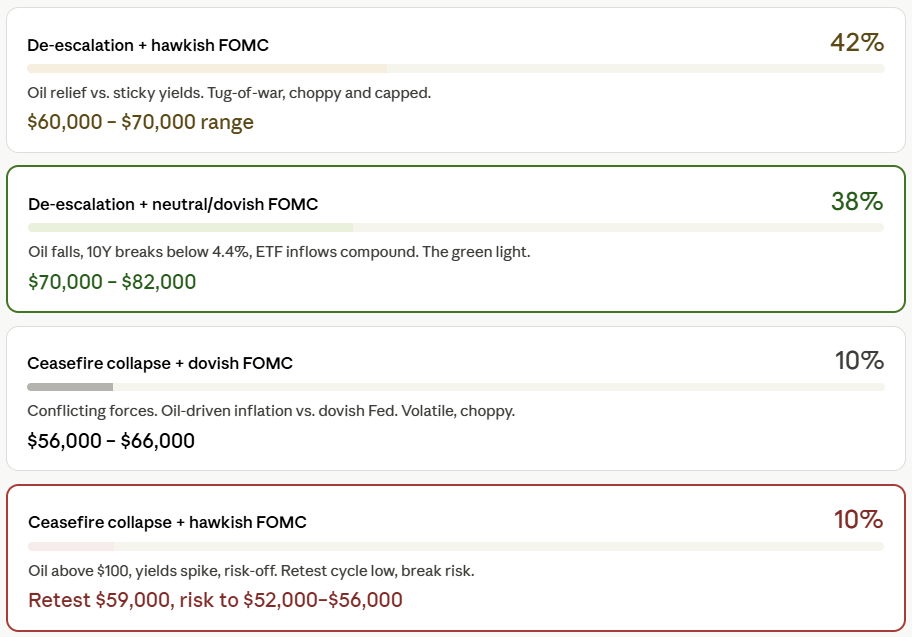
My probability-weighted BTC framework for the next 30 and 90 days, built around four overlapping binary catalysts.
Brent settled at $87.33 on June 12.
That’s the first sustained break below $90 since this whole Iran conflict started. For months I’ve been saying oil is the master variable. Now it’s moving in the right direction, and Bitcoin barely budged.
Here’s the thing: the oil move alone isn’t enough. There’s a second variable that’s been quietly taking over, and it’s the one nobody’s talking about enough. The 10-year Treasury yield is sitting at 4.48%, and until that number moves, the oil relief doesn’t fully translate into a crypto rally.
Let me walk you through how I’m thinking about the next 30 to 90 days, because there are four things happening at once and they all interact.
The Four Things Happening Right Now
1. Iran is close to a deal, but “close” has been a lie before.
A five-point framework agreement is reportedly on the table, and Trump said it could be signed this weekend. An administration official put the odds at 80%.
I’d treat that number with real skepticism. Per CNN’s Aaron Blake, Trump claimed a deal was imminent at least 38 times between late March and early June. The US and Iran are even publishing conflicting term sheets right now (a 5-point US version vs. a 14-point Iranian one), and US drones were still intercepting threats near Hormuz as of June 11.
De-escalation is real. A signed deal is not guaranteed, and definitely not guaranteed soon.
2. The FOMC meets June 16–17, and Warsh’s debut is the wildcard.
A rate hold is essentially certain, about 99%. What matters is the dot plot. May CPI came in mixed: headline jumped to 4.2% YoY (the highest since April 2023, driven almost entirely by energy), but core CPI was a soft 0.2% month-over-month, below consensus.
That core number gives Warsh some room to avoid sounding too hawkish. But May PPI ran 6.5% YoY, the hottest since late 2022. My estimate: 52% chance of a hawkish dot plot (a 2026 hike shows up in the median), 36% chance of neutral, and only 12% chance of a dovish surprise.
3. The Bitcoin ETF outflow streak just ended, and so did a massive liquidity drain.
The 13-day, $4.33 billion outflow streak (nearly 60,000 BTC, per Galaxy Research) is over. June 12 brought $85.85 million of inflows, the best day since mid-May, with all 12 funds positive for the first time in weeks.
On top of that, the SpaceX IPO, the largest in history at $75 billion, completed on June 12. Kendrick at Standard Chartered specifically called this out as removing a structural liquidity drain on crypto. He’s also calling $59,375 (the June 5 low) the cycle bottom. “Winter is over,” he said. “Welcome back to crypto Spring.”
4. Strategy (MSTR) is now trading at a discount to its own Bitcoin holdings.
This is the one that worries me most.
MSTR’s equity-only mNAV is around 0.89x, meaning the stock trades below the value of the BTC it holds, according to Bitcoin Treasuries. Strategy’s own accounting (which includes converts and preferred shares) puts it closer to 1.2x, but the equity-only number is the one that matters for the funding flywheel.
They already sold 32 BTC in late May, their first sale since 2022, to cover a preferred dividend. They then bought back 1,550 BTC at an average of $65,332, bringing total holdings to 845,256 BTC at an average cost of $75,680. They’re underwater on the whole position. Their roughly $1 billion cash reserve covers about 6.3 months of preferred dividends at current rates.
I don’t think this triggers a forced cascade. I put that probability at 25% over 90 days. But if accumulation becomes “constrained” (Grayscale’s Zach Pandl’s word, not mine) at current share prices, that’s a structural risk I’m watching closely.
How These Four Things Combine
The most likely combination, at 42%, is Iran de-escalation continuing alongside a hawkish FOMC. That’s a tug-of-war: oil relief pulling one way, sticky yields pulling the other. My read is a choppy range, $60,000 to $70,000, mildly constructive but capped.
The best-case combination, at 38%, is de-escalation plus a neutral or dovish FOMC. If the 10-year breaks below 4.4% while oil stays under $85, that’s my green light. That combination could send BTC toward $70,000 to $82,000.
The worst case, at only 10%, is a ceasefire collapse paired with a hawkish Fed. Oil spikes back above $100, yields jump, and BTC retests $59,000 with real risk of breaking to $52,000 to $56,000.
My Actual Probability-Weighted Forecast
For the next 30 days (by mid-July), I’m landing on a probability-weighted zone of roughly $64,000 to $66,000. The base case (45%) is a choppy $60,000-$70,000 range above the 200-week moving average. Bear case (25%) is a retest of $52,000-$59,000. Bull case (30%) is $70,000-$80,000 if the deal signs and flows keep building.
For 90 days (by mid-September), the weighted zone widens to roughly $66,000-$70,000. But here’s the honest part: this distribution is genuinely bimodal.
Kendrick says the bottom is in at $59K. Cowen and CryptoQuant’s four-year-cycle models point to an October-November 2026 low, potentially revisiting the $40,000s-$50,000s. Both are credible analysts with real track records. I can’t resolve this tension right now, and I won’t pretend I can. That’s irreducible uncertainty, and it’s exactly why I’m keeping 30–40% dry powder.
The Levels I’m Actually Watching
Forget the noise. Here’s what would change my positioning.
If I see the 10-year close below 4.40% while Brent stays under $85, that’s my core green light to accelerate buying. Add sustained ETF inflows for five-plus sessions and a weekly BTC close above $68,000, and I’m moving from “patient” to “aggressive.”
On the other side, if BTC loses $59,000 on a weekly close, I expect a retest of the $53,800 realized price. Below $53,000, the door opens to that $45,000-$50,000 cycle-low scenario the four-year-cycle crowd is warning about. A 10-year break above 4.60% on a hawkish Fed, or Brent reclaiming $100, would tell me the same thing.
One More Thing: The TAO/Anthropic Story Is Real
I want to flag this because it’s been floating around and I almost dismissed it as another fabricated press release.
It’s not. Anthropic’s own statement, corroborated by VentureBeat and Yahoo, confirms the US government issued an export-control directive forcing Anthropic to suspend foreign nationals’ access to its Claude Fable 5 and Mythos 5 models over a potential jailbreak concern. Bittensor’s official account framed this as validation for decentralized AI, and TAO jumped roughly 15–18% to around $245–250.
This is a real, narrow, narrative-driven move specific to TAO. It’s not a signal about the broader market, and I’m not changing my BTC positioning because of it. But if you’re holding TAO, it’s worth knowing why it moved.
Where This Leaves Me
Right now, with BTC around $60,000-$66,000, I’m holding my core position and laddering modest buys. I’m not chasing the oil-driven relief because the second half of the equation, the 10-year yield, hasn’t confirmed yet.
The FOMC on June 17 is close enough that I’d rather wait through it than front-run it. If it comes in neutral or dovish and Iran signs something real, I accelerate. If it’s hawkish and Iran stays in limbo, I stay patient and keep buying dips into $59,000-$62,000.
And if we get a flush to $53,000-$56,000, that’s my aggressive-add zone, the realized price level. I’ll deploy a bigger tranche there, but I’m keeping a final reserve in case the cycle-low camp turns out to be right.
I could be wrong about all of this. The honest truth is this market has two very smart camps pointing in opposite directions, and only price will settle it.
Not financial advice. Do your own research.
Are you in the “bottom is in” camp with Kendrick, or the “cycle low is still ahead” camp with Cowen? Let me know where you’re positioned.
Four Binary Catalysts Are About to Decide Bitcoin’s Next 90 Days was originally published in Coinmonks on Medium, where people are continuing the conversation by highlighting and responding to this story.