
Billions are being invested in high-performance blockchain infrastructure for real-world assets. But the limiting factor may not be the chain; it may be the compliance layer sitting on top of it.
The tokenization industry has a measurement problem.
When evaluating RWA infrastructure, practitioners reach for familiar lenses: regulatory compliance, legal enforceability, custody arrangements, liquidity access. These are legitimate and important. But an entire dimension of the problem goes largely unmeasured.
How much parallel execution capacity is lost because of how compliance is architected?
This question matters now, because the context has changed. A new generation of high-performance blockchains : Monad, Aptos, Sui, Sei are built around parallel execution engines.
The premise is simple: if transactions don’t touch the same state, they can execute simultaneously. Thirty-two threads executing thirty-two independent transactions produce thirty-two times the throughput.
But institutional asset frameworks weren’t designed with this premise in mind. They were designed for regulatory robustness. And in pursuit of that robustness, they introduced something that quietly undermines parallel execution: shared mutable state.
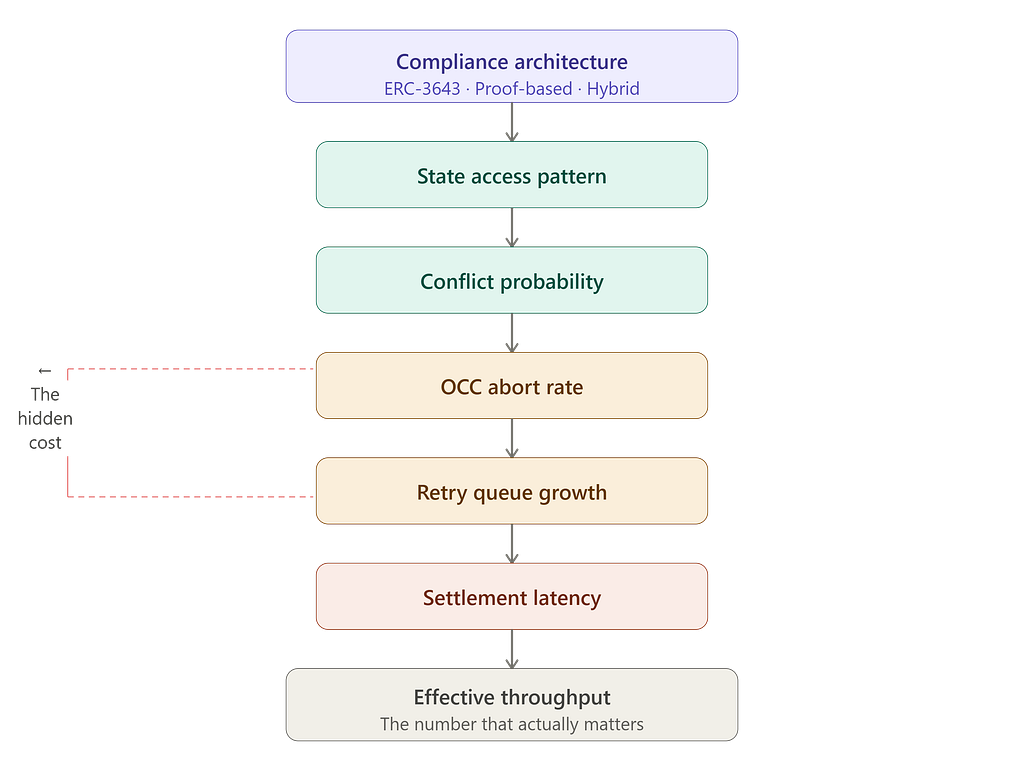
The problem flows like this: every compliance design decision creates a chain of consequences that ultimately determines real-world throughput:
The Contention Problem
Every time a transfer occurs under a legacy compliance framework like ERC-3643 or a traditional transfer agent model, the transaction must read and write to a set of shared registers:
The investor registry (to verify eligibility)Ownership cap counters (to enforce concentration limits)Freeze state (to check transfer restrictions)Jurisdiction tables (to validate cross-border rules)
In a sequential world, this is fine. Transaction A completes. Then transaction B. No conflict.
In a parallel execution environment, this creates a problem. Transaction A and Transaction B both try to update the cap counter simultaneously. The execution engine detects the conflict and must abort one of them: typically the one that lost the race. That transaction goes back into the queue and tries again.
This is Optimistic Concurrency Control, and it’s the mechanism most parallel blockchains use. OCC is elegant under low contention. Under high contention, it collapses.
The cascade looks like this:
32 threads available. 100 transactions submitted. Round 1: 8 succeed, 24 abort. Round 2: 10 succeed, 14 abort. Round 3: 7 succeed, 7 abort…
What should take 4 rounds under zero contention takes 12. Throughput craters. Latency explodes. And critically, under the conditions when you most need performance (a liquidation event, a mass redemption, a dividend distribution) the contention is highest.
Three Compliance Architectures, Three Execution Outcomes
Not all compliance frameworks create equal contention. The architecture of how compliance is enforced determines the shape of the state access pattern, which determines conflict probability, which determines everything downstream.
Model A : Legacy Registry (ERC-3643, ERC-1400, transfer agent)
Every transfer touches shared, writable state. The investor registry is a canonical source of truth. Cap counters are global. Freeze state is centralized. Every transaction writes to the same keys. Under OCC, simultaneous transactions always conflict. Parallel efficiency approaches zero under load.
Model B : Proof-Based (ZK proofs, Merkle attestations)
Compliance is verified locally. The sender attaches a cryptographic proof that they are eligible to transfer. The proof is verified against public parameters; no shared registry write required. Conflict probability is approximately zero. Transactions are independent by construction. Parallel efficiency remains near-maximum regardless of load.
Model C : Hybrid
Reads shared state (to verify against a registry), but writes locally (no shared counter update). A useful middle ground ; better than Model A, worse than Model B.
The Metrics That Actually Matter
When evaluating compliance architectures as execution systems, the relevant metrics are different from traditional performance benchmarks.
Parallel Efficiency: What fraction of available execution capacity is actually utilized on the first pass? This is the ceiling of your throughput before retries are factored in.
Retry Amplification : The ratio of total execution attempts to completed transactions. A legacy registry model under a liquidation event might require 8 attempts per transaction. A proof-based model requires 1.05. The difference is the hidden cost of coordination.
Coordination Cost Index : Total aborts and retries divided by completed transactions. This makes the regulatory overhead visible as an execution variable.
Effective Throughput : Not raw TPS. Actual completed transactions per second after contention, retries, and scheduling overhead are included.
Settlement Latency : Average rounds until final success. Under normal conditions, this difference is small. Under stress conditions, it is the difference between orderly settlement and a queue that never clears.
What the Simulations Reveal
Running these architectures against institutional scenarios produces a striking pattern.
Normal market conditions : All three models perform acceptably. Legacy registry achieves 420 effective TPS. Proof-based achieves 980. The gap exists but doesn’t create operational problems.
Dividend distribution: A mass distribution event creates simultaneous writes to cap counters and registry state from thousands of transactions. Legacy registry drops to ~120 effective TPS. Retry amplification exceeds 6×. Proof-based remains stable above 950 TPS.
Liquidation cascade : This is where the architecture choice becomes critical. Under a market dislocation, correlated liquidation orders hit simultaneously. Legacy registry collapses to ~88 effective TPS with settlement latency exceeding 14 seconds and retry amplification above 8×. The execution engine is spending most of its time on aborted work. Proof-based degrades gracefully to ~920 TPS.
The pattern across all scenarios reveals something important: the compliance architectures that are most restrictive under normal conditions become catastrophically degraded under stress conditions. And stress conditions are precisely when settlement certainty matters most.
Reframing the Question
The industry currently evaluates tokenization infrastructure through a legal and financial lens. Is it regulated? Is it enforceable? Is it liquid?
These questions are necessary but not sufficient.
A compliance framework that is legally robust but architecturally contention-heavy may be unable to process institutional volumes during the exact market events it was designed to handle. A liquidation cascade that should clear in seconds instead queues for minutes — not because the chain is slow, but because every transaction is fighting every other transaction for the same shared counter.
The implication is that compliance architecture is not merely a regulatory design decision. It is an execution-layer design decision. And it should be evaluated with the same rigor we apply to consensus algorithms, validator economics, and network topology.
The central question is not “does this comply?” It is “does this comply and scale?”
The Benchmark
What the industry needs is a standardized framework for measuring how institutional compliance architectures interact with parallel execution systems. Not a simulation of any specific blockchain : but a measurement instrument that isolates the variable that actually matters: the cost, in throughput and latency, of different compliance approaches under different transaction regimes.
The RWA Contention Benchmark is an attempt to build that instrument.
It doesn’t adjudicate which chain is fastest. It doesn’t evaluate legal enforceability.
It answers a narrower, more tractable question: under parallel execution assumptions, how does compliance architecture affect achievable parallelism?
The result is a data-driven framework for comparing architectures not on regulatory features, but on execution economics.
That reframing from compliance as a legal question to compliance as an execution variable is where the next generation of RWA infrastructure design will be built.
The diagrams and benchmark simulator in this piece are part of an ongoing project to build open measurement infrastructure for institutional tokenization. The scenarios and numbers above are illustrative built on the simulation framework rather than live chain data.
The Hidden Bottleneck in Tokenized Finance: Why Compliance Architecture Is an Execution Problem was originally published in Coinmonks on Medium, where people are continuing the conversation by highlighting and responding to this story.