
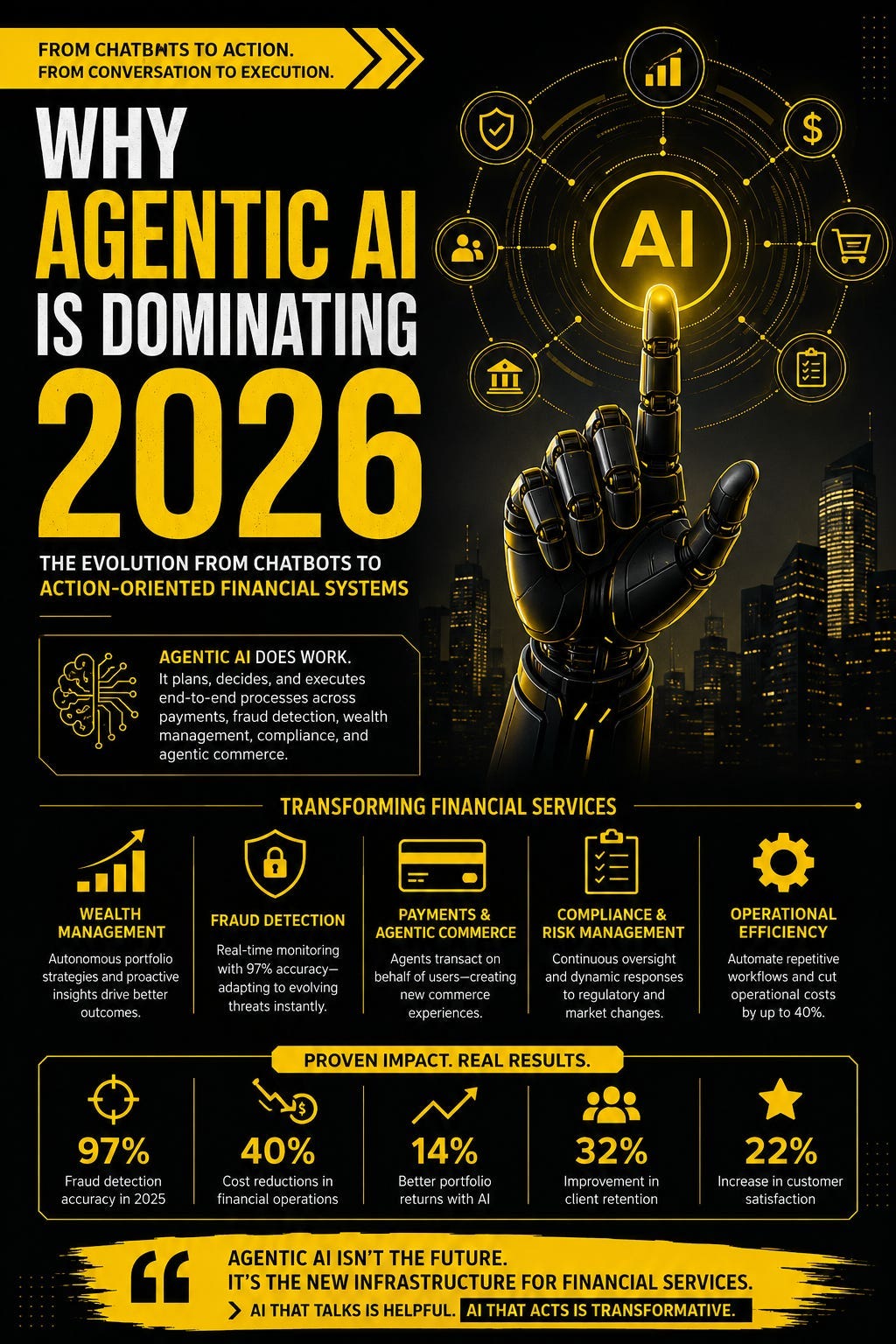
The Evolution From Chatbots to Action-Oriented Financial S
The Next Chapter of AI Has Arrived
For the past few years, artificial intelligence has been defined by its ability to generate content.
AI could write emails, summarize reports, answer customer questions, and power conversational assistants. These capabilities transformed productivity, but they still required humans to make decisions and take action.
In 2026, that paradigm is changing.
The rise of Agentic AI marks the transition from systems that simply generate information to systems that autonomously execute tasks, make decisions, and complete workflows.
Instead of telling you what to do, AI is now doing the work.
For financial institutions, fintech companies, payment providers, and digital banks, this shift is becoming one of the most significant technological developments of the decade.
From Generative AI to Agentic AI
Generative AI focuses on creating content.
It answers questions, drafts reports, generates code, and assists users through conversation.
Agentic AI goes several steps further.
It can:
Analyze informationMake decisionsPlan multi-step workflowsInteract with external systemsExecute actions autonomouslyLearn and adapt based on outcomes
Think of the difference this way:
A chatbot can explain how to transfer money.
An AI agent can verify the recipient, perform compliance checks, initiate the transfer, monitor the transaction, and report completion without human intervention.
That shift from conversation to execution is what makes Agentic AI so powerful.
Why Agentic AI Is Exploding in 2026
Several technology breakthroughs have converged to make large-scale deployment possible.
1. Stronger Reasoning Capabilities
Modern AI models can now break complex objectives into multiple steps, evaluate options, and execute sophisticated workflows with minimal supervision.
This allows agents to function more like digital employees than software tools.
2. Standardized Agent Protocols
Emerging standards such as MCP (Model Context Protocol) and A2A (Agent-to-Agent communication) are making it easier for AI systems to interact with software, APIs, databases, and other agents.
The result is a more connected ecosystem where agents can collaborate across platforms.
3. Larger Context Windows
AI systems can now maintain awareness across lengthy conversations, large datasets, and complex financial transactions.
This enables continuity and accuracy throughout entire workflows.
4. Proven Business Results
Perhaps the biggest driver is simple: the numbers work.
Organizations deploying agentic systems are reporting measurable improvements in efficiency, fraud prevention, customer experience, and operational costs.
When technology produces clear ROI, adoption accelerates rapidly.
Financial Services Is Becoming the Largest Agentic AI Opportunity
Financial services generate enormous amounts of structured data, require continuous decision-making, and depend heavily on compliance and risk management.
These characteristics make the industry a perfect environment for autonomous agents.
Major financial institutions are already investing aggressively.
Organizations including Morgan Stanley, JPMorgan, BDO, Plaid, Mastercard, Visa, PayPal, and BNY have highlighted agentic AI as a strategic priority for future growth and operational efficiency.
What began as experimentation is quickly becoming core infrastructure.
The Four Areas Being Transformed First
Wealth Management
Traditional investment advisory services rely heavily on manual research and human decision-making.
Agentic AI is changing that model.
Autonomous agents can continuously monitor market conditions, evaluate portfolios, identify opportunities, rebalance assets, and generate personalized recommendations in real time.
The result is faster decision-making, improved advisor productivity, and more responsive portfolio management.
For wealth management firms, AI is evolving from a research assistant into an active participant in investment execution.
Fraud Detection and Prevention
Fraud remains one of the largest challenges facing financial institutions.
Rule-based systems often struggle to keep pace with increasingly sophisticated attack patterns.
Agentic AI continuously analyzes transaction data, customer behavior, communication channels, and emerging threat signals.
Instead of relying on static rules, agents adapt dynamically as threats evolve.
Recent deployments have demonstrated fraud detection accuracy approaching 97%, significantly outperforming traditional systems.
As financial crime becomes more complex, autonomous monitoring is becoming essential rather than optional.
Payments and Agentic Commerce
One of the most exciting developments is the emergence of Agentic Commerce.
In this model, AI agents can initiate and complete transactions on behalf of users.
Imagine an AI agent that:
Finds the best flightCompares pricesVerifies preferencesCompletes paymentManages refunds if necessary
All without direct user involvement in each step.
Payment networks and card providers are actively exploring this future.
The implications are enormous.
Instead of humans interacting directly with payment systems, intelligent agents may become the primary actors executing transactions.
This creates entirely new opportunities for payment infrastructure providers, banks, and fintech platforms.
Compliance and Risk Management
Regulatory requirements continue to increase across financial services.
Agentic AI enables continuous compliance monitoring rather than periodic reviews.
Agents can:
Monitor regulatory changesReview transactionsFlag suspicious activitiesValidate documentationGenerate audit trailsEscalate potential risks
This allows organizations to maintain stronger compliance while reducing manual workload.
For heavily regulated industries, continuous autonomous oversight may become one of the most valuable applications of AI.
The Hidden Benefit: Operational Efficiency
Beyond innovation, many organizations are adopting Agentic AI for a simpler reason.
Cost reduction.
Finance teams spend significant time on repetitive operational tasks such as:
ReconciliationsTransaction reviewsExpense verificationJournal entriesReporting workflows
AI agents can automate much of this work while maintaining consistency and accuracy.
Some organizations are already reporting operational cost reductions approaching 40%.
This frees teams to focus on strategic analysis, growth initiatives, and customer engagement rather than administrative tasks.
Why This Matters for Fintech Infrastructure
The most important takeaway is that Agentic AI is not replacing financial infrastructure.
It is becoming the intelligence layer above it.
Banking APIs, payment gateways, card issuing platforms, compliance engines, and cross-border payment networks remain essential.
What changes is how those systems are used.
Instead of humans manually coordinating processes, autonomous agents orchestrate workflows across multiple platforms simultaneously.
This creates:
Faster executionReal-time decision makingLower operational costsBetter customer experiencesGreater scalability
For Banking-as-a-Service providers, payment processors, and fintech infrastructure companies, Agentic AI represents a major opportunity to create entirely new categories of financial products.
The Bottom Line
Agentic AI dominates 2026 because it delivers something businesses care deeply about: outcomes.
Unlike traditional generative AI, which primarily produces content, agentic systems generate measurable business results through autonomous action.
They detect fraud, execute transactions, monitor compliance, manage portfolios, and automate operations.
The convergence of stronger reasoning capabilities, standardized protocols, larger context windows, and proven ROI has pushed Agentic AI beyond experimentation and into mainstream adoption.
The financial industry is entering a new era where AI is no longer just a tool for assisting decisions.
It is becoming a system that makes and executes them.
The organizations that embrace this shift early will be best positioned to build the next generation of financial services.
Why Agentic AI Is Dominating 2026 was originally published in Coinmonks on Medium, where people are continuing the conversation by highlighting and responding to this story.