
The global AI race just entered a phase and Alibaba may have quietly made one of the most important moves of the year.
At an event in Chongqing Alibaba unveiled its most powerful AI accelerator yet: the Zhenwu M890, alongside a preview of its next-generation large language model, Qwen3.7-Max.
At glance this might look like another chip launch and another LLM update.
It’s not.
This is about something bigger: China building a fully sovereign AI stack. From silicon to cloud to AI agents. At a time when U.S. Export restrictions are forcing Chinese tech giants to rethink the foundations of their infrastructure.
If Alibaba succeeds it could reshape the balance of power in the global AI ecosystem.
Image Is Generated By ChatGPT
The Real Story Behind the Zhenwu M890
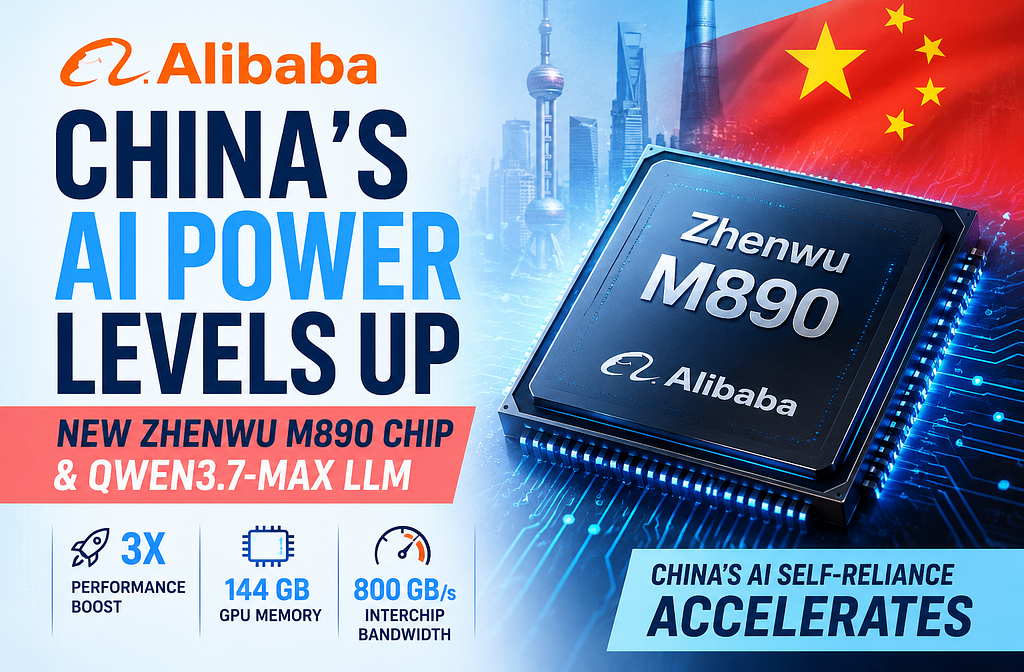
Alibaba says the new Zhenwu M890 delivers 3x the performance of its predecessor, the Zhenwu 810E.
The company also revealed some serious specifications:
144 GB GPU memory800 GB/s interchip bandwidthOptimized for long-running AI agent workloadsAlready deployed at scale across industries
According to Alibaba over 560,000 Zhenwu units have already been delivered to more than 400 customers across 20 industries.
That’s not a prototype ecosystem anymore.
That’s infrastructure.
That’s the key point many people are missing.
For years China’s AI ecosystem depended heavily on Nvidia hardware.. With tightening U.S. Export controls limiting access to advanced chips companies like Alibaba, Huawei and Cambricon have been forced into accelerated self-reliance.
The Zhenwu M890 is Alibaba’s answer to that pressure.
Not just a domestic alternative.
A strategic replacement.
Why This Matters Beyond China
The importance of the M890 isn’t about raw performance.
It’s about control.
Who controls the chips.Who controls the cloud.Who controls the models.Who controls the AI economy.
Alibaba is increasingly trying to own the stack:
AI chips via T-HeadCloud infrastructure via Alibaba CloudFrontier AI models via QwenEnterprise AI deployment channelsAgent ecosystems and orchestration frameworks
That level of vertical integration starts to resemble what Nvidia and OpenAI and hyperscalers collectively represent in the West.
Except this time it’s being built inside China’s technology ecosystem.
That changes the geopolitical equation significantly.
Qwen3.7-Max: China’s Agentic AI Push Gets Serious
Alongside the chip announcement Alibaba teased Qwen3.7-Max, its upcoming flagship LLM.
Based on early benchmark discussions Alibaba is aiming directly at the frontier-model tier.
The model reportedly performs across:
Advanced reasoningMathematical problem solvingcodingTool use and orchestrationMultilingual tasksLong-horizon agent workflows
Benchmarks like SWE-Pro, GPQA Diamond, HLE and multilingual evaluation suites suggest Qwen3.7-Max is positioning itself as a serious competitor to top-tier Western models like Claude, Gemini, GPT-class systems and DeepSeek variants.
The bigger shift is not benchmark scores.
It’s the architecture strategy behind them.
Alibaba appears to be optimizing Qwen not as a chatbot. But as an agent-native model designed to run complex workflows autonomously.
That means:
coding agentsinfra-management agentsresearch agentscompliance-analysis systemsenterprise automation pipelines
Crucially these workloads are being optimized to run directly on Alibaba’s own silicon.
That’s where the story gets interesting.
This Image Is Generated By ChatGPT
The Rise of Parallel AI Ecosystems
For years the AI world mostly revolved around a centric stack:
Nvidia chipsCUDAOpenAI/Anthropic/Google modelsAWS/Azure/GCP infrastructure.
Now a second ecosystem is rapidly emerging:
AlibabaHuaweiBaidudomestic AI chipscloud infrastructureindigenous LLMs.
This is more than competition.
It’s fragmentation.
The AI industry is slowly becoming multipolar.
In terms that means the future may not be one universal AI ecosystem. But several semi-independent ones operating under different geopolitical, regulatory and technological frameworks.
China is moving aggressively to ensure it owns one of them.
Why Enterprises Are Paying Attention
For banks, fintech companies, telecom providers and state-linked enterprises inside China this shift is extremely attractive.
A controlled AI stack offers:
Reduced exposure to export restrictionsLower geopolitical riskBetter regulatory alignmentGreater infrastructure sovereigntyLower compute costs over time
This becomes especially important for sectors handling sensitive financial, government or strategic data.
If Alibaba can offer:
chips,domestic cloud,domestic AI models,and enterprise-grade agents
then many Chinese enterprises may prefer that ecosystem over dependence on foreign-controlled infrastructure.
That’s a strategic advantage.
The Bigger Question: Can AI Chips Catch Nvidia?
Now Nvidia still leads globally in software maturity, ecosystem depth and frontier performance.
The gap may be shrinking faster than expected.The important thing about the Zhenwu M890 isn’t whether it beats Nvidia today.
It’s that China’s AI hardware ecosystem is iterating rapidly at scale.
Scale matters.
Because once you combine:
government support,massive domestic demand,enterprise deployment,cloud integration,and integrated AI ecosystems
improvement compounds quickly.
China doesn’t necessarily need to dominate to succeed.
It only needs to become sufficiently self-reliant inside its market.
That market is enormous.
The Zhenwu M890 and Qwen3.7-Max represent something than a product launch.
They represent the acceleration of an AI reality:
a world where multiple AI superpowers are building parallel technology stacks, optimized around their own infrastructure, regulations and strategic interests.
Alibaba is no just competing as a cloud company.
It is positioning itself as a foundational AI infrastructure player in a fragmenting global ecosystem.
If this momentum continues the future of AI may no longer be defined by a single dominant stack. But by competing sovereign ecosystems evolving side, by side.
The AI race isn’t slowing down.
It’s becoming multipolar.
Alibaba Just Dropped a Beast: Why the Zhenwu M890 Chip and Qwen3.7-Max Matter More Than You Think was originally published in Coinmonks on Medium, where people are continuing the conversation by highlighting and responding to this story.