
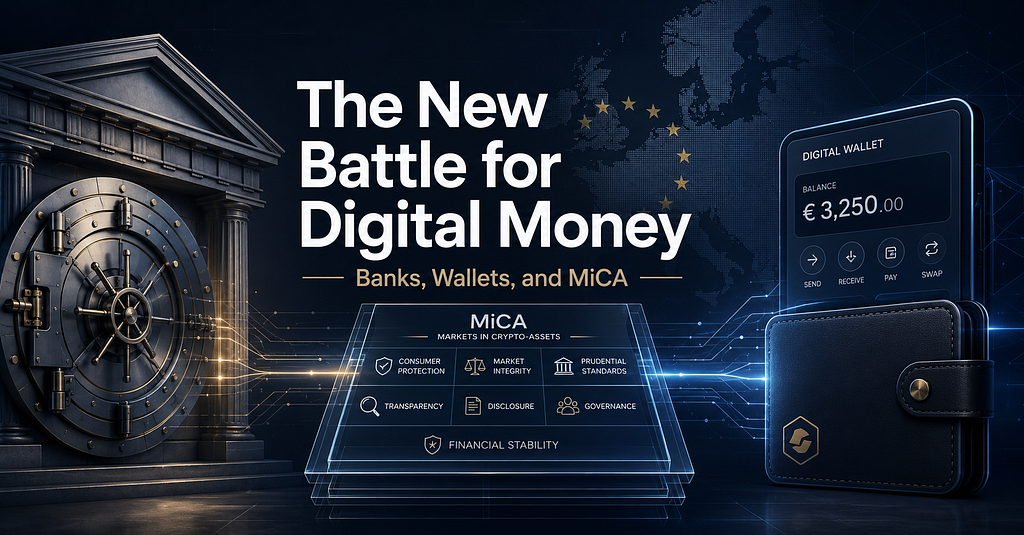
There is a moment in every market cycle when the conversation changes. First, people ask whether the technology is real. Then they ask whether it will scale. Then, quietly, the serious players stop debating the premise and start fighting over the rails. That is where digital finance is now.
Stablecoins are no longer just a crypto-native story. Tokenised deposits are no longer just a banker’s experiment. Wallet-based identity is no longer just a compliance feature. These are becoming the strategic layers of the next payment stack, and the race is no longer about who has the loudest narrative. It is about who controls trust, distribution, and settlement.
For Europe, this is a useful moment to be honest.
The region has done something important: it has built one of the most credible regulatory frameworks in the world through MiCA. That matters. Regulation is not the enemy of innovation. Done properly, it is the operating system of trust. But regulation alone does not create market momentum. It does not attract builders by itself. It does not guarantee liquidity, speed, or adoption.
And right now, the United States is moving fast.
Banks Are Rebuilding the Rails
Recent reporting that major U.S. banks are preparing a tokenised deposit network through The Clearing House, targeting the first half of 2027, is more than a product update. It is a signal. The largest incumbents in American finance are not waiting to be displaced by stablecoins. They are building bank-grade alternatives that keep money inside the regulated perimeter while making it more programmable, faster, and more usable.
That matters because it changes the strategic conversation.
The question is no longer whether digital money will be regulated. It already is.
The real question is who gets to define the default rails.
If bank-led tokenised deposits become the preferred institutional settlement layer, stablecoins will not disappear, but they will face a more serious competitor than many in crypto want to admit. The battle will shift from ideology to utility. From “decentralised versus centralised” to “which rails move value safely, cheaply, and at scale?”
That is the boardroom question founders and CEOs should be asking now.
Identity Is Entering Checkout
The second signal is coming from wallets and identity.
Google Wallet’s expansion of digital ID support in Europe is not a minor UX improvement. It is a glimpse of where payments are heading: identity is moving closer to the transaction itself. In other words, the wallet is no longer just a place to store a payment credential. It is becoming the front door to trust, access, and conversion.
That has real consequences.
For consumers, fewer steps means less friction.
For merchants, less friction means better conversion.
For PSPs, issuers, and fintechs, it means the payment journey increasingly depends on how well identity can be embedded without breaking the experience.
Europe should pay close attention here.
If identity becomes part of the checkout flow, then the winners will be the firms that make verification feel invisible while still satisfying compliance. That is a difficult balance. But it is also where the next advantage will sit. In digital finance, the best products rarely feel complicated to use — they feel inevitable.
The Market Is Getting Bigger
The third signal is the scale of the market itself.
Juniper Research’s 2026 outlook points to digital wallets reaching 5 billion users, while account-to-account transactions could hit $1.4 trillion in consumer volume. That is not a niche trend. That is a structural shift in how people move money. Juniper also frames 2026 as a turning point for stablecoins, agentic AI, digital identity, tokenised assets, and fraud prevention. That combination is telling.
The industry is not converging around one technology.
It is converging around a stack.
And that stack has a clear logic: programmable money, identity-aware access, real-time settlement, and stronger controls. The firms that understand that architecture will build better products than the firms that still sell features in isolation.
ResearchAndMarkets’ projection that the digital payments market will rise from $149.92 billion in 2026 to $213.76 billion by 2030 reinforces the same point. The market is expanding, but expansion alone does not tell you who wins. The real value is shifting toward the layer that can combine compliance, trust, and distribution.
Why Europe Feels the Pressure
That is where Europe faces its hardest test.
MiCA gives Europe an advantage: certainty. But certainty can become a ceiling if it is not matched by speed. Founders do not only choose jurisdictions based on how safe they are. They also choose based on how quickly they can launch, iterate, partner, and scale.
This is where Europe must be careful.
If the regulatory bar becomes too heavy before the market has enough room to breathe, the best builders will quietly look elsewhere. Not because they dislike Europe, but because capital and talent will always migrate toward environments that allow them to move faster.
That is why the comparison with MENA matters.
The UAE, in particular, has shown what happens when a jurisdiction combines regulatory ambition with commercial pragmatism. It does not mean lower standards. It means faster market formation. It means a clearer willingness to let innovation test itself in the real world while supervision keeps pace.
Europe does not need to copy that model.
But it does need to learn from it.
The strategic lesson is not that Europe should deregulate. It is time for Europe to stop confusing compliance strength with innovation leadership. They are related, but they are not the same thing.
What This Means in Practice
If I were in a board meeting today, this is how I would frame it:
The market is moving toward digital money rails that are regulated, identity-aware, and instant.
The U.S. is industrialising that future through bank-led initiatives and faster policy execution.
Europe has built a stronger rulebook than most, but still needs to prove that it can turn rules into market momentum.
MENA is showing that innovation can move quickly when jurisdictions create room for experimentation without abandoning oversight.
So the real trade-off is this:
Do you optimise only for safety, or do you build a system that can also win adoption?
That is not an abstract question. It will decide where talent goes, where capital flows, and which firms become the infrastructure of the next decade.
The Strategic View
My view is simple.
Europe should protect its regulatory credibility, but it must now move from framework to execution. It should give founders enough breathing space to build, enough clarity to invest, and enough speed to compete. If it does not, others will define the future of digital money for it.
The next era of fintech and crypto will not be won by the most fashionable narrative.
It will be won by the jurisdictions and companies that can make trust usable.
That is the real battle for digital money.
And it has already started.
Joseph Zammit is a senior marketing and strategy executive with 25+ years across fintech, crypto, and digital finance. He served as CMO at CrossFi and contributed to the design of Malta’s world-first DLT legislation framework. He writes on regulation, strategy, and the future of digital money.
The New Battle for Digital Money: What Banks, Wallets, and MiCA Really Signal for Europe was originally published in Coinmonks on Medium, where people are continuing the conversation by highlighting and responding to this story.