
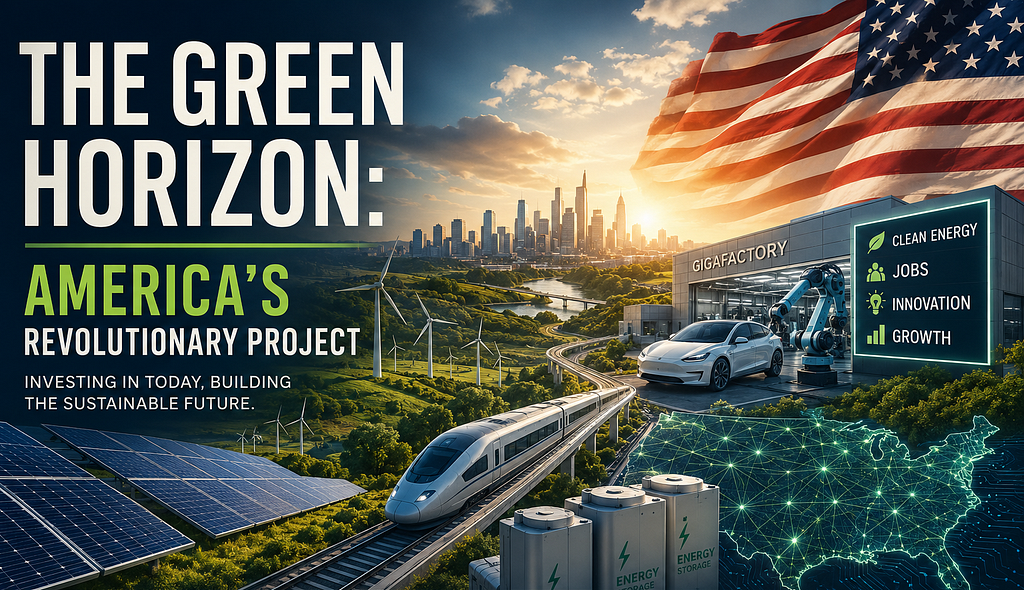
What happens when the world’s largest economy decides that the future isn’t something to wait for, it’s something to build?
Build the future, what if the planet’s biggest economy stops waiting and just starts making it?
When progress doesn’t knock but kicks the door open, what comes next?
Spring 2026 brought a new chapter when the U.S. stepped forward with an overhaul labeled by some as the boldest financial shift seen in decades. Though opinions varied, few could ignore its scale.
Image Generated By ChatGPT
The American Green Horizon Project.
Worth 2.8 trillion dollars, this move went far beyond roads and bridges. Not just spending, it signaled where power shifts: countries bold enough to back clean energy, high-tech production, new digital systems claim tomorrow’s economy.
Surprise rippled through crowds, though some stayed doubtful. Talk spread fast, crossing borders without warning. Not everyone agreed on what it meant.
Beneath the noise of breaking stories sat a deeper issue entirely
One choice, might it shift how a whole nation grows?
The Study That Shifted How People Talk
Years passed before the change caught up with those making decisions.
Economists saw it coming long before others noticed.
Years of tracking financial shifts revealed something odd. Not the usual suspects leading now. Instead, fresh fields rising where old ones once thrived. Growth used to flow through factories and steel, but lately it leans elsewhere. What shaped wealth fifty years ago holds less weight today. The pulse of progress beats in new places. Machines learning, data moving, quiet forces replacing loud engines. Past giants built roads and rails; current momentum builds networks we cannot see. Change creeps slowly until it stands tall. Expectations shift when results insist.
Renewable energy.Electric mobility.Advanced manufacturing.Digital infrastructure.Artificial intelligence.
Out there, nations pouring resources into such areas seemed poised to pull ahead. A shift was brewing, those moving fast could find themselves in stronger positions later on.
Facing tough shifts, old-school sectors felt the squeeze, not just from machines taking over tasks, but also rivals overseas stepping up their game while shoppers started wanting different things.
It stood clear, hard to ignore
Who moves quickest through change might just shape what comes next. Economy shifts often favor those who adjust before others even notice the ground moving.
Some stayed put while others moved ahead.
AI Generated Image
Built three efforts. All sharing one aim.
Starting strong, the Green Horizon plan rests on three linked supports. One piece fits into another, like parts of a puzzle coming together. Each section holds up the next, without any clear beginning or end in sight.
One focused on lifting trade, another built up industry, while a third poured energy into innovation.
1. The Solar Belt Initiative
A ribbon of sunlight-powered stations once imagined cutting across plains, linking Texas to heartland towns through high-capacity power lines built for tomorrow. Wires strung between fields where panels drink in long hours of open sky. Not just isolated sites but a we,binterlaced, designed to move electrons swiftly over vast distances. Each facility feeding into corridors meant to handle surges without strain. Visionaries saw it as an upgrade, a shift from old grids toward something more resilient. Sunlight harvested at scale, then pushed along routes engineered for speed and consistency. The plan: let light do heavy lifting across flat terrains soaked in brightness most months.
Producing clean energy was just part of it.
Energy bills began to shrink while reliance on outside sources faded, one town at a time. Local work opened up where old factories once stood silent.Thousands found roles in places that had been overlooked for decades.Independence grew quietly, fueled by change few saw coming.
Folks who backed the idea said cheap, steady power might just turn into a key edge in today’s world.
They hoped America would take charge.
2. The Electric Manufacturing Corridor
Another key part turned attention to what mattered just as much
Making things again.
A stretch of factories rises with purpose, built for making electric cars, power packs, tiny circuits, also next-gen green machines. This zone focuses only on what drives tomorrow’s grid-powered world.
Instead of just fighting over cheap workers, the plan leaned hard into new ideas, machines doing tasks, also smarter ways to build things.
Clear sight led the way
Start making things that shape what comes next, make them right here. What gets created now begins locally. Shape tomorrow by working where you are. The tools for what follows start on home soil. Create ahead of need, close to hand.
3. The Digital Trade Infrastructure
Maybe the biggest part focused on a thing most folks overlook.
Digital infrastructure.
A fresh push rolled out wider high-speed fiber lines while cash flowed into powerful computers built for AI work, scientific study, plus tools still being invented. Networks stretched further at the same time machines got smarter and faster. New cables ran alongside labs upgrading gear meant to handle what comes after today’s tech. Speed met brainpower when connections widened just as processing centers began handling heavier loads. Growth wasn’t only in wires but also inside rooms humming with future-ready systems.
Out here, where screens shape more than steel ever did, influence isn’t just about highways or harbors anymore.
What counts here includes data, yet ties into how well systems link up along with processing power.
The Green Horizon strategy recognized that reality.
Other Countries Watching Too
Right away, big nations began paying attention.
It isn’t about how big the project is.
Yet its meaning made all the difference.
A shift.
Years went by where the race was about who could make things cheaper, yet still get hold of what they needed. Yet only those who managed both kept pace.
A shift came through, not quite like before.
Change would come through fresh ideas.
Technology.Energy.Talent.And infrastructure.
From Germany to South Korea, governments poured more into wind and solar power while upgrading factories with smarter machines. Some nations tied new tech networks directly into rural grids, bypassing old infrastructure entirely. A shift unfolded quietly, driven by rising fuel costs plus pressure to cut emissions fast. Even smaller economies started prioritizing battery research instead of waiting for larger players to lead.
Momentum built without announcements or grand promises, just steady moves behind closed doors.
One economist called it a fresh start in how nations compete for money matters. A different view saw countries now sprinting after wealth like never before. Not everyone agreed, yet the idea spread, economies shifting into high gear together. The moment felt less like an ending, more like a starting line appearing out of nowhere.
Not for oil.Not for land.Yet technology leads here instead.AI Generated Image
The Critics Asked
True, something this big was bound to meet resistance from the start.
Fair points came up during discussions.
Could those expected jobs really show up?
Maybe the state can handle something so tangled. Efficiency might show up, maybe not.
Could government borrowing grow more quickly than the economy’s earnings?
Take ancient Rome’s roads, some crumbled before they were even finished. Big promises often buckle under real world weight. Look at 19th century rail booms; many tracks led nowhere useful. Projects swell with hope yet shrink in results. Even modern broadband pushes sometimes leave towns darker than before. Expectations rise fast, then stall on execution.
Cost overruns.Political gridlock.Implementation challenges.
Some people who agreed with the idea still saw the dangers ahead.
Yet the real danger, they said, lies in standing still.
Even so, tech keeps shifting ahead as officials talk. While talks drag on, new tools quietly take shape. Though meetings go long, machines learn faster. As leaders wait, code evolves without warning.
Markets evolve.Industries change.Waiting never catches chances.
The Hidden Price of Not Moving
Surprisingly, looking back at how economies have changed shows something odd, what seems costly now might actually be normal during shifts.
Over time, standing still might cost much more than expected.
Shifts in the economy always bring gains for some, losses for others.
The industrial revolution.
The internet age.The rise of mobile technology.Artificial intelligence.Change arriving isn’t what anyone debates anymore.Someone will face it when the moment comes.
Long-term thinking shapes true prosperity, said those behind The Green Horizon Project. Though quiet in tone, its message carried weight through time. Because foresight matters more than speed, they built plans that stretched beyond years into decades. A future worth having needs decisions made today, but done differently. Not haste, rather patience became their guidepost. Where others rushed ahead, they paused to ask what lasts.
Looking ahead, putting money into tomorrow’s sectors goes beyond just expansion.
It’s about relevance.
A Glimpse Into the Future
Soon after, hints of movement started showing up. Not long later, small shifts became visible. A bit down the line, traces of progress popped into view. After a while, quiet signals of forward motion emerged. In time, subtle indicators of growth made themselves known.
Construction began on new buildings.
Firms struck deals behind closed doors. Cooperation emerged without fanfare. Agreements took shape outside public view.
Funds began moving toward areas once overlooked for big initiatives. Development dollars settled where progress had long stalled. Growth crept into corners that history passed by. Money arrived in places distant from past opportunity.
How things started didn’t guarantee how they’d finish.
Yet clarity arrived slowly, piece by pieceIt began as something deeper than solar panels, more than factories, different from fiber-optic cables.It was about confidence.
Hope sat quietly in the idea of tomorrow. It wasn’t about control, just possibility. Not waiting passively but moving toward something unclear. Fear still present, yet less loud now. The path unwritten, yet walked anyway.
Hope lived in the idea things could change. Not a shout, but a quiet hum beneath the skin.
Only bets early ever claim the future. Those who wait inherit what remains. Real control goes to the ones moving when others hesitate. Trust comes not from results but readiness to act unseen. Leadership shows up long before proof arrives.
AI Generated Image
The Bigger Lesson
The Green Horizon Project tells a story larger than infrastructure.
A tale unfolds showing what happens when countries face new realities. How they shift, stumble, adapt, not always by choice, shapes their path forward.
Waiting on sure things happens. Others move without knowing what comes next.
Some create things just because they might happen.
Looking back, progress often skips past societies stuck in old ways.Change doesn’t scare them. Trying new paths feels natural. Moving forward means putting effort where it matters most.Only time will tell if Green Horizon turns into a blueprint for growth or a warning story. What happens next decides that.
Yet the core thought sticks around hard to shake:
Tomorrow’s wealth shifts away from nations stuck in old ways. Not those who hold tight to how things were. Progress skips past familiar habits.Growth follows fresh thinking, not repetition. Old rules lose ground when change arrives.
Boldness claims it, those who shape unseen things. Not waiting. Not copying.
The Green Horizon: America’s Bold Bet on the Future was originally published in Coinmonks on Medium, where people are continuing the conversation by highlighting and responding to this story.