
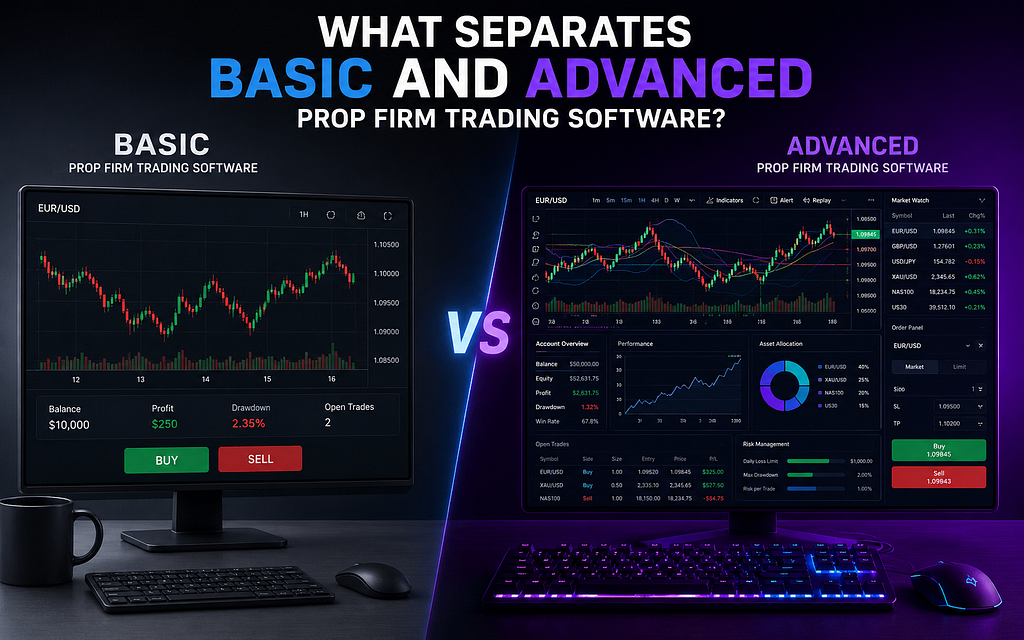
What Separates Basic and Advanced Prop Firm Trading Software?
Prop firm trading firms have grown a lot over the last few years. You have probably noticed more people talking about funded accounts and more businesses trying to build platforms around them.
The software in a prop firm handles everything needed to run the business. It checks trader performance, tracks challenges, processes payouts, and manages risk.
This is why many businesses now look for prop firm solutions that can handle all of these functions in one place.
But here is the thing, not all prop firm trading software works the same way. Some platforms only cover the basics, while others are built to manage the full process in one system.
If you understand that difference, it becomes much easier to decide what you actually need before you build or buy one.
Basic vs Advanced Prop Firm Trading Software: Key Differences Explained
Account tracking and monitoring
Basic prop firm trading software focuses on simple account tracking. It shows key details like profit, loss, drawdown, and full trade history. Most of the time, this information is updated after a trade is closed or with a short delay. This means you are usually looking at past activity instead of what is happening right now.
Advanced systems work in real time. Every trade action is recorded as it happens, including entry price, exit price, lot size, and risk exposure. This gives prop firms a live view of what is happening inside each account instead of waiting for updates later.
Rule enforcement system
In basic systems, trading rules such as daily loss limits, drawdown limits, or profit targets are usually checked after trades are completed or through simple condition checks. This can sometimes delay action if a rule is broken.
Advanced prop firm trading software uses a rule engine that works while trading is happening. It checks rules instantly. If a trader breaks a rule, the system can alert the user or even stop further trading on the account right away. This reduces the need for manual checking and makes rule enforcement faster.
Risk monitoring approach
Basic systems usually use fixed risk limits for each account. These limits do not change based on live trading conditions. They stay the same until someone manually updates them.
Advanced platforms monitor risk continuously. They track open trades, account balance changes, and overall exposure across multiple accounts at the same time. This helps prop firms understand total risk in real time instead of after the fact.
Data handling and reporting
Basic software provides simple reports such as daily profit summaries or trade history logs. These reports are useful but limited in detail.
Advanced systems go deeper into data. They show trading patterns, performance breakdowns, and risk behavior over time. This helps prop firm operators understand how accounts are being used and how traders are performing in different conditions.
System structure
Basic prop firm trading software is usually built as a simple dashboard. It focuses mainly on displaying information with limited backend processing.
Advanced platforms are built with multiple connected parts. These include trade processing, rule checking, account tracking, and reporting systems working together. This structure allows them to handle more accounts and more activity at the same time.
Here I have attached a table view for better understanding in one glance.
Key Features of Modern Prop Firm Trading Software Platforms
Modern prop firm trading software comes with features that help firms manage trading accounts in a more organized way. These features are not just about showing data, but about helping the entire system run in a clear and controlled way. Lets see what include in this
Multi Challenge Program Support
Modern prop firm trading software supports different evaluation models like one step, two step, and instant funding. All programs can run from a single system.
Real Time Risk Engine
A real time risk engine monitors funded accounts continuously. It tracks drawdown limits and account health and reacts when rules are broken.
White Label Customization
Many platforms offer white label options. This allows firms to fully brand the software with their own name and design while using the same backend system.
Trader CRM and Support Tools
These tools help manage traders, review activity, handle disputes, and manage support requests from one dashboard.
Analytics and Reporting
Reporting tools show challenge results, payouts, trader activity, and performance trends. This helps firms understand business growth and make decisions.
How to Choose the Right Prop Firm Trading Software for Your Needs
→ Start by looking at what your firm actually needs today. If you are running a small setup with one evaluation type, you do not need a complex system at the beginning.
→ Check if the software supports the trading models you plan to offer. Some platforms only support standard two step challenges, while others include one step programs or instant funding options.
→ Look closely at the risk management system. Ask how drawdown limits and trading rules are applied and whether they can be adjusted for different account types.
→ Understand how payouts work. If everything is manual, it can slow down operations as your firm grows, so automated payout options can be important.
→ Make sure the platform supports MT4 or MT5, since most traders expect these trading terminals.
→ Review the reporting tools. You should be able to see challenge results, payouts, trader activity, and performance data in a clear and simple way.
→ Finally, request a demo so you can see how the system works for both traders and your internal team before making a decision.
Final Words
Choosing prop firm trading software is not just about features on a list. It is about how the system fits the way you want to run your firm.
Some platforms keep things simple and focus on basic account handling. Others are built to support more structured operations where everything from rules to payouts is managed in one place.
If you are building or running a prop firm, take time to think about how the software will support your daily work and future plans. A clear understanding at this stage can help you avoid switching systems later.
What Separates Basic and Advanced Prop Firm Trading Software? was originally published in Coinmonks on Medium, where people are continuing the conversation by highlighting and responding to this story.