
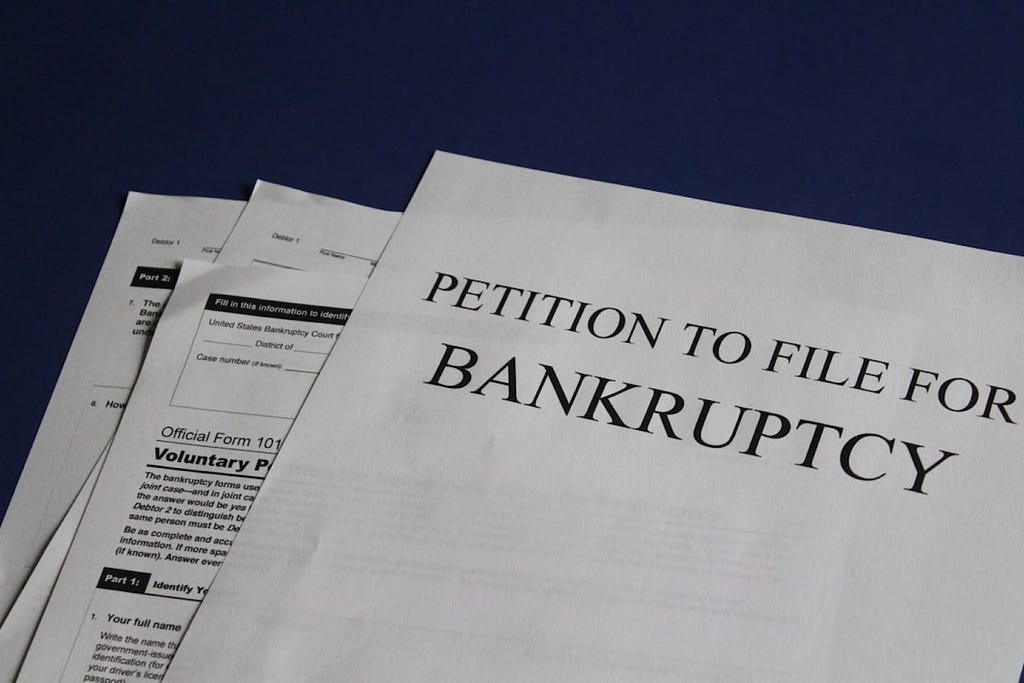
Photo by Melinda Gimpel on UnsplashThe legal fine print most investors ignore – until it costs them everything.
Disclaimer: This article is intended for educational purposes only and does not constitute legal advice. Bankruptcy and insolvency proceedings are complex, highly fact-specific, and vary significantly across jurisdictions. The discussion below is designed to help investors understand why legal rights, property ownership, and exchange terms of service matter when dealing with centralized crypto platforms (CeFi).
Millions of people lost access to their crypto during the 2022 – 2023 exchange collapses. Many are still waiting to find out how much – if anything – they will get back.
When Celsius, FTX, Voyager, BlockFi, and Genesis collapsed in quick succession, the news coverage focused almost entirely on the drama: the founders, the fraud allegations, the missing billions.
However, for ordinary investors sitting at home watching their account balances freeze, a quieter and far more personal question is on their mind.
Is this still my crypto?Or did I just become a creditor of a bankrupt company?
The answer, it turns out, depends on factors most investors never think about when they sign up for a crypto platform and by the time those factors matter, it is usually too late to do anything about them.
How Did We Get Here?
The platforms that collapsed between 2022 and 2023 shared a familiar set of problems.
They lent customer assets to borrowers who could not repay them. They promised yields that required ever-rising markets to sustain. They kept insufficient liquid reserves to meet mass withdrawal requests. Such that when crypto prices dropped sharply, the liquidity dried up almost overnight.
Customers who attempted to withdraw funds encountered unexpected account freezes, which were followed by subsequent bankruptcy filings.
Understanding why these platforms failed matters but for anyone who had funds on them, they want to know what happens to the assets in their account when a platform goes bankrupt.
What Happens During Bankruptcy?
Although terminology differs across jurisdictions, bankruptcy generally refers to a situation where a company can no longer meet its financial obligations.
Once insolvency proceedings begin, a court or appointed administrator typically assesses the company’s assets and liabilities to determine how creditors will be repaid.
At this stage, customers often discover that their legal position may differ significantly from what they assumed when they deposited assets.
The Question That Determines What Happens to Your Crypto
Here is an inquiry that receives almost no attention during bull markets but dominates every crypto bankruptcy proceeding:
Are you the owner of the assets, or are you merely a creditor of the platform?
Most people assume that depositing crypto onto an exchange is roughly equivalent to putting valuables in a safe deposit box.
The bank holds the box, but the contents are yours. You can take them back whenever you want. Legally, however, the relationship may work very differently.
If you retain ownership
The exchange is acting as a custodian.
Your assets remain legally yours. They are supposed to be kept separate from the company’s own money. If the exchange goes bankrupt, those assets should not be available to pay the company’s other debts.
You have a proprietary claim – meaning you are reclaiming something that belongs to you.
If you become a creditor
Something else has happened.
The legal title to your assets may have transferred to the exchange when you deposited them. You no longer hold a claim to specific crypto.
Instead, you hold an unsecured claim– essentially, a debt the company owes you.
During insolvency proceedings, you join a queue with everyone else the company owes money to. Recovery depends on how much is left in the estate after costs, secured creditors, and priority claims are settled.
In practical terms:
In the first scenario, you are trying to get your asset back.In the second, you are trying to get a portion of your asset back from a bankrupt company.
These are very different situations.
Why the Law Ultimately Determines Your Fate
Your classification into the first or second category is determined in part by what the law states.
The question is:
Does the law recognize Crypto as property in the first place?
In jurisdictions that do, courts can recognize proprietary rights in crypto. That means they can draw a clearer line between your assets and the exchange’s assets, enforce custody arrangements, and protect users with genuine ownership claims.
In jurisdictions where the law has not yet caught up with digital assets, the position is gloomier. Courts may struggle to apply traditional property concepts to tokens on a blockchain. Users may find that their ownership rights are less certain than they assumed – and less protected during insolvency.
This is not an abstract legal debate.
It is the difference between getting your assets back and joining a long line of creditors.
The Document Everyone Ignores (Until It Is Too Late)
There’s an important document that can have a big impact on your legal standing, and that’s the platform’s terms of service.
Almost nobody reads it. Signing up for a new exchange typically involves scrolling past several screens of dense legal text and tapping “Agree”. That moment, though ordinary, is when your rights are establish.
The terms of service can determine who legally owns deposited assets;whether the platform is acting as a custodian or taking ownership of deposits;whether the platform can lend your assets to third parties;whether your assets can be rehypothecated – that is, pledged as collateral for the platform’s own borrowing;whether your assets are held separately from company funds; what happens to your claims if the platform becomes insolvent; and which country’s laws govern any dispute.
During the FTX and Celsius bankruptcies, courts spent considerable time examining these documents. In some cases, the terms made clear that customers had transferred ownership of their assets to the platform.
Users who had assumed they were safely storing their own crypto discovered they were actually unsecured creditors of a company that no longer existed in any meaningful financial sense.
Reading the terms of service before depositing significant assets is basic due diligence.
Segregated vs. Commingled: How Your Assets Are Actually Held
Even where a platform claims to act as a custodian, the practical question is how it actually holds customer assets.
Under a segregated model – customer assets are kept separate from the company’s own funds and clearly identifiable as belonging to specific users. If the company goes bankrupt, administrators can identify which assets belong to customers and return them, subject to legal process.
Under a commingled model —customer assets are pooled together – sometimes mixed with the company’s own funds. When insolvency hits, it becomes much harder to establish who owns what. Claims become tangled. Recovery becomes slower and often smaller.
This distinction was central to several of the major crypto bankruptcies. In some cases, customer and company funds had been mixed so thoroughly that untangling them became a years-long process.
The Gatecoin Case: A Lesson From Hong Kong
A clear example of how these issues are addressed in court can be seen in Hong Kong, where a legal dispute arose after the collapse of the Gatecoin exchange, leading to an important question.
Were customer crypto holdings kept on trust for users, or did they form part of the company’s own assets available to creditors?
The case turned not on the technology involved but on how the legal relationship between the platform and its users was characterized – what the terms said, how assets were held, and what legal framework applied.
The outcome underscored a lesson that has since been repeated across multiple jurisdictions: in a crypto insolvency, the legal structure of the arrangement often matters far more than the underlying technology.
Investors who understood this beforehand were better positioned than those who did not.
Five Questions to Ask Before You Deposit Anything
If you are using or considering a centralized crypto platform, these are the questions worth finding answers to before you deposit significant funds:
Who legally owns the assets after I deposit them – me, or the platform?Does the platform explicitly act as a custodian, or does it take ownership of deposits?Are customer assets segregated from company assets, and can I verify this?Can the platform lend or rehypothecate my assets without my explicit consent?Which jurisdiction’s laws govern the relationship, and how mature is the legal framework for digital assets there?
These questions are not always easy to answer. Some platforms make this information clear; many do not. However, asking them – and looking carefully at the terms – is the most direct way to understand your actual legal position before something goes wrong.
The Lesson Most Investors Learned Too Late
The lasting lesson from the wave of crypto insolvencies is not that exchanges can fail. Businesses fail in every industry. Banks have failed. Brokerages have failed.
The real lesson is that an enormous number of investors discovered their legal position only after the collapse had already happened.
By then, the terms had already been agreed to. The assets had already been deposited. The insolvency proceedings had already begun.
What many users learned – often too late – was that their fate depended on factors they had rarely considered when opening an account: the laws of the relevant jurisdiction, the platform’s terms of service, and whether the legal system recognized proprietary rights in digital assets.
Understanding who legally owns your assets, how they are held, and what rights you possess during insolvency may ultimately be just as important as any investment decision you make. When a crypto exchange files for bankruptcy, the question that ultimately determines your outcome is not how much crypto you had in your account.
It is whether the law still considers any of it yours.
If you enjoy analytical commentary on digital asset regulation, crypto markets, and emerging financial technologies, consider subscribing to my newsletter where I share additional research, commentary, and industry insights.
[https://samuel-ayodeji.kit.com/profile]
When a Crypto Exchange Goes Bankrupt: What Happens to Investors? was originally published in Coinmonks on Medium, where people are continuing the conversation by highlighting and responding to this story.