
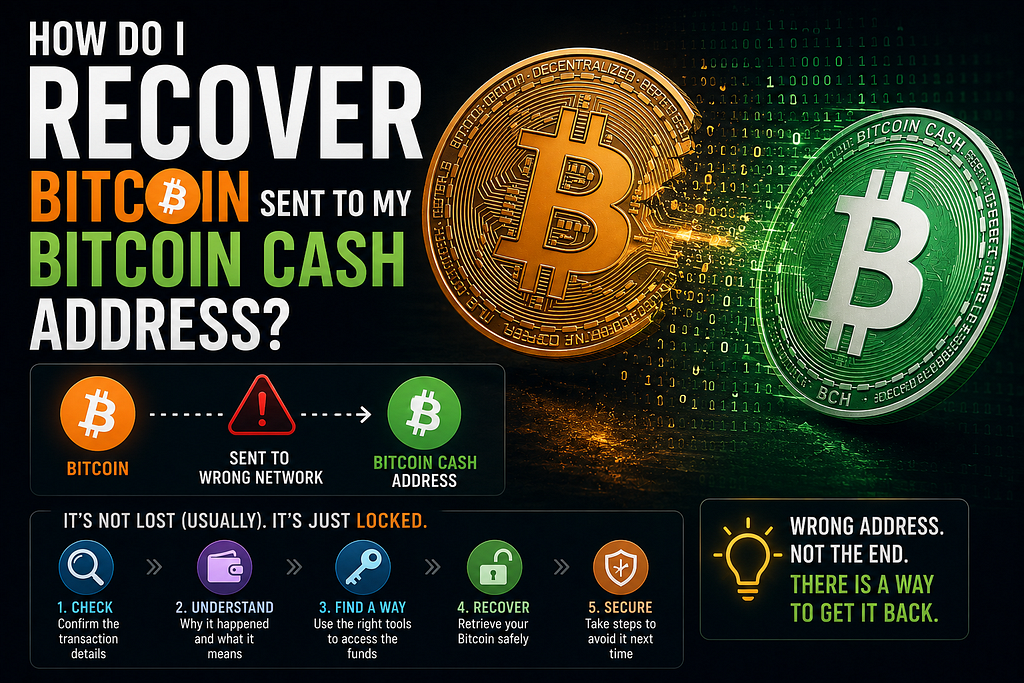
You didn’t lose it. You just don’t know where to look yet.
How Do I Recover Bitcoin Sent To My Bitcoin Cash Address?
You copied an address. You double-checked the first four characters. You hit send.
Then your stomach dropped.
The address you sent your Bitcoin to wasn’t a Bitcoin wallet. It was your Bitcoin Cash address — and now you’re staring at a blockchain explorer, watching your BTC disappear into what feels like a void. Your hands are sweating. You’re Googling “recover Bitcoin sent to Bitcoin Cash address” at 1 a.m., hoping for a miracle.
Here’s the miracle: your Bitcoin is not gone.
This is one of the most common and least understood mistakes in the crypto world. And thanks to the cryptographic relationship between Bitcoin and Bitcoin Cash — and tools like Exodus Wallet’s built-in Sweep for Bitcoin feature — recovering your funds is not only possible, it’s something you can do yourself, in under 15 minutes, without paying a single satoshi to a scam out there.
This guide will walk you through exactly what happened, why your funds are technically recoverable, and the precise steps to get them back — starting with the most effective method available to everyday users right now.
Why This Mistake Happens More Often Than You Think
Before diving into recovery, let’s talk about why Bitcoin and Bitcoin Cash addresses look so eerily similar — because understanding this is the key to understanding why recovery works.
In August 2017, Bitcoin underwent one of the most significant events in its history: a hard fork. A group of developers and miners disagreed over how to scale the Bitcoin network and split off to create Bitcoin Cash (BCH). The two networks are entirely separate blockchains, but here’s the critical detail that trips up millions of users every year:
At the time of the fork, Bitcoin Cash inherited Bitcoin’s exact same address format.
Legacy Bitcoin addresses start with “1” (e.g., 1A2B3C4D…). Early Bitcoin Cash addresses used the exact same format. They are visually indistinguishable. Unless you’re running an address validation tool that checks network compatibility, there is no obvious way to tell a BTC address from a BCH legacy address just by looking at it.
BCH eventually introduced a new address format — the CashAddr format — which starts with bitcoincash:q… or just q…. This was specifically designed to prevent cross-chain confusion. But millions of wallets, exchanges, and users still use legacy addresses, and the confusion persists to this day.
The result? A scenario where you can accidentally send BTC to a BCH wallet — and the transaction will be confirmed on the Bitcoin blockchain, deducted from your BTC balance, and land at an address that also exists on the Bitcoin Cash blockchain. Your Bitcoin sits there, perfectly intact, waiting for the holder of the correct private key to claim it.
That private key? You have it.
The Technical Truth: Why Your Bitcoin Is Recoverable
Here is the core concept you need to understand, and it’s actually elegant once you see it.
Bitcoin and Bitcoin Cash derive wallet addresses using the same elliptic curve cryptography (ECDSA). When you create a wallet — whether on Exodus, Trust Wallet, Coinbase, or any non-custodial platform — the wallet generates a seed phrase (12 or 24 words). From that seed phrase, it derives a private key. From that private key, it derives a public key. From that public key, it derives a wallet address.
Because BTC and BCH use the same derivation algorithm, the same private key controls the same address on both blockchains.
In plain English: your BCH wallet address and a BTC address derived from the same private key are cryptographically identical twins. When you sent BTC to your BCH address, you sent it to an address that your private key controls — just on the Bitcoin blockchain instead of the Bitcoin Cash blockchain.
You own the private key. Therefore, you can claim the BTC sitting at that address.
This is not a glitch or an exploit. This is simply how the math works.
The only question is: how do you access those funds? That’s where the Exodus Wallet Sweep for Bitcoin feature comes in.
Method 1: Recover Your Bitcoin Using Exodus Wallet’s Sweep Feature (Recommended)
Recover Your Bitcoin Using Exodus Wallet
Exodus Wallet is one of the most user-friendly non-custodial wallets in the crypto space, and it includes a powerful built-in feature that makes this exact recovery scenario straightforward: Sweep for Bitcoin.
This feature allows you to import a private key from an external wallet and sweep any BTC sitting at that address directly into your Exodus wallet. It’s designed precisely for situations like this — where BTC is stranded at an address controlled by a private key from another wallet or network.
Here’s how to use it, step by step:
Step 1: Identify Where Your BCH Address Lives
First, you need to identify which wallet holds the Bitcoin Cash address you accidentally sent BTC to. This could be:
A software wallet (Exodus, Trust Wallet, Coinbase Wallet, Electron Cash)A hardware wallet (Ledger, Trezor, Coldcard)An exchange-hosted wallet (note: if your BCH address is hosted on an exchange like Binance or Kraken, skip to the section on custodial wallets — the process differs significantly)
If your BCH address is in a software wallet you control, you have everything you need to proceed.
Step 2: Export the Private Key for Your BCH Address
You need the private key (or the WIF — Wallet Import Format key) for the specific Bitcoin Cash address that received the BTC. This is different from your seed phrase, though your seed phrase can be used to derive it.
How to export your private key varies by wallet. Here are the most common:
Exodus Wallet: Navigate to the BCH wallet → Settings → Export Private Keys. Exodus will show you the private key for your BCH address directly.Trust Wallet: Go to Settings → Wallets → Select your BCH wallet → Show Secret Phrase. You may need a third-party tool to derive the specific private key from the seed.Electron Cash: Go to Wallet → Private Keys → Export.
Security Warning: Your private key is the master key to your funds. Never share it with anyone. Never enter it on a website you don’t fully trust. Never send it via email, screenshot it, or store it in a cloud document. Treat it with the same care you’d give a signed blank check for your entire net worth.
Once you have your BCH private key in WIF format (it usually starts with a “5”, “K”, or “L”), you’re ready for the recovery step.
Step 3: Open Exodus and Access the Sweep for Bitcoin Feature
Launch Exodus Wallet on your desktop (the sweep feature is available on the desktop application).
From the main dashboard, navigate to the Bitcoin (BTC) walletClick the three-dot menu (⋮) in the top-right corner of the BTC wallet viewLook for “Move Funds” or navigate to Help > Developer MenuSelect “Sweep Private Key” or “Sweep for Bitcoin” from the available options
This opens a simple input field where you can paste the WIF private key you exported in Step 2.
Step 4: Enter the Private Key and Initiate the Sweep
Paste your BCH WIF private key into the sweep input field.
Exodus will:
Scan the Bitcoin blockchain for any BTC associated with that private keyDisplay the recoverable balanceAsk you to confirm the sweep transaction
Once confirmed, the BTC will be sent from the stranded address directly into your Exodus BTC wallet, minus a small network transaction fee. The entire process typically takes 10–30 minutes depending on network congestion.
That’s it. Your Bitcoin — once thought lost — is back in your wallet.
Method 2: Recover Using Electrum (For Advanced Users)
If you’re comfortable with a slightly more technical workflow, Electrum is another powerful option for BTC recovery.
Download Electrum from electrum.org (always verify the signature)During wallet setup, choose “Import Bitcoin addresses or private keys”Paste your WIF private key when promptedElectrum will scan the blockchain and display any BTC balance at that addressOnce the wallet loads, simply send the funds to your main BTC address
Electrum is one of the oldest and most trusted Bitcoin wallets in existence, with a track record going back to 2011. Its sweep/import feature is battle-tested and reliable.
Method 3: If Your BCH Address Is on a Custodial Exchange
If the Bitcoin Cash address you accidentally sent BTC to was provided by a custodial exchange (Coinbase, Binance, Kraken, Bybit, etc.), the recovery process is different — and significantly more complex.
With custodial exchanges, you do not control the private keys. The exchange does. This means you cannot personally sweep the funds. Your only path forward is to:
Contact the exchange’s support team immediately: Time matters. Provide the exact transaction hash (TXID), the sending address, the receiving BCH address, and the amount.Explain clearly that you sent BTC to a BCH deposit address on their platform: Many major exchanges have an internal process for handling cross-chain recovery.Be prepared to verify your identity: For security and compliance reasons, exchanges will require full KYC verification before crediting recovered funds.Expect a fee: Most exchanges charge a cross-chain recovery fee, typically ranging from $50 to $200 or a percentage of the recovered amount.Be patient: This process can take days to weeks, depending on the exchange’s workload and internal policies. Reach out to Mintonfin Support if you need some guidance.
Binance, Coinbase, and Kraken all have documented cross-chain recovery processes. Always use official support channels and don’t engage with just any third-party “crypto recovery services” that contact you via social media — most are scams targeting people in exactly your situation.
Prevent This From Ever Happening Again
Now that you’ve recovered your funds — or are in the process of doing so — here are the habits that will ensure you never have to go through this again.
1. Always verify addresses using a blockchain explorer before sending large amounts: Paste the destination address into blockchair.com and confirm it shows as a Bitcoin address, not a Bitcoin Cash address.
2. Use the CashAddr format for all Bitcoin Cash transactions: Modern BCH wallets default to the bitcoincash:q… address format, which is visually distinct from BTC addresses. If someone gives you a BCH address that starts with “1”, ask them for their CashAddr format address instead.
3. Send a test transaction first: For any transfer over $100, always send a small test amount (the minimum allowed) first. Confirm it arrives. Then send the remainder.
4. Use wallet-native address book features: Both Exodus and most other major wallets allow you to save frequently used addresses with labels. Save your BTC and BCH addresses separately, clearly labeled, to avoid future mix-ups.
5. Triple-check the network before initiating any send: “Copy-paste errors” and “wrong network” mistakes account for a staggering percentage of non-recoverable lost crypto. Slow down. The blockchain doesn’t have an undo button — but your own caution does.
Frequently Asked Questions
Can I recover Bitcoin sent to a Bitcoin Cash address if I don’t have the private key?
If you have your seed phrase (the 12 or 24 words), you can derive your private key using BIP39 tools (use it offline). If you have neither the seed phrase nor the private key, and the address belongs to a custodial exchange, contact that exchange’s support. If you have neither and the address was in a wallet you no longer have access to, recovery is unfortunately not possible through any legitimate means.
How long does the recovery process take?
Using Exodus’s Sweep for Bitcoin feature, the actual sweep takes 10–30 minutes once you confirm the transaction. The most time-consuming part is locating and exporting the correct private key, which can take 5–30 minutes depending on your wallet.
Will I lose any Bitcoin during the recovery process?
You will pay a small Bitcoin network transaction fee (typically a few dollars worth of BTC at normal network congestion). Your recovered BTC, minus this fee, will arrive in your wallet intact.
Does this work for Bitcoin sent to an Ethereum address or other chains?
No. The BTC-to-BCH recovery is possible because of the shared address format and cryptographic derivation method between Bitcoin and Bitcoin Cash specifically. Sending BTC to an Ethereum, Solana, or other non-Bitcoin-fork address is a different scenario with different (often much harder) recovery pathways. Always verify network compatibility before sending. Contact MintonFin support if you need guidance.
Is the Exodus Sweep for Bitcoin feature safe?
Yes. Exodus is a well-established, non-custodial wallet with a strong security track record. The sweep feature processes everything locally — your private key is never transmitted to Exodus’s servers. That said, always download Exodus from the official website (exodus.com) and verify you’re using the latest version.
What if the BCH address received both BCH and BTC? Do I lose my BCH?
No. Sweeping the BTC using your private key does not affect your BCH balance on the Bitcoin Cash blockchain. The two transactions exist on entirely separate networks. Your BCH remains accessible through your BCH wallet as normal.
The Bottom Line
Sending Bitcoin to a Bitcoin Cash address feels catastrophic in the moment. The confirmation notification, the sinking realization, the frantic Googling — it’s a genuinely awful experience. But here’s what separates this mistake from truly unrecoverable situations: your private key exists, the address is valid, and the funds are there.
The Exodus Wallet Sweep for Bitcoin feature is one of the best tools the crypto ecosystem has produced for exactly this kind of cross-chain recovery scenario. It’s built into a wallet millions of people already use, it requires no technical background, and it works.
Your Bitcoin isn’t gone. It’s waiting.
Export that private key, fire up Exodus, and take it back.
If this article helped you recover your funds, consider leaving a clap — it takes two seconds and helps other people in this exact situation find this guide when they need it most. You were searching for this answer once. Someone else is searching right now.
How Do I Recover Bitcoin Sent To My Bitcoin Cash Address? was originally published in Coinmonks on Medium, where people are continuing the conversation by highlighting and responding to this story.