
Image by Ideogram
Artificial intelligence (“AI”) and Bitcoin are arguably two of the most transformative technologies of this century. AI is like having your own assistant who can be an expert in just about any subject. Bitcoin has enabled faster settlements of payments free of censorship.
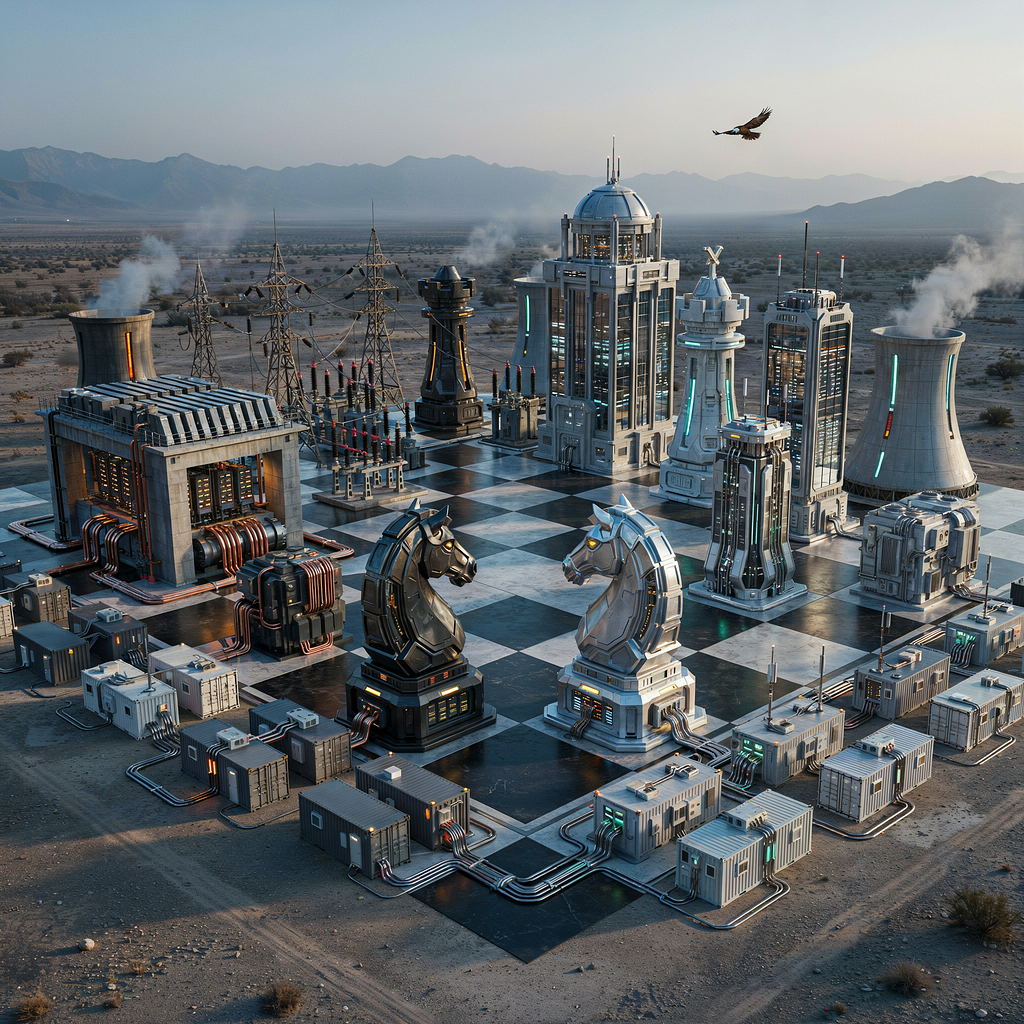
However, both technologies require an enormous amount of computational resources. As both industries grow, they will increasingly compete against each other for those same resources.
Bitcoin mining was designed to react to external forces like a self-righting ship. Mining rewards halve every few years as the scarcity of remaining coins increases. The difficulty adjusts to ensure a block is produced approximately every ten minutes regardless of the hash rate.
The problem is that efficient mining is only possible when the cost of production is lower than the expected value of the rewards. When electricity is too expensive, a miner may find that they are spending more money to acquire new coins than the realised value of those coins.
In the early days of Bitcoin, a laptop could be used to mine because of a low hash rate in the network. As bitcoin became more valuable, miners adapted by acquiring better hardware that was more specialised. Eventually, it was no longer economically viable to mine using a central processing unit (“CPU”) because graphical processing units (“GPU”) outperformed them significantly. If you are trying to mine bitcoin with a laptop these days then you are really just wasting electricity. Even GPUs started to become obsolete as “Application-Specific Integrated Circuits” (“ASIC”) more efficient than GPUs were introduced.
Companies were established that built data server farms in remote places with access to cheap electricity. The hash rate increased significantly but the value of bitcoin also increased so the model was very profitable for a time.
That model was really only profitable when electricity was cheap and bitcoin prices were in the six digit range. With current prices, those same companies are struggling to make a profit and have had to start selling their bitcoin reserves which further pushes down prices.
Just a few years ago, the AI compute boom started. At first it felt more like a novelty. AI could be used to research topics, write documents, or provide feedback on systems and designs. Early AI was terrible at writing code, mostly because it was trained using the publicly available code on the internet where that code was not necessarily well written.
AI has come a long way since then and its ability to write software has improved considerably. It is not perfect and it needs guidance, but if used correctly it can reduce development costs.
In that time, there has been a considerable expansion of data centres. Firms are continuously scouting for new sites to build data centres on land that is cheap but has access to abundant electricity and water; the water is required for cooling the infrastructure that would otherwise overheat and fail. There has been so much expansion that some communities are starting to push back against these data centres and some companies are discussing hosting these centres in space.
AI largely relies on GPU so the AI boom has significantly increased demand for GPU capacity. While the Bitcoin network may have data centres running ASICs, a good portion of them are still using GPUs. This means that AI and Bitcoin are both reliant upon GPU capacity, cheap electricity, and water.
This is great for anyone running this infrastructure. Two emerging technologies with a lot of money behind them are both competing for the same resources. But all resources have their limits. There may currently be a glut of supply that satisfies both fields but soon the demand could outstrip supply and it is likely Bitcoin that will suffer.
Image by Ideogram
Bitcoin mining does not have a guaranteed rate of return, it has an expected value of return. It is like playing the lottery. The more lottery tickets you buy, the more likely you are going to win, except sometimes the amount you win could be less than what you paid for the tickets.
AI on the other hand, pays regardless of the outcome. Large language models require a lot of computing power and they have to pay for it, there’s no competition for rewards. There may be competition between providers to maximize their revenue but they all still get paid for all their computing time.
Obviously, if a significant population of miners switched to AI then the difficulty would adjust to ensure block times still average around 10 minutes. But the reduced hash rate would also mean a reduction in decentralisation. This means that the security of the network could be affected.
Decentralisation contributes to Bitcoin security because it makes it prohibitively expensive to conduct a 51% attack. But if the hash rate is reduced because of large migrations to AI then so does the cost of such an attack.
I am not suggesting the imminent failure of Bitcoin. I do not think that it could ever drop to a zero price because if it did drop that much then it would probably become economically feasible to mine it with a laptop again. But this could mean an upper limit on the value of bitcoin. An equilibrium may be reached between the cost of computing resources and the value of the rewards.
This could easily change in the future but it would require two things.
The first requirement would be an unlimited cheap form of power. Fusion power would probably be the best candidate although more efficient conversion of solar or wind power could probably do.
The second requirement would be an abundance of cooling capabilities. There is only a limited supply of fresh water on the planet and people need it to survive (not just for drinking but also to produce food and manage sanitation). Salt water is not useful because it can be extremely corrosive and would mean higher maintenance costs. Gray water may be a good candidate but that would require building new infrastructure.
This issue is only relevant to blockchains that use proof of work as their consensus mechanism. Running a validator node on Ethereum does not rely on cheap electricity or large data centres. Bitcoin uses proof of work and always will use proof of work for its consensus; there are no plans to change this.
Electricity may be relatively cheap at the moment, but that can easily change. The rare earths used to build the digital infrastructure are another limited resource that can also require a lot of electricity and water for its production.
AI has become a serious consumer of energy and infrastructure. Although Bitcoin’s design enables it to adapt through the difficulty adjustments, it would still be competing against AI for the same resources. The real competition may not even be for computation but for electricity.
The question that needs to be answered is whether society values digital scarcity over increased productivity.
Artificial Intelligence and Bitcoin are Competing for the Same Resources was originally published in Coinmonks on Medium, where people are continuing the conversation by highlighting and responding to this story.