
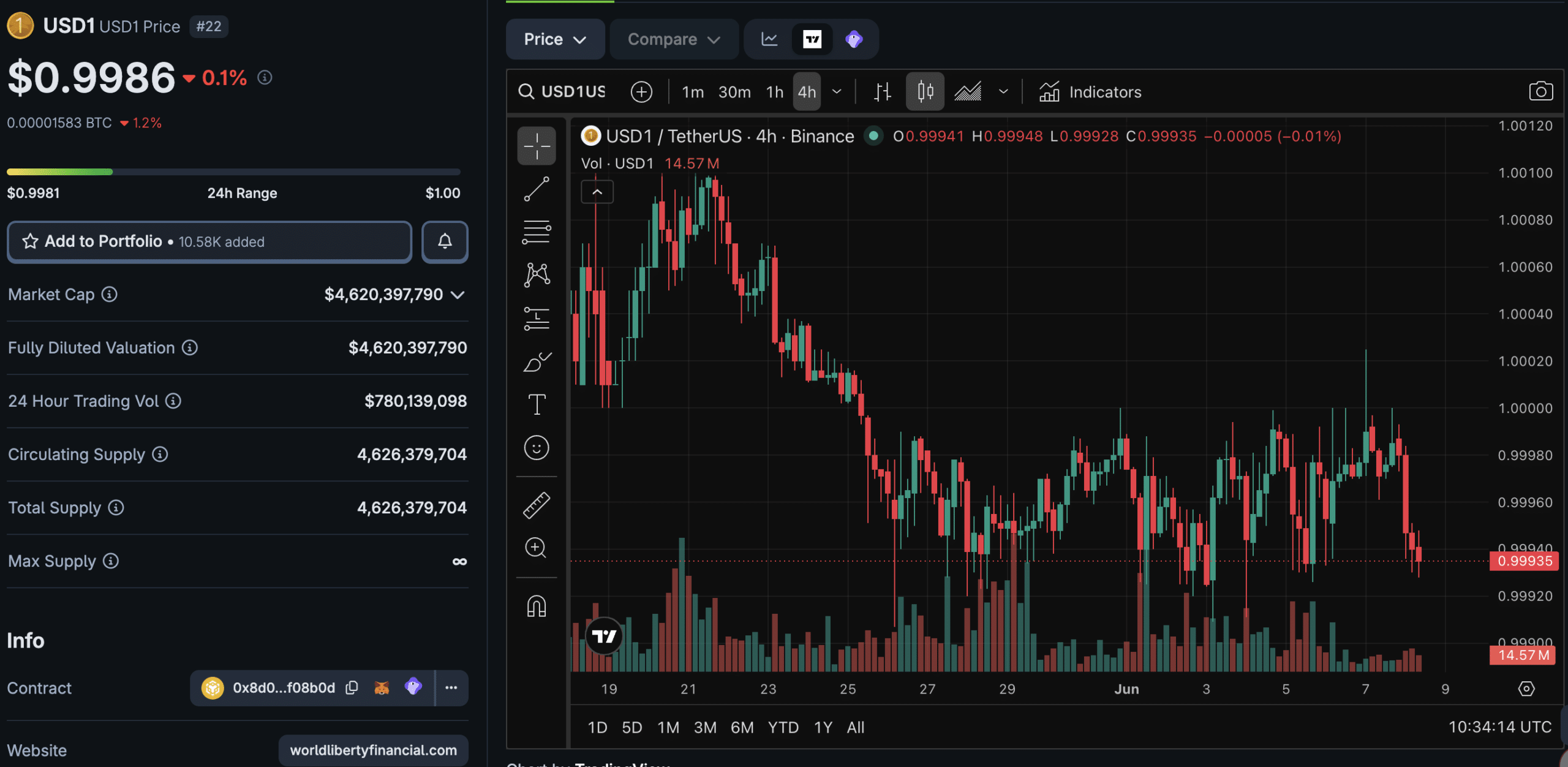
Justin Sun and his HTX exchange delisted the USD1 stablecoin issued by World Liberty Financial on June 7, 2026, after WLFI froze multiple HTX on-chain addresses in what it described as a sanctions compliance review.
All USD1 holdings on HTX are being automatically converted to Tether (USDT) at a 1:1 ratio, and HTX has warned it will pursue legal action if the freeze is not reversed.
JUSTIN SUN-LINKED HTX DELISTS TRUMP FAMILY’S USD1
HTX, a crypto exchange reportedly owned by Sun, has delisted $USD1 after claiming Trump’s World Liberty Financial froze some of its on-chain addresses.
HTX says it may pursue legal action if the freeze is not reversed.
Sun… pic.twitter.com/Cf1FRgiK2s
— Nehal (@nehalzzzz1) June 8, 2026
Here is the central tension this article unpacks: a dispute between two powerful crypto entities, Sun’s HTX and the Trump family-linked WLFI, has landed squarely on ordinary users who held a Trump stablecoin on an exchange they had nothing to do with in either party’s legal war.
As this news dropped, Bitcoin was trading around $63,000, up +0.5% on the day after a brief weekend rally from under $60,000. Trading volume has also been boosted, sitting at $35.3Bn in the past 24 hours.
EXPLORE: Best Meme Coin ICOs to Invest in 2026
The USD1 Stablecoin Freeze and Delist: What Actually Happened
Think of it like this: imagine a landlord and a tenant have a bitter legal fight, and in the middle of it, the landlord changes the locks on an entire apartment building – affecting every resident, not just the tenant they’re suing. That is roughly what happened here.
WLFI, the platform behind the USD1 stablecoin, used admin-level controls baked into its smart contracts to freeze specific HTX on-chain wallet addresses.
A smart contract freeze works exactly like it sounds: the issuer flips a switch, and those wallet addresses can no longer move, transfer, or withdraw the tokens held inside them. The frozen addresses belong to HTX as an exchange, but the assets inside represent real user balances.
HTX stated that its addresses were locked “without sufficient prior communication, adequate contractual or legal grounds, transparent disclosure, or adherence to due process.”
In response, it halted all related trading pairs, WLFI/USDT, USD1/USDT, BTC/USD1, and ETH/USD1, and announced the automatic conversion of user USD1 balances to Tether at a 1:1 ratio. HTX framed the crypto freeze response as a user protection measure, though users had no vote in the decision.
WLFI, which counts US President Donald Trump and his sons Donald Jr., Eric, and Barron as advisers, has not directly addressed whether HTX’s addresses were targeted. On June 4, the platform posted on X that “in light of recent sanctions updates, World Liberty Financial maintains risk-based sanctions compliance controls“.
EXCLUSIVE: Earn $10 USDC Via Binance Sign-Up
The Justin Sun–WLFI Dispute: Why This Fight Escalated Here
The recent delisting of the stablecoin is part of an ongoing legal battle between Justin Sun and World Liberty Financial (WLFI) that began in early 2025. Sun was a major backer of WLFI, but disputes arose when he refused to make further investments, leading WLFI to block access to his digital assets worth $300–320M and threaten to burn his tokens.
In April 2026, Sun sued WLFI, claiming its actions were unjustified. WLFI responded with a defamation lawsuit in May, accusing Sun of false claims and violating token sale terms.
The situation escalated with UK sanctions on Huobi Global S.A. on May 26, 2026, over alleged support for Russia, prompting WLFI to freeze HTX-related addresses, claiming the sanctions justified their actions amid an already contentious dispute.
What This Means for USD1 Holders and HTX Users Right Now
Here’s the uncomfortable truth: if you held USD1 on HTX, your assets have already been moved without your explicit consent. That conversion may feel fine on paper. Tether is a well-established stablecoin, but it is a reminder that exchange custody means someone else controls your tokens.
Here is a breakdown by situation:
1. You currently hold USD1 on HTX. Your balance is being automatically converted to Tether (USDT) at a 1:1 ratio. You are not losing dollar value in the conversion, but the exact timing for completion has not been specified. Watch your account and confirm the conversion has settled before making any moves.
2. You hold USD1 on a different exchange. Your tokens are not directly affected by the HTX delisting. However, the precedent set here – that WLFI can freeze exchange-level addresses citing sanctions compliance is relevant to any platform listing USD1. Monitor whether other exchanges announce reviews of their USD1 or WLFI listings.
3. You are considering buying USD1 elsewhere. This dispute has surfaced a structural risk that every prospective USD1 buyer should understand: the stablecoin’s smart contracts contain issuer-level freeze functions. That means WLFI can restrict any wallet’s access to USD1 tokens at will. That is not a theoretical risk; it is documented behavior. A stablecoin that can be frozen by its issuer is a permissioned asset, not a censorship-resistant one.
The broader lesson applies beyond this specific Justin Sun and Trump stablecoin incident: centralized stablecoins, USD1, and most others, carry issuer risk that Bitcoin and other truly decentralized assets do not.
Retail users exploring regulated, lower-risk alternatives may want to review how products like Bitcoin ETFs provide exposure without the risks associated with a stablecoin issuer.
EXPLORE: Best Meme Coin ICOs to Invest in 2026
The post Justin Sun News: HTX Delists USD1 Stablecoin After Wallet Freeze Standoff appeared first on 99Bitcoins.