
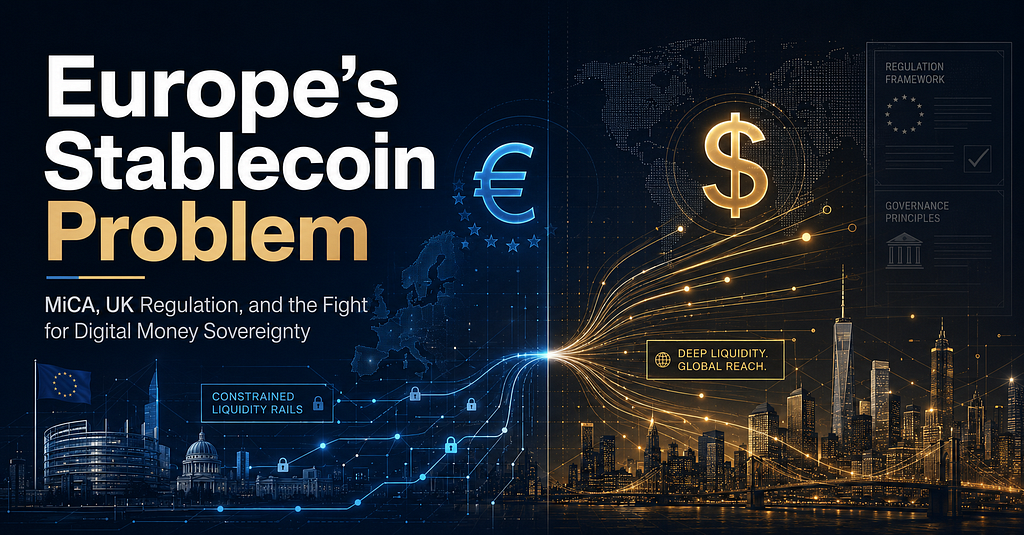
Europe’s Stablecoin Problem: Why MiCA, the UK, and Euro Liquidity May Decide the Future of Digital Money
Europe does not have a stablecoin regulation problem. It has an execution problem.
Europe’s stablecoin problem, framed as a strategic fight for digital money sovereignty.
That is the uncomfortable truth behind MiCA, behind the UK’s emerging stablecoin framework, and behind the widening gap between Europe’s policy ambition and the pace at which digital money is actually being built, distributed, and used. The rules are coming into focus. The market has already moved.
For years, Europe seemed to believe that the right regulation would be enough. Build the framework, lower the risk, and innovation will follow. But stablecoins have shown something harsher: liquidity, distribution, and utility move faster than policy. And when that happens, the default wins.
Right now, the default is the US dollar.
Christine Lagarde has been clear about the implications. Stablecoins are overwhelmingly dollar-denominated, and that is not just a market fact, it is a monetary one. The European Parliament has also treated this as a sovereignty issue, not a niche crypto debate. The concern is simple: if Europe does not create credible alternatives, it will end up importing someone else’s digital money architecture.
That is the real story.
The market has already chosen a default
The stablecoin market is no longer an experiment. It is part of the financial plumbing. Yet around 98% of stablecoins remain denominated in dollars, which tells you where the liquidity, trust, and usage are concentrated. That does not mean euro stablecoins are impossible. It means they begin from a weak position.
Europe is trying to respond. MiCA created a common regulatory framework for crypto-assets and stablecoins across the EU, while the UK is moving toward its own stablecoin rules and sandbox-led testing environment. But the gap is not framework design. The gap is speed.
Bruegel’s warning is worth taking seriously: if Europe stays too cautious, demand may simply move offshore, and digital dollarisation will intensify inside the bloc anyway. In that case, Europe would regulate the edge while losing the core.
Revolut and Deblock show the two paths
This is where the market becomes interesting.
Revolut represents the fintech-to-crypto path. It started as a consumer fintech, then expanded into banking, payments, and digital assets, and now sits close to the stablecoin frontier. In 2025, it reported roughly $6 billion in revenue and $1.7 billion in profit, and it has been selected for the FCA’s stablecoin sandbox. It also crossed $1.2 billion in cumulative on-chain stablecoin volume on Polygon, which is not a headline about hype; it is a signal about scale.
Deblock represents the opposite direction: crypto-native first, then moving toward everyday fintech utility. Its non-custodial design matters because it reflects a broader shift in the market: users increasingly want the convenience of fintech and the control associated with crypto-native infrastructure.
These two companies are not identical. But together they reveal the shape of the next market. The future of European financial infrastructure is likely to be a hybrid bank-grade trust on one side, crypto-native flexibility on the other.
That is a much bigger story than “neobank versus crypto app.”
Regulation will reshape infrastructure
MiCA and UK regulation will not just define what is allowed. They will shape who can build, who can distribute, and who can survive. Licensed issuers, compliant custodians, and regulated wallet providers will have a clearer path to scale. Purely offshore models will face more pressure on compliance, banking access, and user trust.
That is why founders should not read regulations as a ceiling. They should read it as a filter.
Europe does not need more theoretical debate about stablecoins. It needs a build environment that rewards serious infrastructure. If founders are willing to build inside the perimeter, and regulators are willing to support innovation without relaxing standards, Europe can still create a credible digital-money stack. If not, the market will route around it.
The same logic applies to payments. The next battle is not only about issuance. It is about settlement, treasury, merchant acceptance, and everyday utility.
Europe’s real stablecoin question
Europe should stop asking whether euro stablecoins can beat USDC and USDT globally.
They probably will not, at least not any time soon.
The better question is whether Europe can stop the digital economy from defaulting into dollar rails. Because if euro stablecoins remain too small, too fragmented, or too slow to scale, then the market will keep using dollar stablecoins even when the activity is happening inside Europe.
That is why the debate is really about sovereignty.
Not the old, abstract kind. The practical kind.
Who controls the settlement? Who captures liquidity?
Who sets the default currency of digital commerce?
Those are the questions that matter.
The Middle East changes the equation
The Middle East deserves a serious section in this debate because geopolitics affects digital money faster than most people admit.
A prolonged Iran war or broader regional conflict can increase volatility, weaken risk appetite, and push capital toward safer, more liquid assets. In some moments, that can help stabilise borderless digital instruments. But in practice, it often strengthens the USD-linked side of the market, because the dollar still sits at the centre of global liquidity.
For Europe and MENA, that matters in two ways.
First, conflict can slow founder confidence and make capital more selective. Second, it can accelerate demand for portable settlement rails, but if Europe has not built enough euro-native infrastructure, that demand will still flow into dollar stablecoins.
So geopolitics does not just create risk. It can hard-code the wrong default.
The global comparison
The United States is using stablecoins as an extension of dollar power, not just as a fintech product. Hong Kong is moving quickly, with formal stablecoin licensing and bank-led participation showing what implementation looks like when policy and market structure align. Singapore remains a benchmark for regulated digital finance. Europe, by contrast, has a strong policy base but slower execution.
That is the gap.
Not in regulation alone. In urgency.
What Europe must do
If Europe wants to preserve financial sovereignty in the digital future, three things have to happen at once.
Founders have to build products people actually use.
Banks and neobanks have to distribute those products at scale.
Regulators have to create trust without smothering the market.
If one of those fails, the whole system weakens. Europe can write the rules, but if no one builds inside them, the rules will not matter. Founders can build, but if they cannot operate in a regulated way, they will hit walls. The outcome Europe needs only happens when the three sides move together.
That is the part I think too many people still miss.
Europe is not in a stablecoin debate.
It is in a race to decide whether its digital-money future will be shaped by its own infrastructure or by someone else’s.
And at the moment, the market is still leaning in the wrong direction.
The next phase of European fintech will not be decided by regulation alone, or by innovation alone, but by whether Europe can turn policy into infrastructure before the default becomes permanent.
That is the real fight for digital money sovereignty.
Joseph Zammit is a senior marketing and strategy executive with 25+ years across fintech, crypto, and digital finance. He served as CMO at CrossFi and contributed to the design of Malta’s world-first DLT legislation framework. He writes on regulation, strategy, and the future of digital money.
Europe’s Stablecoin Problem: Why MiCA, the UK, and Euro Liquidity May Decide the Future of Digital… was originally published in Coinmonks on Medium, where people are continuing the conversation by highlighting and responding to this story.