
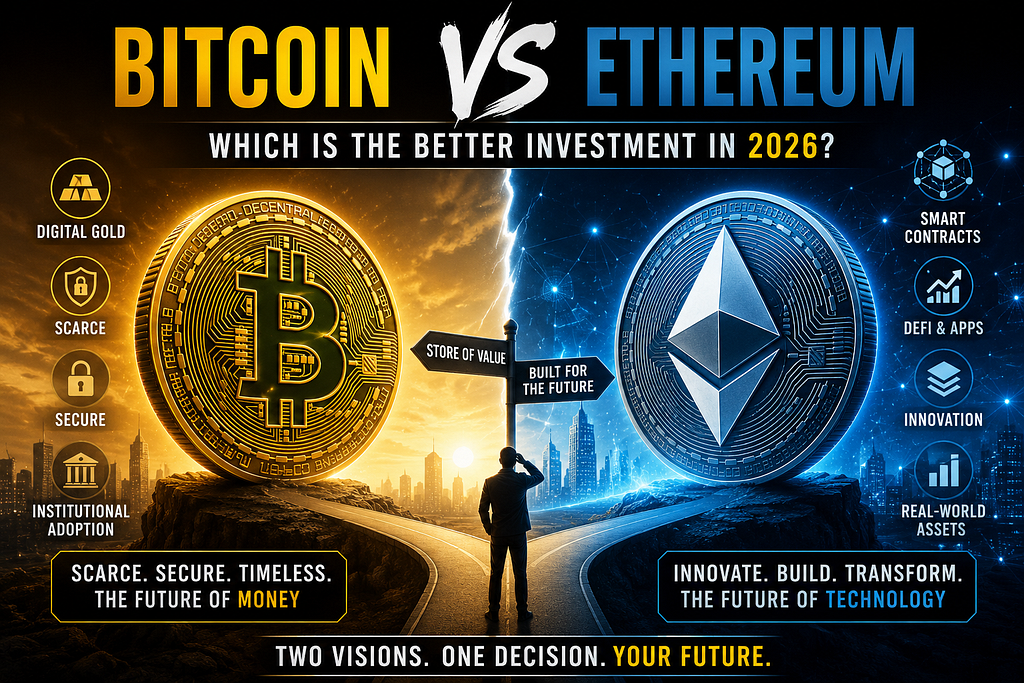
Bitcoin and Ethereum are giants in the crypto market, but putting them side by side as investments isn’t as easy as it looks. Sure, they’re both at the top, but they come from totally different backgrounds, and each one pushes a different vision of what blockchain should become.
Let’s start with Bitcoin. It first appeared in 2009, thanks to someone (or maybe a group) known as Satoshi Nakamoto. The idea was pretty radical: make money digital, peer-to-peer, free from banks and government control. These days you can still use Bitcoin for payments, but it’s honestly not built for speed or cheap transactions. Over time, it’s settled into a new role — people now treat it like “digital gold.” It’s become a way for investors to store value outside regular markets, prized for its scarcity and independence.
Ethereum, on the other hand, showed up a few years later in 2015, created by Vitalik Buterin and his team. Ethereum wasn’t about reinventing money, at least not primarily. Its big breakthrough was the smart contract — code that runs itself when certain things happen. Suddenly, the blockchain wasn’t just about sending coins back and forth. Now, you could build all sorts of things: lending systems, exchanges, stablecoins, insurance, games — the works. Ethereum turned blockchain into an entire digital economy.
This is a really important distinction. People compare Bitcoin to gold; Ethereum is more like the foundation for a new kind of digital society. They’re not trying to outdo each other because they’re not solving the same problem. Getting that is key if you’re thinking about investing in crypto at all.
Why do people like Bitcoin so much? There are three main reasons: scarcity, simplicity, and security. First, there’ll never be more than 21 million Bitcoins. Over 20 million are already out there, so what’s left is limited. Plus, Bitcoin’s built-in “halving” event — where the number of new coins minted gets cut in half every four years — keeps new supply shrinking. The last halving in April 2024 dropped the mining reward down to 3.125 BTC per block, and next up is 2028. No one, not even governments or tech companies, can change those rules. It’s baked into the code. This makes Bitcoin disinflationary by design.
Then there’s simplicity. For all the fuss, Bitcoin’s purpose is dead simple: store and move value securely. That’s it. No wild features, no complex programmable parts. For new investors, this straightforwardness is actually inviting — you don’t need to decode decentralized finance or technical jargon to get started.
And security? That’s possibly Bitcoin’s strongest suit. The whole thing runs on thousands of independent computers around the world. To mess with it, you’d need to control most of its computing power — a 51% attack — which would cost mind-boggling amounts of money and energy. Honestly, the chances are basically zero, and that’s why people call it the most secure blockchain there is.
The adoption wave from big money players just cemented Bitcoin’s dominance. With the launch of spot Bitcoin ETFs in early 2024, investors got safer, legal ways to buy in. Those ETFs grew insanely fast. Add in more big companies scooping up Bitcoin, and you’ve got even higher demand. Altogether, scarcity and trust from institutions have anchored Bitcoin as the king of store-of-value crypto assets.
Ethereum’s investment pitch looks totally different. If Bitcoin is all about scarcity, Ethereum bets on blockchain becoming a foundation for finance and applications worldwide. It uses a proof-of-stake system — so you secure the network by locking up ETH, not by running power-hungry mining machines. People buy ETH not as digital gold, but as fuel — everything on Ethereum runs because of it.
With smart contracts, Ethereum made decentralized finance possible. It’s still the top platform for DeFi apps, and tons of real-world capital lives on its network. Stablecoins — crypto’s most widely used, real-world application — also lean heavily on Ethereum. This isn’t just speculative trading; these numbers reflect real utility and usage.
Institutions are getting on board here, too. In 2024, spot Ethereum ETFs launched and drew in billions. There’s another lure: with Ethereum, you can earn income by staking your ETH. That kind of yield just doesn’t exist with Bitcoin, and for many investors, it’s a big deal.
And we can’t forget tokenization. Think of it like putting bonds, property, or money markets on the blockchain for better liquidity and lower costs. Ethereum leads here, too, giving institutions a real-world use case for blockchain tech.
So, if you believe blockchain will work its way into the guts of global finance, Ethereum gives you exposure to that future. Its value comes not just from ETH itself but from all the apps and financial products being built on top of it.
Still, both have their downsides. Bitcoin’s straightforward design is a plus, but it’s also its biggest limitation. Besides storing and sending value, it doesn’t do much. If people stopped believing in the “digital gold” concept, there’s no backup ecosystem of applications to support it. Most folks think that scenario is pretty unlikely, but it’s a risk.
Ethereum’s risks are different. The open-ended, complex system breeds more competition. New players like Solana are faster and cheaper, stealing some of the spotlight. Ethereum relies on layer-2 networks to handle more transactions without jamming up the main chain, but this can make things more confusing and split up liquidity for users.
Another challenge is its story. Bitcoin is easy to explain. Ethereum isn’t — its uses are all over the map, which some people love and others find too vague or convoluted.
Their supply mechanics are different, too. Bitcoin has a hard cap: 21 million, no exceptions. Ethereum’s supply isn’t fixed — instead, it burns some fees during each transaction, destroying ETH. When the network’s busy, this makes ETH more scarce (even deflationary). When things are slower, supply can actually rise. So, what happens to ETH depends a lot on how much people are using Ethereum.
Bottom line: Bitcoin and Ethereum aren’t even trying to be the same thing. Bitcoin is about digital scarcity, independent value, and stability. Ethereum focuses on technology, decentralized applications, and the future of finance.
If you crave something tried-and-true with predictable rules — Bitcoin will probably seem right. If you’re excited by the potential of blockchain and all the new possibilities it opens up, Ethereum might be your best play for bigger growth.
A lot of seasoned investors don’t sweat the choice; they just own both. That way, they get the best of both worlds — protection and scarcity from Bitcoin, plus exposure to next-generation tech via Ethereum. If you want a taste of where the future may be headed in crypto, you really can’t go wrong holding some of each.
The REAL Winner🏆Between Bitcoin & Ethereum in 2026 was originally published in Coinmonks on Medium, where people are continuing the conversation by highlighting and responding to this story.