
For more than a decade, Software-as-a-Service was the default way the digital economy operated.
If a business needed software, it didn’t buy servers. It didn’t install anything locally. It subscribed.
CRM became Salesforce. Design became Figma. Communication became Slack. Accounting became QuickBooks Online. Everything moved from ownership to subscription, from product to service.
SaaS didn’t just change software distribution. It changed how companies were built.
But something fundamental is shifting again.
We’re not just entering a new phase of SaaS.
We’re watching the slow collapse of “traditional SaaS” as the dominant paradigm.
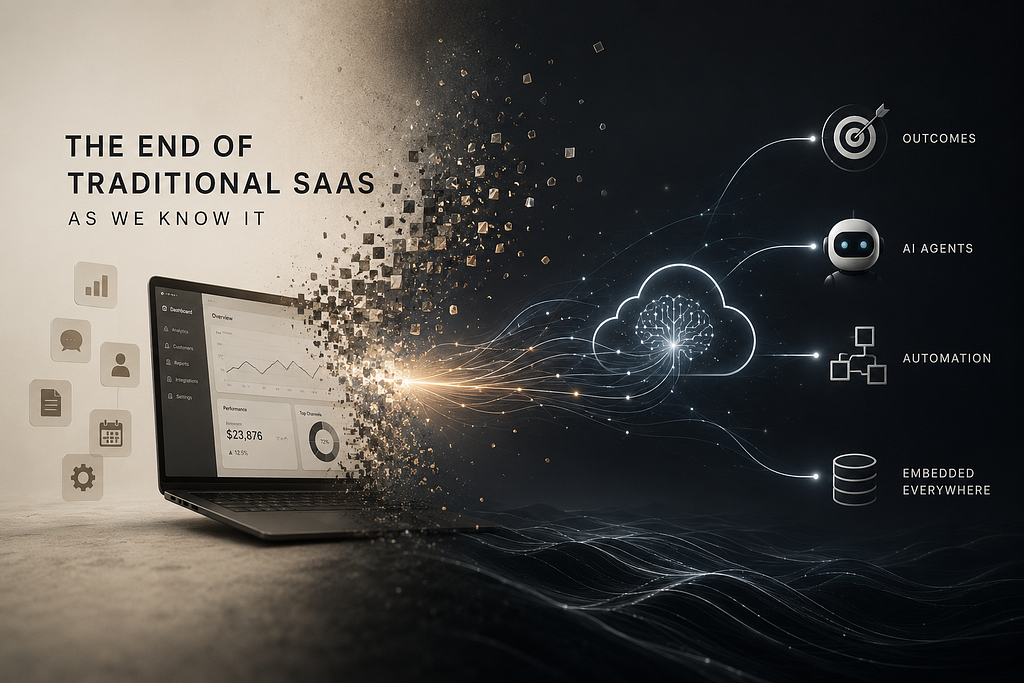
Not because SaaS is disappearing, but because what we used to call SaaS is dissolving into something broader, more embedded, and far less visible.
The image is generated by chatgpt
The Original SaaS Promise Is Breaking
Traditional SaaS was built on three assumptions:
Users will log in to softwareWork will happen inside the applicationValue is delivered through features inside a dashboard
That model worked beautifully when software was the destination.
You went to Slack to communicate.
You went to Notion to write.
You went to HubSpot to manage customers.
But modern digital behavior is no longer “destination-based.”
Software is no longer where work happens.
Software is now inside the workflow.
And this shift quietly breaks the original SaaS model.
From Apps to Invisible Infrastructure
The biggest transformation happening right now is this:
Software is moving from interfaces to infrastructure.
Users don’t want more dashboards. They don’t want more tabs. They don’t want to “go” anywhere to get work done.
They want outcomes.
Send the email → not use the email toolGenerate the report → not open analytics dashboardsProcess the payment → not log into a banking portalCreate the design → not manually build in Figma
This is why AI-native tools are exploding.
They don’t behave like SaaS.
They behave like embedded intelligence layers.
The interface becomes optional. Sometimes it disappears entirely.
And once the interface becomes optional, the SaaS model starts to weaken.
The Rise of Outcome-as-a-Service
Traditional SaaS sells tools.
The next wave sells outcomes.
This is a subtle but massive shift.
Instead of paying for:
CRM softwareMarketing automation toolsAnalytics dashboards
You increasingly pay for:
Qualified leads generatedCampaigns optimizedReports producedWork completed autonomously
This is “Outcome-as-a-Service.”
And it changes everything:
Pricing moves from seats to resultsProducts move from static features to adaptive systemsUsers move from operators to supervisors
In this world, software is no longer something you use.
It’s something that works for you.
SaaS Is Being Absorbed Into Everything Else
One of the most overlooked shifts is that SaaS is not being replaced by one category.
It is being absorbed into multiple layers:
1. AI Systems
AI copilots and agents are turning SaaS features into background processes.
2. Embedded Finance and Platforms
Software is becoming part of banking, payments, and commerce infrastructure rather than standalone tools.
3. APIs and Headless Services
More companies are consuming functionality via APIs instead of interfaces.
4. Super Apps and Ecosystems
Users increasingly stay inside platforms where multiple services are bundled together.
The result?
Standalone SaaS products lose visibility.
They become components, not destinations.
The Death of “Login-Based Value”
Traditional SaaS is built around one core mechanic:
Login → Use → Get value
But that model is becoming outdated.
Because AI and automation introduce a new flow:
Trigger → Execute → Outcome
No login required.
No dashboard needed.
No user session necessary.
The software becomes event-driven rather than user-driven.
This removes one of SaaS’s strongest historical advantages: daily active users.
If users no longer need to “use” your product, DAUs stop being meaningful.
Why Traditional SaaS Companies Feel Stuck
Many SaaS companies today are experiencing a strange tension:
Revenue is still strongCustomers are still subscribedBut product usage is flattening or declining
This is not just competition.
It’s structural shift.
Because customers are slowly migrating from:
“Using software tools”
to
“Using software outcomes”
And SaaS companies are stuck between two identities:
Old identity: tool providersEmerging expectation: outcome providers
Most haven’t fully transitioned.
So they keep adding features, dashboards, and integrations…
While the market is moving toward automation and abstraction.
The Real Disruption Isn’t AI — It’s Abstraction
People often say AI is disrupting SaaS.
That’s partially true.
But the deeper force is abstraction.
Every technological wave reduces friction:
Command line → graphical UIDesktop software → web appsWeb apps → APIsAPIs → AI agents
Each step removes layers of human interaction.
We are now entering the phase where interaction itself is optional.
And traditional SaaS is built on interaction.
So when interaction disappears, SaaS loses its core gravity.
What Replaces Traditional SaaS
It’s not one replacement.
It’s a spectrum of new models:
1. AI-Native Platforms
Systems where intelligence is the product, not the interface.
2. Embedded Software
Capabilities built directly into workflows, devices, and financial systems.
3. Agent-Based Systems
Software that executes tasks autonomously on behalf of users or businesses.
4. Infrastructure-Layer SaaS
Products that don’t aim to be used directly but power other systems invisibly.
In all of these, the “SaaS dashboard” becomes optional at best.
And irrelevant at worst.
The Winners in the Next Era
The companies that will thrive are not necessarily the ones with:
the best UIthe most featuresor the highest number of integrations
They will be the ones that:
Own workflows, not interfacesDeliver outcomes, not toolsIntegrate invisibly into systems people already useReduce human effort instead of requiring engagement
In other words:
The best SaaS product of the future may not look like SaaS at all.
A Subtle Ending, Not a Sudden One
Traditional SaaS is not going to disappear overnight.
It will slowly fade in importance, like desktop software did before it.
It will still exist.
But it will stop being the center of gravity in software innovation.
Because the center is moving:
From applications → to systems
From tools → to outcomes
From usage → to automation
From interfaces → to intelligence
And once that shift completes, we will look back at “traditional SaaS” the way we now look at CD-ROM software.
Not obsolete.
Just a previous era of how humans interacted with technology.
Final Thought
The real question is not whether SaaS is ending.
It’s this:
If software no longer needs to be used… what exactly are we building software for?
The answer to that question will define the next decade.
The End of Traditional SaaS as We Know It was originally published in Coinmonks on Medium, where people are continuing the conversation by highlighting and responding to this story.