
AI Agents and Autonomous Systems Reshaping Workflows Without Code
We Are Now In The Era Of AI Workers
Artificial Intelligence is no longer just a productivity assistant or chatbot.
By 2026, something different is happening. Not just tools anymore, these AI helpers think ahead. While before they answered questions, now they finish whole jobs alone. One after another, tasks like reaching customers, closing deals, helping users, or building products run without constant human guidance. Behind the scenes, decisions unfold step by step on their own. It wasn’t obvious at first how much could change. Yet here it is, workflows once handled person by person now move forward quietly, driven by logic and data. With time, less hand-holding becomes normal.
This changes more than tasks. Machines handle steps once done by hand.
This is the rise of AI-powered digital employees.
Some companies now skip basic software, shifting straight to smart helpers run by artificial intelligence. These systems do more than follow orders, they figure out steps on their own. Instead of waiting for prompts, they set goals, make choices, then carry them through. Over time, tasks once handled by people get managed by programs that learn while working. What started as digital tools has grown into something that acts almost independently.
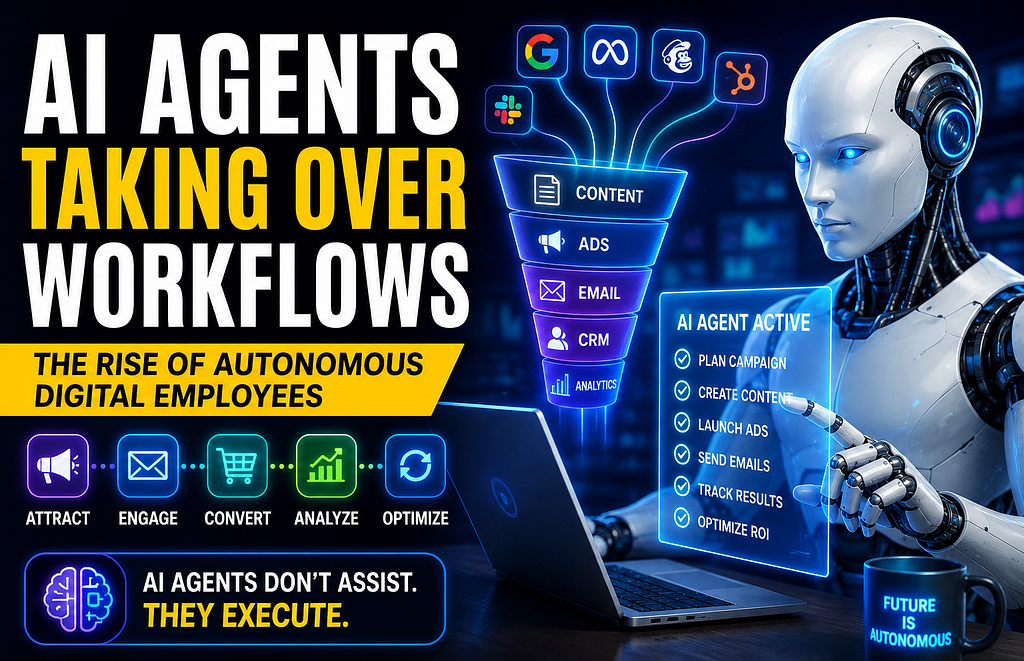
Image Is Generated By ChatGPT
AI Agents What They Are and Why Now?
Out there, some programs think for themselves instead of waiting around for orders. These doers jump into action without needing a push each time.
Unlike traditional software or chatbots, AI agents can:
Break down complex goals into stepsMake decisions based on contextUse tools (CRMs, email, ads, analytics platforms)Learn and improve performance over timeOperate continuously without human input
Picture these tools like tireless newcomers, always on duty, holding every detail without fail, expanding the moment more hands are needed.
AI Managing Every Step of Marketing?
A shift this large rarely shows up in any industry. Marketing happens to be where it’s unfolding now.
Imagine this:
An AI agent handles your entire funnel:Generates content ideas based on trending keywordsWrites SEO blog posts optimized for Google rankingRuns A/B testing on ad creativesLaunches email campaigns
Tracks conversions and adjusts targeting automatically
Right now, it shows how things are doing. As stuff happens, you see the results. While actions unfold, updates appear. During activity, feedback comes through. When tasks run, details emerge
Just skip the screens. Skip clicking things by hand. Things happen right away.
Just outcomes.
Fueled by results, firms now shift toward agent-driven AI marketing platforms rather than standard SaaS software. Machines that act keep pulling attention away from old-style tools.
AI Agents and Human Teams Compared in 2026?
What really matters isn’t if machines take over human roles.
What moves early matters most.
AI wins in:
Repetitive workflows
Data-heavy decision-making
Scaling marketing and outreach
Customer support at scale
Content generation and optimization
Humans still win in:
Strategic thinkingBrand storytellingComplex negotiationEmotional intelligenceCreative directionWhat wins in 2026 isn’t machines against people. Instead, it’s this:
teamwork without labels, where help flows both ways
Where others split focus, blending the two creates sharper results than sticking to just one.
AI Image
The Rise of No Code AI Workers in New Companies
Faster movement marks startups more than big companies in this shift. Yet change flows differently across each kind of organization.
Why?
Now building AI workers is possible even without coding skills.
With modern no-code AI agent platforms, startups can deploy:
AI sales development reps (SDRs)AI content writersAI customer support agentsAI research analystsAI growth hackers
Fewer expenses show up in recruitment because tasks move faster from start to finish.
A small team of five people, along with twenty artificial minds working beside them, holds its own against companies built on fifty to a hundred employees. Each digital helper handles tasks once reserved for full-time staff. Strength isn’t measured by headcount anymore. Numbers shift when machines amplify human effort. What used to take rooms full of workers fits inside a single office now. Scale hides in code more than seats.
AI Agents Taking Over From Old Software
Right now, the largest change taking place is this
SaaS tools are becoming “invisible infrastructure”
AI agents are becoming the “active layer”
Instead of:
logging into 10 toolsmanually moving datamanaging workflows
You just say it straight to the AI agent:
Execution happens between systems. It runs through different setups.
For these reasons, folks putting money into tech say 2026 kicks off what they’re now labeling the agent economy.
How AI Agents Affect Real Businesses
Companies adopting AI agents early are seeing:
30–70% reduction in operational workloadFaster go-to-market executionLower customer acquisition costsHigher content output with consistent qualityImproved decision-making through real-time data loops
Out front now are firms running on artificial intelligence, not those loaded with machinery. Machines matter less when smart systems decide what wins.
Challenges AI Agents Still Face
Even so, problems still pop up here and there
Reliability in complex decision chains
Data privacy and security risks
Over-automation leading to brand dilution
Lack of human judgment in edge cases
Integration complexity across legacy systems
Facing what comes next means building clear rules for how artificial intelligence is managed. Governance can’t wait until problems arise, it must shape progress before it outpaces control.
AI Native Organizations Ahead
A different sort of business is coming into view. Not built like the old ones. Shaped by shifts nobody expected. Running on newer rhythms. Held together differently. Growing where it’s least predicted
In these companies:
Humans design strategyAI agents execute operationsSystems continuously self-optimize
What counts as a team might not look the way it used to.
Faster than expected, AI agents shift how tasks get done. Not merely boosting speed, they reshape daily routines instead.
Starting fresh changes the way companies do their work. New methods replace old systems piece by piece.
Is it still about asking?
It is:
Whoever moves fastest now sets the pace for what comes next. Business belongs to those who act before others see it coming.
AI Agents Taking Over Workflows: The Rise of Autonomous “Digital Employees” in 2026 was originally published in Coinmonks on Medium, where people are continuing the conversation by highlighting and responding to this story.