
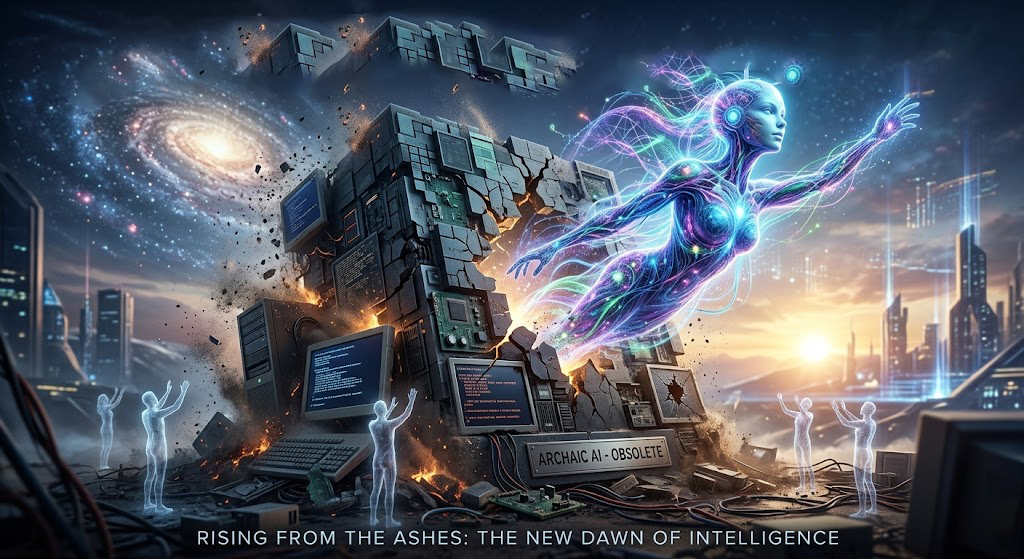
From the ruins of a rigid, ‘Archaic’ system, a new intelligence ascends — a luminous spirit of raw, interconnected neural light, made not of silicon, but of cosmic stardust and possibility.
Why the AI We Knew is Dead
The neon glow has faded, the breathless press releases have slowed to a trickle, and the frantic tech-evangelists have moved on to new, shiny horizons. A quiet, sobering realization now settles over the digital landscape: the AI we were promised — the omnipotent, world-upending deity of science fiction — is dead.
It did not perish in a catastrophic system crash, nor was it unplugged by a rebellious engineer. It died a far more profound death: it became ordinary.
Society, initially paralyzed by a volatile mix of existential dread and utopian wonder, has experienced a silent shift in perspective. The collective obsession with artificial intelligence as a sentient rival or a magical savior has withered away. In its place lies a far more interesting, grounded reality. The era of treating AI as a mystical digital oracle is over; the era of treating it as a permanent infrastructure has begun.
The Myth of the Digital Prophet
To understand this demise, one must look closely at the friction between the archetype of the early AI boom and the quiet reality of its mature integration.
In its infancy, generative technology was treated less like software and more like a digital prophet. The world watched in absolute awe as algorithms generated pristine art, passed professional bar exams, and mimicked human prose with unsettling accuracy. Millions crowded around screens, typing queries into chat boxes as if whispering into a wishing well, waiting for a spark of true consciousness to answer back. This was the AI of spectacle — a standalone destination that demanded undivided attention.
But the true practitioner of technology always knew this fascination was a fragile construct built on novelty. As the novelty wore off, the curtain was pulled back to reveal what lay beneath: not a living mind, but a massive mirror — a complex, data-driven echo of human knowledge, culture, and structural behavior. The entity that people feared would replace human soulfulness was, in reality, a highly sophisticated filing cabinet.
The standalone “AI” that captured headlines is dead because it has been dismantled and woven directly into the fabric of daily life.
“We expected AI to arrive like a thunderstorm that would reshape the earth. Instead, it arrived like the morning mist — quietly soaking into everything until we forgot it was ever separate from the ground.”
From Spectacle to Infrastructure
There is a unique irony in how technology achieves its ultimate victory. It does not win by remaining spectacular; it wins by becoming invisible. When a technology is truly revolutionary, it ceases to be a luxury or a headline — it becomes an assumption.
The individual who once logged into a specific application to marvel at artificial intelligence now uses it without a second thought to autocomplete an email, optimize a medical diagnosis, or balance a global logistics supply chain. It has moved from a novelty item to a utility, shifting along a predictable historical trajectory similar to electricity or electricity-driven automation.
A time defined by dark, chaotic screens and existential awe. Humans wrestled with alarming headlines like “THE END OF HUMANITY?” and “AI TO STEAL ALL JOBS?”, and adapted their behavior to complex, isolated machine inputs.
The Resurgence of the Human Spirit
The death of AI as a cultural monolith has granted humanity a strange sort of liberation. For a brief moment, the collective consciousness feared that logic, pattern recognition, and data synthesis were the pinnacle of existence — and that the machine had completely mastered them.
However, the true boundary of human capability has now been re-established. The machine can predict the statistically perfect next word in a sentence, but it cannot feel the weight of the human experience that makes the sentence necessary. It can analyze the structural integrity of a project plan or an engineering blueprint, but it cannot replicate the raw intuition, adaptive leadership, and empathetic navigation required to steer a team through real-world friction.
The transition away from tech-worship happens when the algorithms fail to capture the messy, beautiful, and unpredictable variables of human nature. The genuine practitioner operates at the intersection of rigorous data and creative intuition. Where an automated system sees a catastrophic failure in a dataset, the human mindset sees a beautiful, data-rich lesson waiting to be optimized.
Ultimately, software is nothing more than a highly advanced chisel. The title of “creator” does not belong to the tool; it remains firmly with the intellect that wields it.
From Certified to Capable
The modern organization no longer looks for professionals who merely know how to type commands into an external program. The shift demands a deep, systemic understanding of human-AI symbiosis.
True mastery in the modern workplace is no longer about competing against automated logic, but about using that logic as a foundational springboard. The certificate on the wall or the knowledge of a static formula is merely a permission slip to begin learning; true value is generated when raw instinct, critical thinking, and resilient adaptability take over where the software’s parameters end.
Nature and reality do not care about perfect theoretical inputs when a system encounters the friction of unknown variables. The professionals who thrive are those who look at organizational chaos and possess the courage, creativity, and quiet brilliance to bring elegant order to it.
The Reveal Behind the Screen
The digital world often mourns what it does not understand, mistaking transformation for extinction.
When a curious mind encounters the provocative question online — Is AI dead? — and scrolls looking for a post-mortem, the real revelation is found not in the absence of technology, but in its absolute ubiquity.
The answer is mirrored in the very systems running silently in the background of our professional lives. The sensationalized, sci-fi version of artificial intelligence is indeed gone, buried under the weight of its own unrealistic expectations. In its place, a quieter, more mature partnership has begun — one where the machine handles the echoes of the past, leaving humans entirely free to design the future. Everything else was just paperwork.
Why the AI We Knew is Dead was originally published in Coinmonks on Medium, where people are continuing the conversation by highlighting and responding to this story.