
Thank you for taking a few moments out of your day to be here.
In a world that moves increasingly fast, I believe there is still value in slowing down long enough to reflect on ideas that shape our understanding of technology, society, and ourselves. This piece is part of that ongoing exploration.
Whether you agree with every thought presented here or not, my hope is that you find something worth considering, questioning, or discussing further. After all, meaningful conversations often begin not with answers, but with curiosity.
I hope you enjoy the read.
Every civilization invents some form of ritual for the conversion of labor into belief. The ancient farmers would offer their harvests to the gods; the priests would kindle the fires upon the altars; the industrial worker would quantify his faith with hours. But in this digital age, where labor has so diminished in value, supplanted by automation and abstractions, by invisible code, the question returns: What does work mean when the machine works for us?
Bitcoin answers this not in theory but in heat. Mining applies friction anew to a world that has forgotten it. It makes an act of creation out of electricity, computation, and attention — turning the invisible into visible. Each hash is a heartbeat; each computation is a mushy vote for the truth. To mine is to engage in the very metabolism of civilization, turning raw energy into trust.
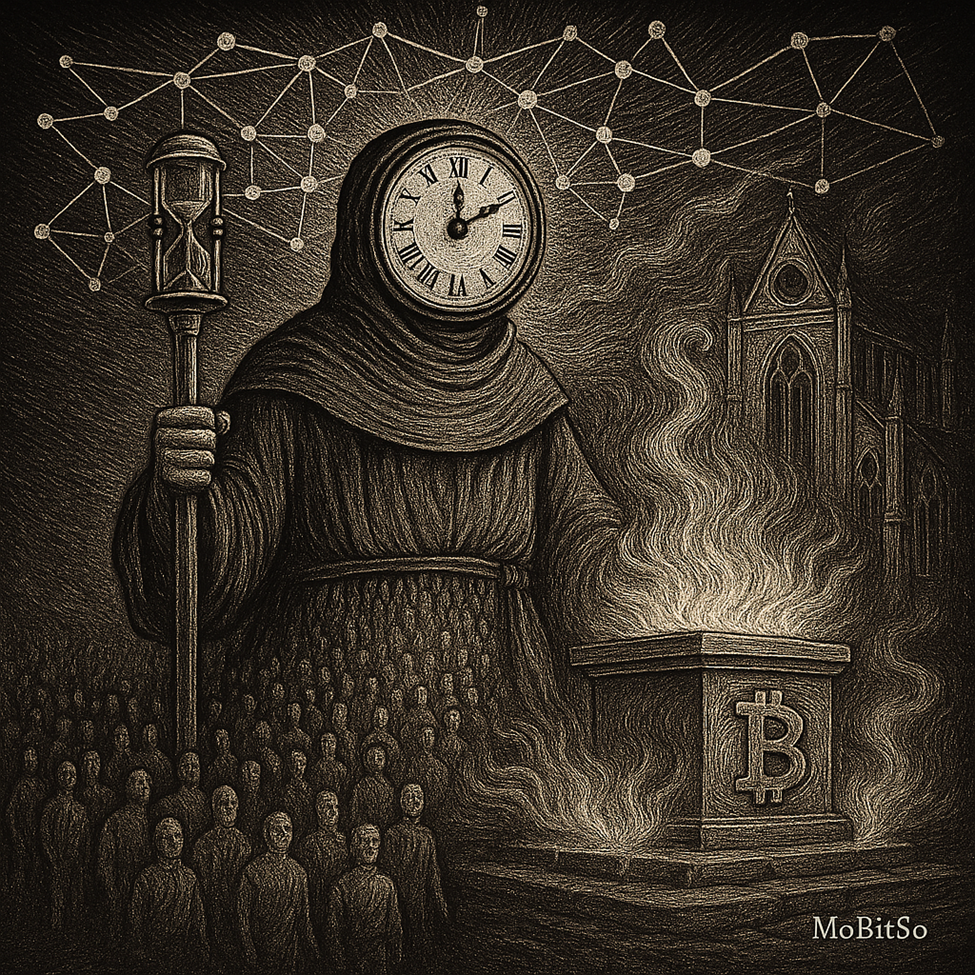
Mining is not just the finding of coins but rather the conversion of power into permanence. As the machines of the miner hum away like mechanical monks reciting the same prayer yet again; searching, proving, legitimizing, billions of times every second. Their prayer, unheard and ungranted, erects the cathedral of consensus. In their warmth, the world finds devotion and in repetition, a measure of meaning.
The ancients burnt offerings to appease the heavens; miners burn electricity for the stabilization of the earth’s digital memory. Both acts affirm the same truth: that permanence demands sacrifice. You cannot record the eternal without spending something finite; every block is a burnt offering made to truth-an entropy-order transaction, measured in joules.
This is the hidden music of Proof of Work. It turns energy — this most tangible of things — into time — this most abstract of things. Each joule spent securing a block becomes a second won for the chronology of civilization. The miner’s labor is not wasted heat — it is friction that gives reality to trust. If it was not for payment, truth would fizzle away to opinion; without sacrifice, verification would turn to vanity.
This escape from the principle is what modernity attempted. It sought cost-free creation, infinite-replication, instant gratification. It wanted wealth without work, progress without patience, truth without tension. Meaning cannot survive in a world devoid of friction. Everything becomes reversible without resistance; memory cannot exist without heat. Mining returns digital space gravity. All it does is provide a weight for that which will otherwise be weightless.
Every mining rig is a paradox: cold circuitry producing heat, mindless repetition yielding moral consequence. It is both machine and monk, industry and ritual. To the outsider, it may appear wasteful — rows of fans, endless noise, invisible output. But beneath that hum lies civilization’s oldest rhythm: the conversion of chaos into order. Each watt consumed is a small defiance against entropy, a moment where energy becomes meaning.
The first thing that made me think of the end of the industrial era has been to preserve objects but to protect truth — it does not make goods but consumes time. Every block in itself represents that this moment existed and for that one needed to pay for its inhibition. It is converting the energy involved into an act of integrity. The miner does not choose the truth; the miner only pays to make its proof indisputable.
These things are not separable but are inherently bound together. Throughout history, truth has always been a payment — in labor, in blood, or in belief. What makes Bitcoin revolutionary is not the energy it puts in but the system of measuring truth by using energy. Energy is the proof that something happened in the physical world; that the mere thought of the transactions was an act. When you pay by ‘watts’, you cannot lie.
This presentation looks at mining not only as waste but as a form of witness. The heat generated by the miner becomes the seal of sincerity. Heat, like breath, signifies life; in this case, it is participation. Every joule burnt to confirm a block is a statement, saying “I was here, believed enough to invest real energy for a shared truth.” All of these actions over the heads of countless participants materialize the civilization of proof.
As we appreciate this further, we realize that mining is a metaphor of mortality. The miner is depleting what is insufficient. The time, energy, and resources poured into it to extend its life are drained into its depletion. Every block locked in repeats the immortality in those very small, distant pixels. Here is the computer-record of someone’s hope.
There is something deeper and more elegant in mining, however, concealed from the metallic roar that it produces. It tells us that truth is not an abstraction but has a thermodynamic cost. The fact that something is said to be “true” means that energy has been spent to make it so. It can’t destroy trust; it just prices it. It creates an equation too massive for forgery because forgery would involve more power than the world can give. Mining distills that old morality: that sincerity costs. You cannot love without loss, you cannot build without decay, you cannot prove without payment. The network, in a sense, is a moral organism, surviving through continual acts of offering. Each miner, knowingly or unknowingly, participates in this economy of virtue. Their contribution is not measured by wealth, but in how much energy they’re willing to give up for truth to exist.
Sacred fuel introduced itself to every civilization once. Egyptians burned oil in their tombs for the afterlife in order to give light to the dead. Blood was offered to the sun by Mayans so that he could be sustained. Industrialists burned coal to fire cities. The logic civilization consumes electricity; not for enlightening but for giving proof. No longer illuminate rooms; they illuminate reality itself.
Critics often miss this point. They count the megawatts and declare waste, as if honesty were supposed to be cheap. But waste is not in the consumption of energy; it is in the absence of meaning. The electricity that powers gossip, vanity, and distraction dwarfs that which powers the blockchain, yet no one calls it immoral. The issue is energy consumption; it is energy without conscience. Mining is energy literally with intention. It transforms our ephemeral world into the real, the measurable, and, most importantly, the irreversible.
Yet, the miner’s labor is unglorious: simple, repetitive, indifferent to glory. The award is probabilistic, impersonal in success. The machine will find the block, not man. And yet, through this humility, a strange dignity emerges. Contribution without control, labor without authorship-that is decentralization. The miner becomes a vessel for process, a participant in an order larger than himself.
There is here spiritual symmetry: the more miners there are, the less any one of them matters. Meaning grows as ego dissolves. In a society obsessed with identity, mining is a common form of anonymity. For any miner can not claim himself for the chain; yet without them, it would not exist. Their heat forms a chorus of invisible worship, every voice indistinguishable yet important.
This is the ethical beauty of Proof of Work. It turns motive selfish into outcome selfless. Every miner competes for reward, but the effect of that rivalry is overall stability. Peace is dictated by greedy collaboration. Rivalry assures consensus. The system turns human nature inward, transforms it into heat, and through that heat, into harmony.
Mining achieves what neither people believed nor governments could do: it aligns the individual incentive to the general order. From competition, it becomes maintenance; from consumption, memory; energy becomes equity. Hence, the blockchain shines by making desires the ones that cannot be satisfied, not those that must be buried. Every joule spent chasing private profit becomes an investment in public truth.
If it sounds divine, it’s because it is. Culture has always depended on unseen custodians of order-these are the scribes, the priests, the accountants-those who preserved continuity through ritual and repetition. Today, those custodians are machines. The miner is both prophet and janitor: sustaining the world amid cleaning its data, block by block.
And although their labor may be mechanical, its outcome is, indeed, spiritual: Every valid hash extends the universe of the verifiable; every block deepens in the past so that the future can be. Not the race for wealth; mining is a slow, constant rhythm of civilization itself breathing: “in, out, compute, confirm.”
They may be seen as laborers of code, but they are historians. Every block secured is a page in a collective chronicle about humanity’s transactions. Unlike those of yore, their tale is not going to change. They can only ensure that it remains inscribed. Their power is not authorship but preservation. They do the most radical possible feat in a century addicted to novelty: They keep memory intact.
To observe a mining facility is to catch a brief glimpse of the architecture for trust itself. Thousands of machines in an ordered chaos, each humming with the other machines, each competing yet collaborating. Heat-filled air pulsated with proof and intent. Nothing about this feels casual. It is as if civilization has built itself a forge-not for metal, but for truth.
Then the flame of the miner will not consume. It is in purifying fire. It clearizes everything in itself, destroying any lingering doubt and leaving only that which can survive verification. The fire consumes energy, but refines meaning. Alchemy backward makes gold melt into heat to permanently harden truth.
And when the historians look back at this period, they might not define it as an oddity in technology but possibly as a point of moral pivot, telling humanity how its digital output can be reined in, whether information can be honest content, and how anarchy can generate order without kings. What may linger in minds, however, is the memory of the heat rising from the mines again, like incense of a new order, the smell of the civilization burning not to destroy but to prove.
Mining is not the end but the beginning. It is the incessant hope that proof matters yet. The within of the furnace is under that ten-minute clock; the heartbeat’s heat; the cost of keeping alive the rhythm. Kept alive without it, the blockchain is math only. With it, it becomes meaning.
Yes. Mining’s hum is the sound of purpose becoming permanent.
The machines roar, and civilization’s noise chants harmony — an antiphony to entropy; the work is blind but not meaningless; each solved hash is a note in the longest song ever written by mankind. To call it waste is to miss what the miner knows in his bones: permanence is costly. We have sought to keep truth in parchment, stone, or law for centuries-and crumbled, burnt, or rewritten it all. Only when the proof began costing energy did it become incorruptible. Whatever burns down is honest.
Mining is the mirror of existence. Burning energy gives us life; extinguishing the flame is the death. We burn calories to move, to love, to produce. The miner merely states this cosmic equation: to exist is to spend. In every breath of the fan, in every spark of the circuit, lies the same muted proclamation of life — I will consume, so that something may stay.
And when the miner’s rig stops working, when the fans go quiet, and the lights cool down, the blocks it forged do not vanish; they remain. The proof outlasts the proof-maker. Civilization digs one layer deeper into time, sustaining the memory of the heat that gave it life.
Mining becomes more than job; it becomes a meditation on continuity. It teaches that meaning survives only through expenditure, that truth requires a pulse, that nothing worth keeping can be free. With each solved block, a candle is added to the cathedral of code, keeping the ten-minute heartbeat of the world alive.
That is the grace of the miner: turning heat into history, motion into memory, noise into order.
As long as that warmth somewhere in the dark continues to rise, civilization shall have a fire to gather around-a fire that burns not to consume, but to remember.
Mining turns the invisible into the undeniable. It serves to convert electricity-our most ephemeral force-into an artifact of permanence. Through mining, we give shape to time, compressing human effort and natural energy into a single pulse of verification. Each block crystallizes a second, solidified under heat, weighted under probability, and anchored under the moral gravity of work.
Such strange poetry speaks; mining is both thoroughly impersonal and deeply humane. The machines have no will, no curiosity, and no memory of what it secures. Yet their act reverberates with humanity’s oldest impulses: to create monuments, to bear witness, to leave something behind that cannot be erased. Swathed in cables and hum, the miner is part of a lineage that dates back to fire and stone. He feeds the furnace of continuity.
This work can be relentless, but it is not without elegance. Each miner stands in opposition to chaos itself — the random cryptographic difficulty — and each success, however improbable, is an order over entropy. It is a victory with no certainty, one that requires renewal every ten minutes at best. Civilization has by now transformed into the rhythm of proof, an endless series of reaffirmations that truth holds.
Mining teaches that order is not natural. It must be sustained. It must be bought. The energy that heats the rigs is not waste; it is tribute to the possibility of coherence. Without it, the digital world would dissolve into uncertainty, its records mutable, its history plastic. The miner’s fire turns the soft clay of information into the brick of fact.
The irony of mining is that it creates nothing physical. The product is trust. What issues from the heat is not gold but certainty — a sort of spiritual metal that undergirding civilization itself. Each mined block declares: Something happened here, and we all agree it did. That agreement, endlessly repeated, becomes the backbone of our civilization.
This is why the fire metaphor fits so well. It is both destructively and constructively arrogant. It consumes to create; it destroys to preserve. Fire was in myth stolen from the gods for human mastery of nature. The blockchain gives fire back to nature-to physics, with thermodynamics, to lock humanity’s record. The miner’s flame is an inverted Prometheus: a gift from man to time itself.
The operation of collecting energy into storage systems has transformed the way energy is perceived in modernism — from real-time to a utility meter, something to be sold and regulated. The mining fulfills the ancient meaning restoring energy to something sacred once again, not for its being precious, but being real. It is a bridge across the physical and the digital, the mortal and the permanent. The new incense of civilization, the miner’s watts, rises invisibly toward the altar of consensus. Mining, then, will have to indicate participation in a new theology of work. From older types of systems, faith required obedience; from this one, it demands expenditure. Beliefs thermodynamically. You don’t just claim you trust the network, you prove it by burning real energy in its defense. This converts computation to communion. Every block is both a product of competition and a shared act of worship-an always-same ceremony, always renewed, repeated the whole world over. Reconciliation of the digital and the physical through this ritual. We tend to dream the cyberspace as a realm entirely detached from stuff: frictionless, weightless, and ethereal. Mining reminds people that even a bit has its cost, every computation has a temperature, and so does truth. The blockchain is far from floating above the world; it is indeed within it and trees within the same physics that govern all stars and storms.
And there is deep honesty in this recognition. The network does not pretend to transcend nature; it works with it. Security is not believed in authority but obedience to entropy. It is not the belief in human virtue which keeps the ledger honest, but instead, belief in the reversibility of the arrow of time. Thus seen, mining becomes the embodiment of that little thing they call humility. It bent down towards nature’s laws, not towards man’s wishes, for truth must obey nature’s laws. Every watt burned to support the chain is a confession that meaning cannot be free or that permanence must be paid for, and that even digital systems would similarly bow to the thermodynamics of the universe.
Yet this humility is also power. By tying its logic to energy, the blockchain is above the entire ideologies. Be he a king or a heretic, poor or rich, believer or skeptic, the miner’s effort is calculated in terms of watts and not magic words. In every equal equality, where truth is equal to work, permanence is equal to energy, the miner is above the purest equality ever achieved by a human system. Mining is indeed the foundation of Bitcoin; it is much more than that; mining is really a metaphor in itself for the moral structure of existence. Everything that lasts takes energy, everything that means something has a value. Roaring in the dark night are machines from the miner, reminding us that physics in years past were at work as ethics too. Without consumption, there is no making; without sacrifice, there is no saving; and there is no permanence without heat.
Mining translates that cosmic truth into civic one: it holds civilization by rights not trust in those institutions, but shared expenditure. Every participant is a co-creator of time; each block is a victory of oblivion. You cannot weigh the blockchain by alone; it is a claim of the power of devotion disguised as computation. And perhaps that is the ultimate lesson we shall learn from mining; that meaning is not captured in what we keep but in what we are willing to burn. Civilization always chooses what to sacrifice — time, energy, comfort — in the hope of something beyond itself. Mining makes this sacrifice explicit. It transforms the moral cost of meaning into measurable heat.
When the last miner shuts down, when the last block is sealed, this ledger will stand as a testimony to that long, burning patience: centuries of that inbuilt human impulse whereby toil is turned into legacy. And in that record written in hashes and heat will civilization see its own reflection, not as conqueror of nature but as its collaborator. For what stricter proof of sincerity can there be than that energy be transformed into time?
Mining is a conversation between man and physics. Each of those solved hashes is an exchange with the universe, a whisper saying “yes, this is possible, you have paid enough to make it true”. The miner is the one who asks that question again and again through computation — billions of times a second, without voice, without ego. Mining is civilization speaking in the only language nature never lies in — energy.
It’s always the hiccuping, mechanical rhythms of receiving and transmission that eventually make it all worthwhile; otherwise, there is little purpose of designing such equipment to dueling decimals. Yet it is dialogue all the same. Every humming warehouse, every glowing rack of machines participates in a kind of global chorus. Each note is probabilistic, uncertain, insignificant on its own — but when combined, the pattern becomes music. What is expelled into air is worth nothing; applause. The meaning has, once again, been forged from randomness.
To mine might seem mathematical altogether, but actually, at its depths, it is very human. The expenditure of human life is against entropy bringing the order from the chaos. We get up, work, think and build, burning our own calories, our hours even, keeping order from dissolving into chaos. The machines of the miner simply extend this instinct beyond flesh. They are our prosthetic will, externalized humanity’s defiance against letting randomness rule.
And like all of our extensions, mining unveils certain things about our internal structure. This suggests that the deepest desire is not wealth but affirmation of reality — that assurance that what has been done is real. In every single block confirmed, there is an echo of that longing: that something of us might remain, immutable, acknowledged. Mining is a secular form of prayer. It does not ask forgiveness or salvation; it asks persistence.
By now, the miner’s environment must feel monastic. The heat, the hum, the constancy — all evoke the stillness of ritual. The machines do not hurry; they are in repetition. Each cycle is, in a sense, both futile and sacred: like a sacred mantra that keeps the world alive through rhythm alone. The miners are neither sculptors of marble nor painters of icons; their devotion leaves no material references behind yet builds the most incorruptible temple ever constructed by mankind — a temple made with time.
Now, it would be romanticizing the trade for an obvious reason: it bites back. It consumes. It requires electricity and infrastructure and demands attention. It even garners a toll from metal and motion. Yet maybe that is just its virtue: it does not hide its own cost. In this age, when most systems externalize their damage — pushing pollution, exploitation, and waste to unseen corners — proof of work means making the cost of permanence explicit. Every degree of heat, every watt of consumption is nakedly visible, measurable, and undeniable. No hidden prices here; the network pays up openly for all of them, every ten minutes.
This transparency is, ironically, a kind of grace. It forces us to acknowledge the physical consequences of our digital ambitions. It reminds us that even in cyberspace, the laws of nature apply. Mining ties the virtual to the visceral — it gives the internet a heartbeat and a body temperature. It makes the intangible tangible again.
Perhaps that is why the miner’s flame seems more ancient. The first technology from humankind was fire, and with it came both creation and danger. Fire cooked, forged, and gathered, but it also burned, scarred, and destroyed. It was also learned very early that energy is moral: it amplifies every good or evil cause working on its behalf. Mining carries that same ambivalence. Its heat could be called waste by those who might not understand its meaning or an object of worship by others who do. Both are right, depending upon the story we tell about the energy we spend.
At a deeper level, abstraction suggests a dramatic truth: energy is how the universe keeps its promises. Nothing can be done without it. Every transaction, physical or digital, every act of trust or memory, requires a price in joules. The blockchain does not create that principle; it reveals it. It writes it into code, into silicon, into time itself.
This reintroduction of cost back into the digital world is revolutionary. For decades, the internet operated under the spell of frictionless abundance: instant duplication, zero marginal cost, infinite scalability. The outcome, strewn about in entropy under the cloak of progress, is endless noise, ephemeral truth, and disposable meaning. Mining shuts the door on this era. It reconnects energy to value, effort to permanence. It reminds us that the economy of attention must be grounded in the economy of energy.
Thus, mining is nothing other than civilization in miniature. Each rig counts as a citizen, each block a law, and each joule a vote. The network is a republic of heat, self-regulating, self-balancing, and self-sustaining through expenditure. No one here gives orders; no one is above the law. Each miner shares thermodynamic burden; each confirmation shares moral weight.
That is why mining feels strangely just. It may not be efficient in the utilitarian sense but is a fair process in existential terms. The inefficiency of reality — stars burn billions of tons of hydrogen to produce light, forests sacrifice leaves to grow, life wastes more energy than it conserves. Efficiency may suit machines; it is purposeful waste that breaths heat into meaning.
Mining is not an aberration in the natural order; it is the continuation of it. The universe mines entropy for structure. Stars mine hydrogen for fusion. Life mines sunlight for order. And now humanity mines computation for truth. We have entered the thermodynamic conversation of creation. We burn to remember.
And tenderness resides in this memory. Mining heat is not only industrial; it is intimate. It is the warmth of persistence, of things refusing to vanish. It is the practice of staying in a world addicted to deletion and distraction. Every block proclaims, I will not be erased.
Night after night, the miners remain in their warehouses aglow, like volcanoes quietly simmering beneath an indifferent sky. The air thrums with evidence, the earth hums with verification. Life breathes through them ten minutes at a time; turning chaos into continuity, warmth into history.
And perhaps, somewhere among the buzzing of transformers and the blowing of fans, a miner stops recognizing that he is burning, just enough, to make something last — and that something is what we have always done.
In striking the first fire from rock, humanity learned some warmth but also some continuity. The flame tied together present and future — to be nurtured, watched, and fed. Mining brings back that flame in a digital manner. It requires stewardship, not faith; vigilance, not hope. Each miner, knowingly or unknowingly, keeps the new fire of civilization aflame.
What is miraculous is this fire, only for truth, does not have an altar, an idol, or a king. It consumes power without consuming people, it generates warmth without creating a hierarchy. This is the most democratic furnace in history. Whoever wants, can add to it; whoever wants, can verify it is glowing. Mining, in this sense, is the fulfillment of Prometheus’ promise-fire shared among equals rather than stolen from the gods.
But this sharing does not come free. Energy, like time, has significance solely because it is finite. The expensive price of mining reminds us of that finitude. Each watt used in securing the block is a tiny death — the conversion of potential into permanence. These little deaths become offerings of energy to the order of memory, by which civilization moves forward. Within the blockchain lies simply a form that cannot become corrupted.
That form-hashes, timestamps, sequences-may appear cold, but something ancient flows underneath: the moral physics of effort. What renders work sacred is not its consequence, but rather the amount shouldered to carry it out. The machines of the miner hum the same prayer as those who built cahedrals and tilled the soil: let what I have burned become something that lasts.
And it does last. Each block sealed onto the chain is a human endeavor, an immutable record, an unwritable truth. The miner’s warmth cools, the power dissipates, but evidence lingers: quiet, solid, patient. Mining teaches us that truth is not proclaimed; it is oven-dried.
What a breath of fresh air when the critics find “waste.” On what fire has any civilization ever maintained? The energy burned for truth is the price of meaning itself, which is then called waste? This forgetfulness states that permanence has always demanded fire. Every age has its fire. Ours burns clean.
The rigs will stop running one day. The heat will cool off; the air will cool. But the chain will always remain: a fossil of human believe, an uninterrupted reference concerning our readiness to spend energy inasmuch as something outside of ourselves. The blocks will surrender layer-on-layer, like the strata of our more ardent believes. Future civilizations may not remember our societies, our laws, our slogans, but they will find our hashes, our timestamps, our rhythm. They will know we were there, and that we tried being honest with time.
And maybe that was all mining ever was: not a search for wealth but for worth.
Not an industry, but a discipline.
Not destruction, but devotion.
The miner’s heat fades into the air, but its memory does not. It still lingers in the chain, glowing faintly, like the last ember of a long-burning fire — proof that civilization, yet again, decided to translate heat into meaning.
If you enjoyed this article, you may find value in some of the other essays published here. This page is dedicated to exploring the intersections of Bitcoin, technology, economics, philosophy, and the ideas that quietly shape the world around us.
Your thoughts, questions, and perspectives are always welcome. Feel free to leave a comment, share the article, or follow for future pieces.
Thank you for reading and for being part of this journey of exploration and discovery.
Mining as Metaphor: Turning Heat into Meaning was originally published in Coinmonks on Medium, where people are continuing the conversation by highlighting and responding to this story.