
By Richard Fetyko, CEO & Founder of altFINS
Let’s drop the narrative that stablecoins are a crypto convenience tool — a way to park money between trades, avoid volatility, or move in and out of positions quickly.
That story is two years out of date.
Today, stablecoins are settlement infrastructure. They are the plumbing beneath cross-border commerce, institutional finance, DeFi liquidity, and the emerging tokenized asset economy. And the numbers back it up in a way that’s hard to ignore.
Where We Are Right Now
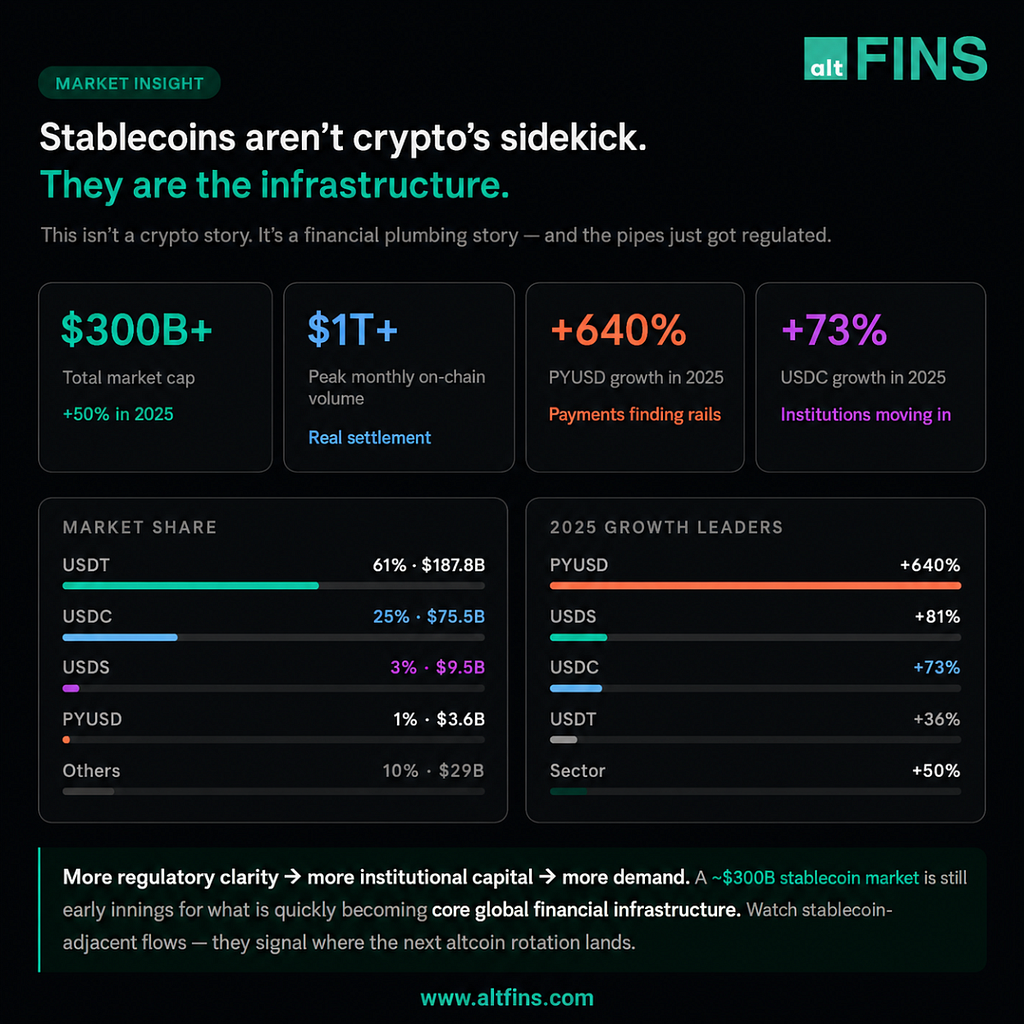
The total stablecoin market cap has crossed $300 billion — up roughly 50% in 2025 alone.
On-chain transfer volume hit tens of trillions of dollars over the past year, with monthly peaks crossing $1 trillion. That is not speculation. That is real economic settlement happening on public blockchains, 24/7, without a correspondent bank in sight.
The composition of that growth tells the real story:
USDC grew approximately 73% in 2025. Circle’s stablecoin has become the preferred instrument for institutional on-chain activity. That growth rate does not come from retail traders — it comes from firms, payment processors, and protocols that need a dollar-denominated instrument they can trust in a regulated context.PayPal’s PYUSD grew roughly 640–700% in 2025. When a company with 400 million users builds stablecoin rails into its payments product and that asset grows sevenfold in a year, you are no longer watching a crypto experiment. You are watching a payments infrastructure shift.USDT remains dominant at over 61% market share ($187B+), demonstrating that even under sustained regulatory scrutiny, demand for dollar-denominated digital liquidity continues to compound.
This is not a “crypto story.” It is a financial plumbing story. And financial plumbing, when it works, becomes invisible — and indispensable.
The Use Cases That Are Actually Live
Here is what stablecoins are doing in the real economy today — not in whitepapers, not in roadmaps:
Cross-border B2B payments
SWIFT is a 50-year-old messaging protocol. It takes 2–5 business days to settle an international wire. It involves correspondent banks, intermediary fees, FX conversion delays, and cut-off times that exist for no reason other than legacy architecture.
Stablecoins settle in seconds, 24 hours a day, 365 days a year, for fractions of a cent. Businesses moving money between jurisdictions — payroll for remote teams, supplier payments, remittances — are adopting stablecoin rails because the alternative is genuinely worse.
DeFi collateral and lending
The entire DeFi lending stack — Aave, Compound, Sky (formerly MakerDAO), and dozens of others — runs on stablecoin liquidity. Stablecoins are the collateral, the borrowing target, and the unit of account. When traders use leverage, manage positions, or provide liquidity to automated market makers, stablecoins are the substrate.
Over $100 billion in DeFi TVL at peak in 2025 relied on stablecoin liquidity. You cannot run a decentralized financial system without a stable unit of account, and stablecoins are that unit.
Yield-bearing stablecoins and tokenized T-bills
One of the most underappreciated developments of the past two years: stablecoins that pay you while you hold them. Products backed by U.S. Treasury bills — BlackRock’s BUIDL, Ondo’s USDY, and others — now let holders earn short-term risk-free rates directly on-chain.
This merges the yield of traditional money market funds with the programmability and composability of blockchain infrastructure. Institutional asset managers are paying attention. Capital is moving.
RWA settlement
Tokenized real-world assets — real estate, private credit, Treasury securities, commodities — require a settlement layer. That settlement layer is stablecoins. As RWA tokenization scales from experiment to institutional practice, the stablecoin market scales with it.
The RWA market grew to over $15 billion in tokenized assets in 2025. Every trade, every redemption, every coupon payment runs through stablecoin settlement. This market is just getting started.
The Regulatory Shift That Changes Everything
For years, the stablecoin market operated in a gray zone. Issuers faced patchwork state licensing, inconsistent federal guidance, and the constant threat of enforcement-first regulation. That ambiguity was a genuine ceiling on institutional adoption.
That ceiling was removed in July 2025.
The GENIUS Act — Guiding and Establishing National Innovation for U.S. Stablecoins — became the first comprehensive federal framework for payment stablecoins in the United States. It established:
1:1 reserve requirements — every payment stablecoin must be backed dollar-for-dollar by U.S. dollars or liquid equivalents like Treasury billsFederal oversight pathways — issuers can be supervised by the OCC, their primary banking regulator, or qualify under state frameworks that meet federal standardsAML and sanctions compliance — the Treasury and FinCEN are actively finalizing rules that treat stablecoin issuers as financial institutions under the Bank Secrecy Act
This is not abstract. The Treasury issued its first proposed rules under GENIUS in April 2026. Comments are being reviewed. Implementation deadlines are July 2026. The machinery of federal financial regulation is turning, and it is turning in favor of legitimate stablecoin issuance.
The strategic implication is straightforward:
More regulatory clarity → more institutional capital enters the market → more demand for high-quality, compliant stablecoins → the market grows.
Banks that previously could not touch stablecoins due to regulatory uncertainty are now exploring issuance. Payment processors that needed federal clarity before committing to stablecoin rails now have it. Asset managers that required a regulated framework before allocating to yield-bearing digital dollar instruments can now proceed.
The Market Opportunity
A $300 billion market that grew 50% in one year sounds large. In the context of what stablecoins are replacing, it is still small.
The global cross-border payments market processes over $150 trillion annually. Daily foreign exchange turnover exceeds $7.5 trillion. U.S. money market fund assets total over $6 trillion. Global trade finance represents another multi-trillion-dollar opportunity.
Stablecoins are capturing share across all of these. They are doing it from a $300B base. The arithmetic of what that implies over the next five years is significant — for the stablecoin market directly, and for the on-chain ecosystems built on top of it.
What This Means for Crypto Traders
At altFINS, we track the technical signals. But part of reading markets well is understanding the structural context behind price action.
Here is the structural context: stablecoin supply growth is a leading indicator for crypto market activity. When stablecoin supply expands, new dollar-denominated capital is entering the on-chain ecosystem. That capital eventually flows into BTC, ETH, and altcoins. Watching stablecoin market cap trends, USDC vs. USDT supply dynamics, and DeFi TVL gives traders early reads on where liquidity is building before it shows up in price.
The $300 billion stablecoin market is not just an asset class. It is the fuel tank for the entire crypto market. And right now, it is being filled at a rate — and with a legitimacy — that we have not seen before.
Stablecoins processed more economic activity in 2025 than most national banking systems. They are growing faster than traditional financial infrastructure. They now have a federal regulatory framework in the world’s largest economy.
This is early innings for what is quickly becoming core global financial infrastructure.
The traders and institutions positioning ahead of that reality will be the ones who look smart in three years.
Richard Fetyko is the CEO and Founder of altFINS, a crypto analytics platform for active traders. He spent 14 years as a Wall Street equity analyst covering Internet tech and media before building altFINS from scratch.
Track on-chain data, and technical setups at altfins.com.
Stablecoins Aren’t Crypto’s Sidekick Anymore. They Are the Infrastructure. was originally published in Coinmonks on Medium, where people are continuing the conversation by highlighting and responding to this story.