
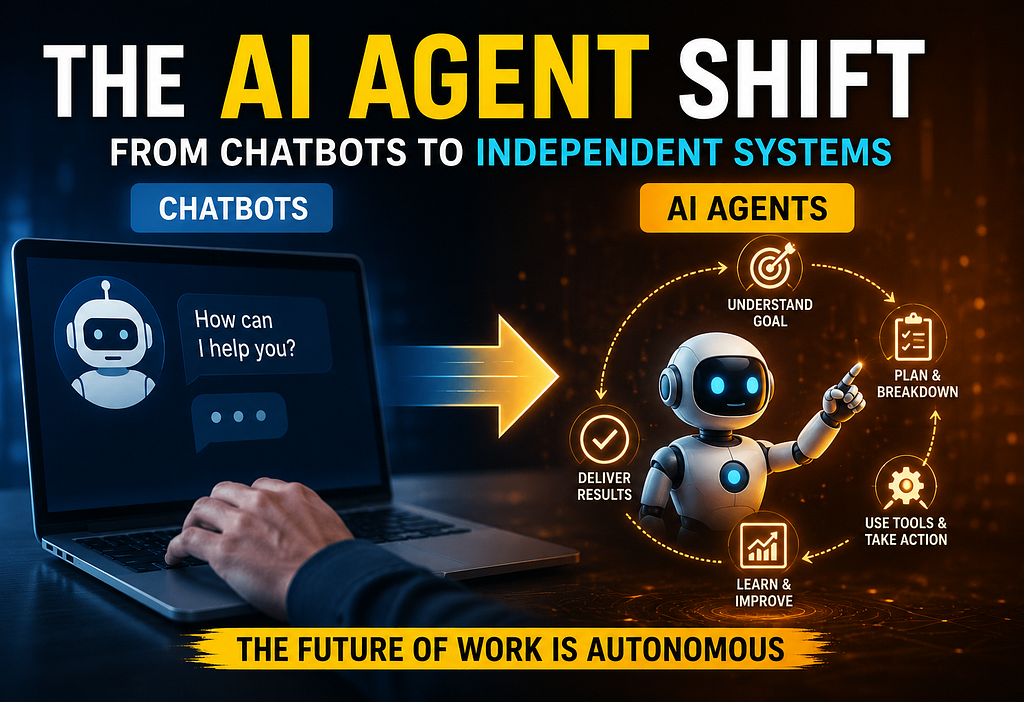
image is generated by chatGPT
We’ve all experienced it.
A few years ago, opening ChatGPT felt almost magical. You’d type a question, and within seconds, a thoughtful answer appeared. It could help write emails, brainstorm ideas, debug code, summarize documents, and even explain complex topics in simple language.
For many of us, it felt like a glimpse into the future.
But something interesting has happened.
The excitement that once came with every interaction is beginning to fade. Not because the technology became worse, but because we’ve become familiar with it.
Today, chatting with AI often feels routine. You ask a question, receive an answer, refine your prompt, ask again, and repeat. The process works, but it still requires constant guidance from the user.
And that’s exactly where the next evolution of AI begins.
Welcome to the era of AI Agents.
The End of “Ask and Receive”
Between 2023 and 2025, Large Language Models (LLMs) such as ChatGPT, Claude, and Gemini transformed the way people worked.
They became writing assistants, coding partners, research companions, and productivity boosters. Entire industries began adapting their workflows around conversational AI.
Prompt engineering became a valuable skill. People learned how to ask better questions to get better answers.
But despite their impressive capabilities, these systems shared one major limitation:
They waited for instructions.
No matter how intelligent they appeared, they couldn’t truly take ownership of a task.
They didn’t remember long-term objectives.
They didn’t independently coordinate multiple actions.
They couldn’t monitor progress and make decisions without continuous human involvement.
Every step required another prompt.
For businesses handling complex workflows, that model eventually became a bottleneck.
Organizations didn’t just want smarter answers.
They wanted work completed.
Enter AI Agents
AI Agents represent a fundamental shift in how artificial intelligence operates.
Instead of functioning as conversational tools that respond to requests, AI Agents act more like digital employees capable of pursuing goals autonomously.
Think of the difference between asking a consultant for advice and assigning a project to a skilled team member.
A chatbot provides information.
An AI Agent takes action.
Rather than waiting for every instruction, an AI Agent can:
Understand a high-level objectiveBreak the objective into smaller tasksAccess relevant tools and systemsMake decisions during executionAdapt when unexpected situations occurLearn from outcomes and improve future performance
The interaction changes dramatically.
Instead of saying:
“Write a report.”Then:
“Now analyze the data.”Then:
“Create charts.”Then:
“Summarize the findings.”
You simply provide the goal:
“Prepare the monthly financial performance report.”
The agent handles the workflow from start to finish.
That’s a completely different relationship between humans and machines.
What This Looks Like in 2026
The shift is no longer theoretical.
Across industries, AI Agents are already moving beyond experimentation and into real business operations.
Finance
Financial teams use AI Agents to reconcile transactions, identify anomalies, verify records, and prepare draft audit reports.
Instead of reviewing thousands of entries manually, teams focus on exceptions and strategic decisions.
Software Development
Modern coding agents can take a feature request, generate code, execute tests, identify issues, deploy updates, and report results with minimal supervision.
Developers increasingly act as architects and reviewers rather than performing every implementation task themselves.
Sales and Marketing
Sales organizations deploy agents to:
Research prospectsPersonalize outreachUpdate CRM systemsSchedule follow-upsAnalyze engagement patterns
Tasks that once consumed entire workdays can now happen continuously in the background.
Human Resources
Recruitment teams use AI Agents to screen applications, rank candidates, coordinate interview schedules, and manage initial communication with applicants.
Human recruiters spend more time evaluating talent and building relationships.The pattern is becoming clear.
We’re moving from AI-assisted work to AI-executed work.
Why This Shift Feels Inevitable
Several forces are driving the rise of AI Agents.
1. Continuous Operation
Humans need breaks.
Agents don’t.
An AI Agent can work 24 hours a day, monitoring systems, processing requests, and handling repetitive tasks without interruption.
2. Reduced Cognitive Overload
Many professionals spend large portions of their day managing routine processes rather than solving meaningful problems.
When agents handle repetitive execution, people gain more time for strategy, creativity, and decision-making.
3. Better Economics
Organizations increasingly want outcomes, not tools.
A chatbot that requires constant supervision still consumes employee time.
An agent that completes tasks independently creates a much stronger return on investment.
4. Growing Workflow Complexity
Modern business operations involve countless interconnected systems.
One task often triggers five others.
Managing these chains through simple chat interactions becomes inefficient.
Agent-based systems are better suited for handling complex, multi-step workflows across different platforms and tools.
This is why frameworks like AutoGen, CrewAI, and enterprise agent platforms from companies such as OpenAI, Anthropic, and Google are attracting so much attention.
The New Skill That Matters
Prompt engineering isn’t disappearing.
Understanding how to communicate effectively with AI will remain valuable.
However, a new skill is emerging as even more important:
Agent Design.
The most valuable professionals in the coming years won’t simply know how to write prompts.
They’ll know how to:
Define objectives clearlyDesign workflowsCreate guardrailsEstablish decision frameworksCoordinate multiple agentsMonitor outcomes and performance
In other words, they’ll learn how to manage digital workforces.
Just as managers coordinate human teams, future professionals will coordinate networks of specialized AI agents.
The advantage won’t come from doing more work personally.
It will come from orchestrating systems that can do the work effectively.
ChatGPT introduced the world to conversational AI.
It showed us what was possible when machines could understand and generate human language.
But AI Agents represent the next chapter.They’re not designed simply to answer questions.They’re designed to achieve outcomes.That doesn’t mean humans become irrelevant.
In fact, human judgment, creativity, ethics, and strategic thinking become even more important.
The role simply changes.
Instead of spending hours executing repetitive tasks, we increasingly focus on setting direction, defining goals, and overseeing intelligent systems that carry out the work.
“The real question is no longer whether AI will become more autonomous.”
It’s already happening.
The question is whether we’re preparing to work alongside these systems or whether we’re still treating AI as nothing more than a chatbot.
Because the future of AI may not be about asking better questions.
It may be about assigning better goals.
What are your thoughts?
Have you started using AI Agents in your daily work or business processes?Which use case excites you the most or concerns you the most?
I’d love to hear your perspective in the comments.
The AI Agent Shift: From Chat-bots to Independent Systems was originally published in Coinmonks on Medium, where people are continuing the conversation by highlighting and responding to this story.