
Why Compressed Oracle Frames Create a New Class of Liquidity Trap in the Staking Middleware
People think that shortening oracle reporting cycles is an objective win for protocol safety. Faster data means faster reactions to slashing, right?
What is actually happening is a dangerous decoupling of protocol perception from physical reality.
As Lido moves to compress its Volatility Engine Beacon Oracle (VEBO) reporting frame from 75 epochs down to 45, it is inadvertently narrowing the reaction window for governance without addressing the physical bottleneck: the Ethereum Beacon Chain exit queue.
https://research.lido.fi/c/proposals/9
We are entering an era of Synchronization Debt, where the application layer’s panic switches are moving faster than the underlying consensus layer can settle the bill.
The Illusion of Real-Time Safety
The industry is currently obsessed with State Compression : the idea that by shrinking the time between a consensus event and an on-chain oracle update, we reduce risk. On paper, LIP-28’s CircuitBreaker and the new 45-epoch reporting frame (roughly 4.8 hours) create a more responsive system.
But infrastructure doesn’t exist in a vacuum. It exists in a hierarchy of dependencies.
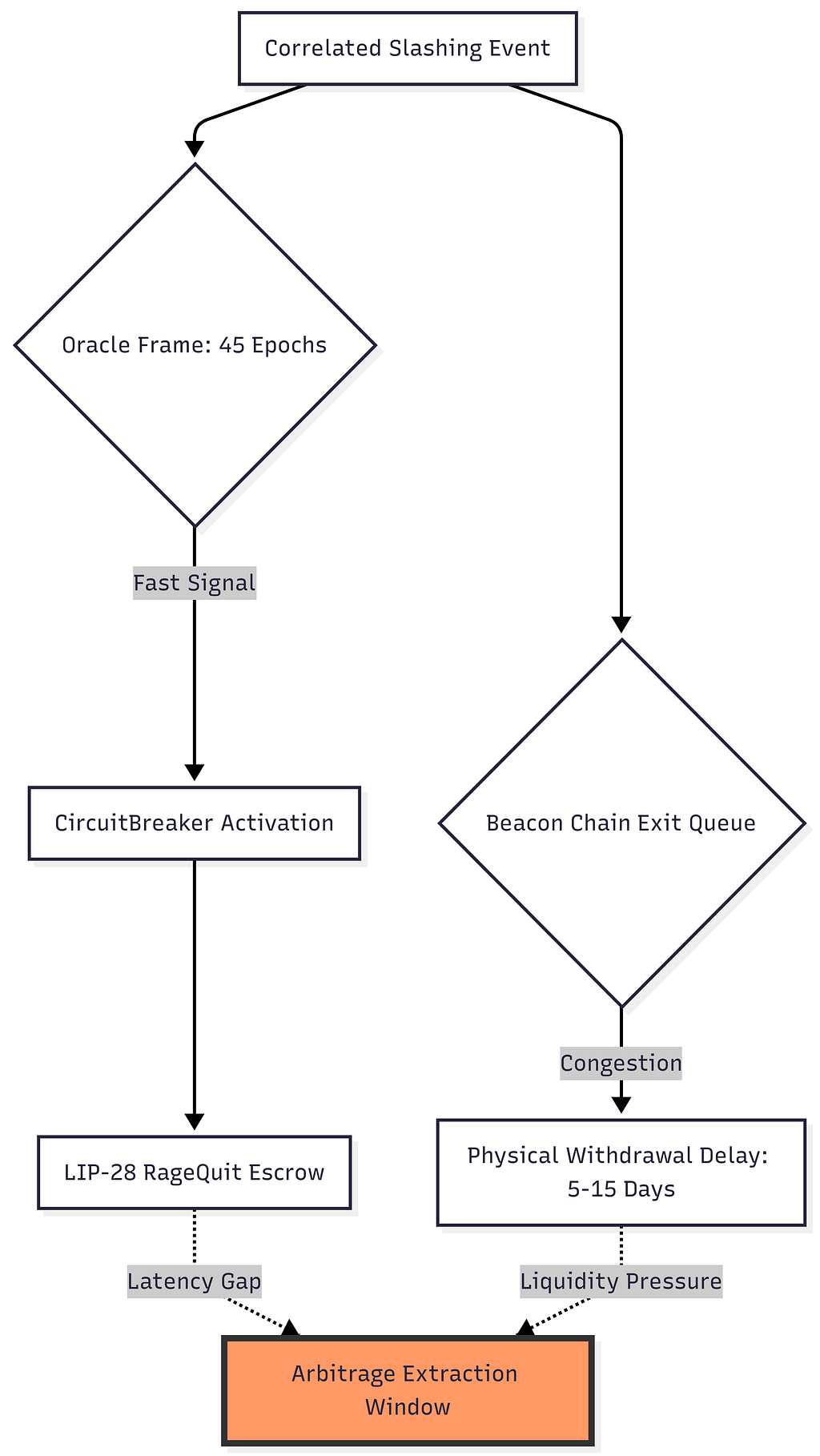
When a major node operator cluster fails, it triggers two simultaneous clocks:
The Application Clock: The oracle detects the drop in effective balance and triggers a CircuitBreaker lock.The Consensus Clock: The physical exit queue on the Beacon Chain begins to swell as validators are ejected or voluntarily exit.
The tension lies in the fact that while the Application Clock is being engineered for speed, the Consensus Clock is a rigid protocol constant. By accelerating the oracle, we aren’t just getting faster data; we are shortening the duration that capital remains in the Dual Governance escrow.
The Coordination Asymmetry
The RageQuit Escrow: A Strategic Bottleneck
The LIP-28 RageQuit mechanism is designed as the ultimate veto. If governance goes rogue or a catastrophic failure occurs, stETH holders can lock their assets in an escrow to stop the protocol.
However, the Veto is only as strong as the exit path. If the oracle reports a loss (the 45-epoch frame) but the escrow’s internal timelock is static, the system creates a Liquidity Vacuum.
The Arbitrage Loop
When the Oracle signals a significant slash, the secondary market price of stETH (on Uniswap/Curve) reacts instantly, often overshooting the actual loss. Sophisticated actors look at the delta between:
The Escrow Value: The official book value of the locked stETH.The Market Value: The price of stETH under panic.
Because the new oracle frame is so tight, the protocol updates its internal exchange rate before the market can stabilize. If the RageQuit escrow doesn’t account for the physical exit queue’s density, it becomes a fixed-price exit door in a burning building.
Infrastructure Intuition: An accelerated oracle without a queue-aware exit mechanism is like installing a high-speed elevator in a building where the ground-floor exit is a single revolving door. The speed only serves to pile more people into the lobby faster.
Synchronization Debt and Capital Drain
The most pressing operational risk is Synchronization Debt : the accumulated risk resulting from the delta between application-state finality and consensus-layer settlement.
In the May 2026 upgrade, Lido is essentially choosing to increase its sampling rate. But in high-volatility events, high-sampling rates without adaptive dampening lead to signal noise. If a slashing event is reported in 4.8 hours, but the exit queue is 10 days deep, the RageQuit escrow is effectively pricing future capital that won’t exist for a week.
The Strategic Reality: Proximity to the Exit
We are moving toward a structural reality where decentralization is no longer just about who holds the stake; it is about proximity to the fastest coordination paths.
If you are a sophisticated operator who can predict the Oracle’s 45-epoch window and compare it against the churn limit of the Beacon Chain, you have a structural advantage over the passive staker locked in the escrow. You can loop the discount, capture the spread, and exit while the safety mechanism is still processing the initial shock.
The Emerging Power Shift
Control is migrating from the DAO’s voting power to the Sequencing of Information. He who controls the timing of the oracle reporting frame or better yet, he who can model the decay of the exit queue with higher precision effectively governs the value of the underlying asset during a crisis.
The Path Forward: Queue-Aware Security
To solve the Latency Mismatch, the staking industry must move away from static epoch-denominated timelines. We need Queue-Aware Infrastructure.
The withdrawal frame should not be a fixed constant of 45 or 75 epochs. It must be a function of the Exit Queue Density (D_q).
If the Beacon Chain is congested, the protocol’s internal safety locks must automatically dilate to prevent arbitrageurs from outrunning the physical settlement of the assets.
The Unsettling Conclusion
The push for efficiency in staking middleware is creating a new class of fragility. By tightening the feedback loops of our safety mechanisms without respect for the physical constraints of the base layer, we aren’t making the system safer ; we are making it more explosive.
The next major protocol failure won’t be a bug in the code. It will be an elegantly executed arbitrage attack that lives in the gap between a 4.8-hour oracle update and a 10-day exit queue.
The decentralization debate is no longer about stake. It is about the geometry of the exit.
The Geometry of Exit Latency was originally published in Coinmonks on Medium, where people are continuing the conversation by highlighting and responding to this story.