
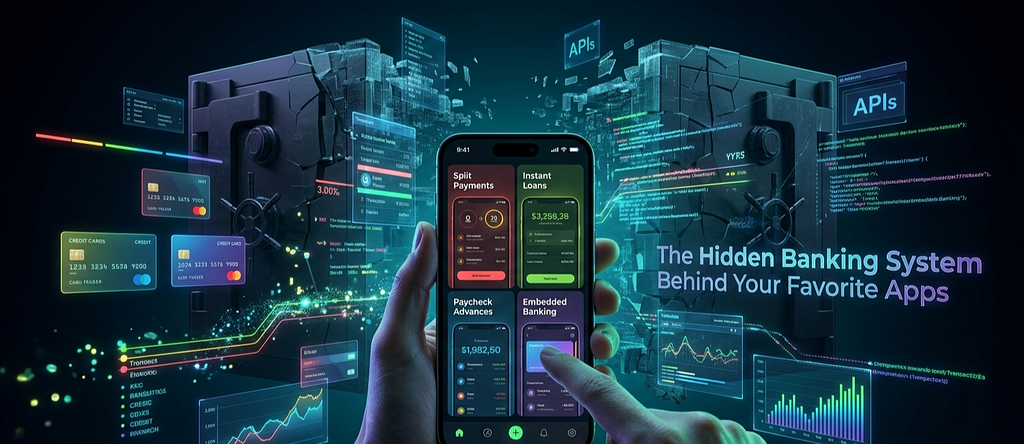
Why the biggest financial institutions today may never have a branch, a vault or even a logo you know
There is a quiet change happening inside the products you use daily. When you split a dinner bill through a messaging app get a paycheck advance from your employers HR platform or apply for a loan while checking out of a store you’re using banking infrastructure thats been quietly added to experiences that weren’t designed to be financial. No teller. No marble counter. No queue. A moment a tap and money moves.
This isn’t a future. Its already happening. The system making it work is called Banking as a Service.
Image Generated by Gemini AI
The Shift from Traditional Banking
For most of the century banking was a place you went. It had hours. It had parking lots. It had a smell that told you this was serious business. Then came the internet, smartphones and people realized they didn’t want to go to a bank. They wanted their money to work like their lives do. Quietly and without requiring a visit.
The first wave of change was banking. Banks built apps. New banks emerged with no branches. People celebrated the end of Saturday morning queues.. This wasn’t radical enough.
The real change was pulling banking apart. Distributing its pieces into every digital surface people touch.
That’s the idea behind Banking as a Service or BaaS. It’s the separation of the banks core infrastructure from the customer experience and licensing that infrastructure to anyone with an idea and an API key.
Understanding Modern Banking
To see why BaaS matters you need to know what a bank is at its core.
A bank is a set of licenses a ledger system and a network that allows money to move. The license lets it hold deposits. The ledger tracks who owns what. The network moves value from one place to another. Everything else. The logo, branch, relationship manager. Is a layer built on top.
BaaS separates the core from the experience. Licensed banking infrastructure providers make that core available to businesses through standardized interfaces. A fintech company, retailer, employer or software platform can now offer products without becoming a bank.
The products that can be added this way include accounts, debit and credit cards, loans, foreign exchange and more.
Why Non-Banks Are Building Financial Products
There’s a logic to embedded finance that goes beyond novelty. When a business offers services inside its product something interesting happens to customer behavior. The customer stays. The relationship deepens.
An e-commerce platform that offers a checkout loan keeps the customer shopping. A gig economy platform that offers payout retains drivers. An accounting software company that adds a business account makes it harder for customers to switch.
This is sometimes called the “ app” instinct.. It’s more nuanced. Even companies with no ambition to be super apps see that embedding moments creates loyalty.
There’s also a revenue dimension. Financial products carry margins that software alone rarely achieves.
The Foundation of BaaS
BaaS relies on regulation. Every BaaS arrangement involves an institution at its foundation. In the US this is typically an FDIC-insured bank. In Europe it may be an institution licensed under the European Banking Authority.
That institution holds the licenses maintains compliance and bears accountability. Companies building products on top inherit access to that infrastructure in exchange for compliance requirements.
This structure has produced an ecosystem. At the foundation chartered banks with compliance cultures and API-forward thinking. In the specialized BaaS platforms that aggregate banking relationships and handle complexity. At the brands, fintech and technology companies building customer-facing experiences.
Challenges and Opportunities
BaaS isn’t a friction-free opportunity. Compliance is a practice. Regulators expect companies to take responsibility for their products.
Unit economics can be a challenge. Embedding a product isn’t the same as running a profitable one. Customer acquisition costs, fraud losses and operational complexity can erode margins.
Data governance is complex. Financial data is sensitive and expectations around its storage, use and protection are high.
The BaaS model depends on the health and strategy of institutions. When those institutions face pressure or change strategy companies built on their infrastructure face disruption.
The Right Mindset
Companies navigating this space successfully build bridges between banking and technology. They take compliance seriously. Move quickly in product and slowly in risk.
They hire people who can handle complexity and regulatory nuance. There’s a kind of humility involved. Companies that have overreached have created problems not for themselves but for the broader ecosystem.
The opportunity ahead belongs to those who understand that speed and trust aren’t opposites. They’re the thing expressed at different timescales.
Market Growth
The market numbers for BaaS are remarkable. Research firms project the BaaS market growing from single-digit billions to well, over $50 billion by the early 2030s. Embedded finance broadly carries projections that dwarf even those figures.
The more interesting growth story is not in the total market size calculations. It is in the areas where people need help.
In places with people who don’t have bank accounts or have limited access to banks embedded finance is not just a nice feature. It is, in cases the first real access to formal financial systems that a household or small business has ever had. A mobile wallet in a shopping platform in Southeast Asia or a small loan product in an agricultural supply chain platform in sub-Saharan Africa is different from a premium checking account add-on in a developed market.
The expansion of Banking as a Service into these markets is not easy. Rules and regulations vary a lot.
Infrastructure problems are real.
The financial models for serving lower-income customers require approaches than those developed for wealthy digital users.
The companies working on these problems are doing some of the most important work in financial technology and the markets they are opening have the potential to be much bigger than the mature market opportunity.
In markets growth is coming from the continued expansion of embedded finance across industries that have barely started to explore the possibility.
Healthcare has a lot of potential, where the financial complexity of billing and insurance creates problems that embedded financial products can help solve.
Real estate is another as the process of buying renting or selling property remains one of the financially intensive and operationally fragmented experiences most people ever navigate.
Construction, logistics, agriculture, education and professional services all have patterns of financial complexity that embedded products could begin to simplify.
The Borrower Who Never Filled Out a Form
Consider a business owner running a restaurant. They use a point-of-sale system to process payments a payroll platform to pay staff and an inventory management tool to track supplies.
Each of these platforms already has data about how that business operates: revenue by hour labor costs by shift, supplier relationships and payment terms.
In the banking model, when that restaurant owner needs a working capital loan they go to a bank fill out forms provide documents and wait for a credit decision that may or may not reflect the actual health of their business.
The bank is working from a picture of a dynamic reality.
In a world where Banking as a Service has matured the platforms that restaurant owner already trusts, uses already shares data with can offer financing that is underwritten in real time against the actual flow of the business.
The application is not a form. It is a moment: a dashboard prompt, a notification an offer calibrated to a need at a specific time.
The Relationship Between Infrastructure and Imagination
One of the things that makes Banking as a Service genuinely interesting as a phenomenon is that it is, at its heart a question about what becomes possible when infrastructure becomes accessible.
The history of technology is, in part the history of that question.
When cloud computing made server infrastructure accessible the kinds of companies that could be built changed dramatically.
When smartphone platforms made location and camera accessible, categories of products that had never existed became obvious.
When the APIs of networks made distribution accessible new models of content and commerce followed.
Banking infrastructure has for most of its history been accessible to those with the capital, the regulatory standing and the organizational complexity to become banks.
Banking as a Service is changing that.
Not eliminating the need for the infrastructure not bypassing the regulations that make it trustworthy but democratizing access to it in ways that are only beginning to manifest in the diversity of products being built.
A Final Thought on the Quiet Revolution
The profound technological shifts tend to share a common characteristic.
They become invisible precisely as they become essential.
We do not notice the protocols that move data across the internet.
We do not think about the electricity grid when we plug something in.
We are not aware of the systems that process a card payment in the fraction of a second between tap and confirmation.
Banking as a Service is moving in that direction.
The infrastructure is becoming sophisticated enough the regulatory frameworks mature enough the tooling enough that it will increasingly disappear into the products it powers.
The user will simply experience a moment that worked.
A loan that appeared when they needed it.
A payment that moved without friction.
An account that felt native to the platform they were already using.
What that invisibility represents, for the people who use these products is access.
It represents the extension of financial capability to people and businesses who have historically found banking too complicated, too expensive too far away or too indifferent to their actual needs.
For those who are building this infrastructure embedding it regulating it and imagining its next applications it represents something rarer still, in the world of financial technology: a genuine opportunity to make something better.
Not just faster. Not just cheaper. Better.
The Hidden Banking System Behind Your Favorite Apps was originally published in Coinmonks on Medium, where people are continuing the conversation by highlighting and responding to this story.