
Introduction
Scalability remains one of the most critical challenges in blockchain systems, particularly for Ethereum. As network usage grows, congestion leads to high transaction fees and slower confirmation times.
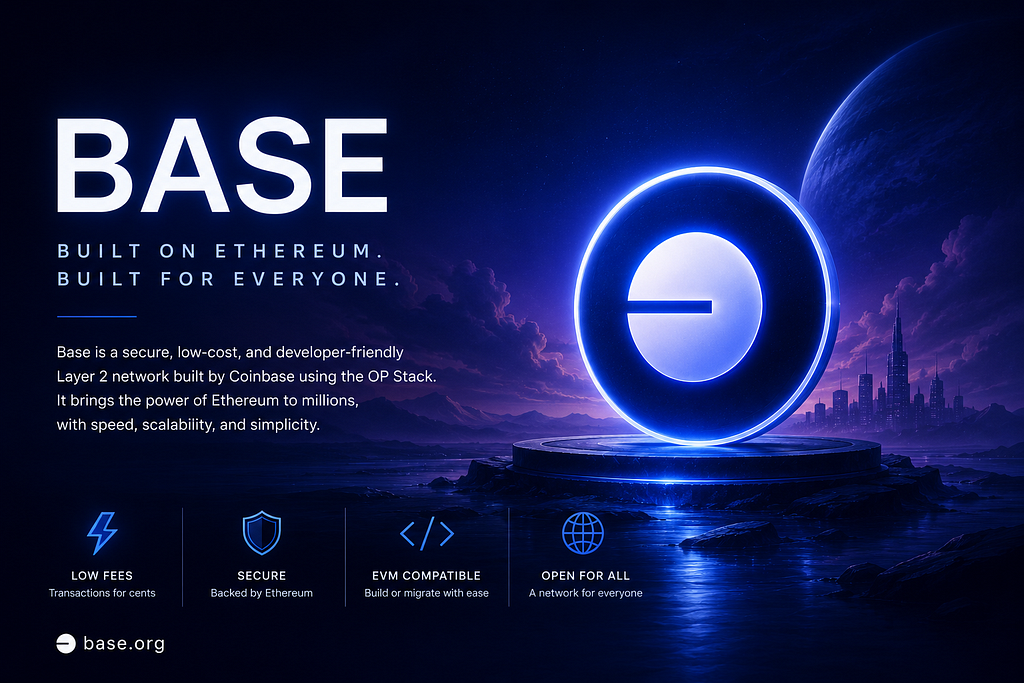
Layer 2 (L2) solutions address these limitations by processing transactions off-chain while still inheriting Ethereum’s security. One of the most important modern L2 networks is Base, developed by Coinbase.
Base aims to provide a low-cost, high-throughput environment for decentralized applications while maintaining Ethereum-grade security.
—
What is Base?
Base is an Optimistic Rollup Layer 2 network built on the OP Stack framework. It is fully EVM-compatible, allowing developers to deploy Ethereum smart contracts without modification.
Key Objectives
– Reduce transaction costs
– Increase throughput
– Improve onboarding for Web3 users
– Enhance developer experience
—
Architecture of Base
Base follows a modular rollup architecture based on OP Stack principles.
Execution Layer
Transactions are processed off-chain using an Ethereum Virtual Machine (EVM) environment, ensuring full compatibility with Ethereum smart contracts.
Sequencer
The sequencer is responsible for:
– Ordering transactions
– Producing Layer 2 blocks
– Submitting transaction batches to Ethereum
Currently, the sequencer operates in a relatively centralized manner under Coinbase, although decentralization is part of the long-term roadmap.
Batch Submission
Transactions are grouped into batches and submitted to Ethereum. This reduces gas costs and improves efficiency.
Data is stored using calldata or upgraded Ethereum data availability solutions such as EIP-4844 blobs.
Settlement Layer
Ethereum acts as the settlement layer where:
– State roots are committed
– Finality is achieved
– Fraud proofs are verified
Fraud Proof Mechanism
Base uses an Optimistic Rollup model:
– Transactions are assumed valid by default
– Fraud can be challenged within a dispute window
– Disputes are resolved on Ethereum Layer 1
—
OP Stack
Base is built on the OP Stack, a modular framework designed to standardize and scale Optimistic Rollups.
Main Components
– Execution layer
– Derivation pipeline
– Sequencer
– Data availability layer
– Bridging infrastructure
This modular architecture improves interoperability between different Layer 2 networks.
—
Security Model
Base inherits security from Ethereum through three primary mechanisms.
1. Data Availability
All transaction data is published on Ethereum, ensuring transparency.
2. State Commitment
State roots are periodically committed to Ethereum.
3. Fraud Proofs
Invalid state transitions can be challenged and corrected on Layer 1.
—
Transaction Lifecycle in Base
1. A user submits a transaction to Base
2. The sequencer orders the transaction
3. Execution occurs within the Layer 2 environment
4. The state root is updated
5. Transaction batches are submitted to Ethereum
6. Final settlement occurs on Layer 1
—
Optimizations
EIP-4844 (Proto-Danksharding)
EIP-4844 reduces data costs by introducing blob storage for rollup data, significantly improving scalability.
Compression Techniques
Transaction data is compressed before submission to Ethereum to reduce gas consumption.
—
Comparison with Other Layer 2 Solutions
Base
– Architecture: Optimistic Rollup
– Stack: OP Stack
– Sequencer: Centralized (current)
– Ecosystem: Coinbase-integrated
Arbitrum
– Architecture: Optimistic Rollup
– Stack: Arbitrum Nitro
– Sequencer: Semi-decentralized
– Ecosystem: Independent
Optimism
– Architecture: Optimistic Rollup
– Stack: OP Stack
– Sequencer: Semi-decentralized
– Ecosystem: OP Collective
—
Advantages
– Full EVM compatibility
– Low transaction fees
– High throughput
– Strong integration with Coinbase ecosystem
– Inherits Ethereum’s security model
—
Challenges
– Sequencer centralization
– Dependency on Ethereum congestion
– Competitive Layer 2 landscape including Arbitrum, Optimism, and zkSync
—
Future Outlook
Base is evolving toward:
– Sequencer decentralization
– Higher throughput through Ethereum upgrades
– Expansion of its decentralized application ecosystem
– Deeper integration with Coinbase products
—
Conclusion
Base represents a major advancement in Ethereum scaling. By leveraging OP Stack and Optimistic Rollups, it provides a scalable, low-cost environment while maintaining strong security guarantees inherited from Ethereum.
As Layer 2 adoption continues to grow, Base is positioned to become a significant component of the broader Ethereum ecosystem.
—
Quick Summary
Base is an Ethereum Layer 2 Optimistic Rollup built on OP Stack by Coinbase.
It reduces fees, increases throughput, and inherits Ethereum security.
Transactions are processed off-chain, batched, and settled on Ethereum.
It is fully EVM-compatible and designed for scalable Web3 applications.
Base: A Technical Overview of Ethereum’s Layer 2 Scaling Solution was originally published in Coinmonks on Medium, where people are continuing the conversation by highlighting and responding to this story.