
Cross-Validation — The Missing Piece in My Machine Learning Workflow
(From Confused Developer to Building Real ML Systems — Part 12)
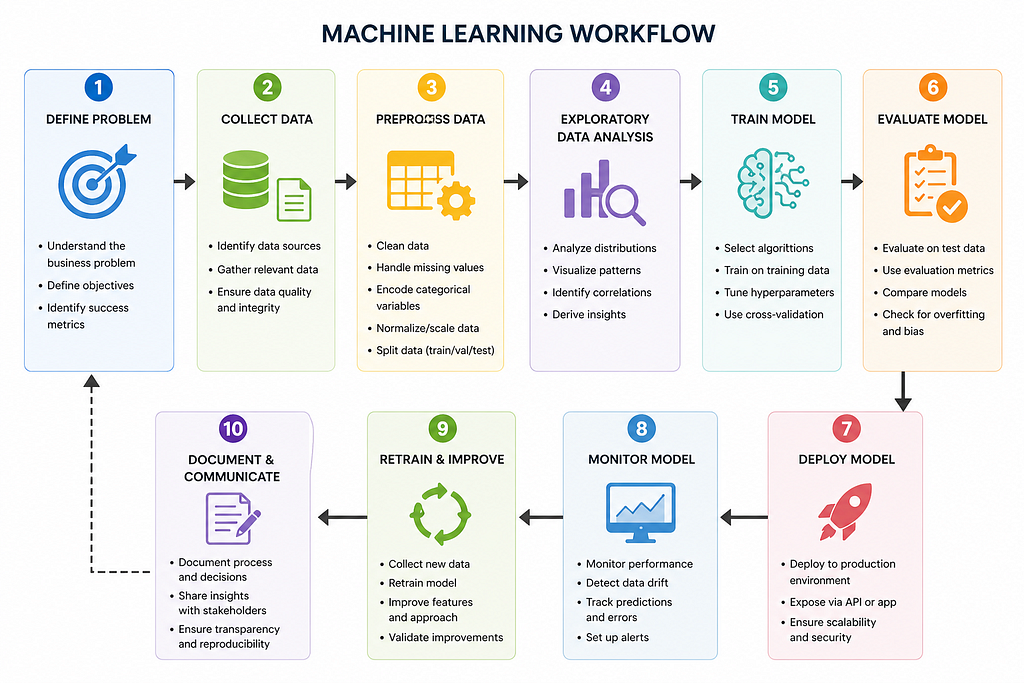
ml workflow
I thought I finally got it right.
Clean data ✅Tuned model ✅Great accuracy ✅
Everything looked perfect.
Until…
I ran the model again.
And got a completely different result.
😕 The Problem I Couldn’t Explain
Same dataset.
Same code.
But:
Accuracy changedPredictions shiftedResults felt unreliable
That’s when I realized:
My model wasn’t stable.
🧠 The Question That Changed Everything
I asked:
“What if my train-test split is misleading me?”
And that’s when I discovered:
Cross-Validation…
🔍 What Is Cross-Validation (Simple Idea)
Instead of splitting data once:
👉 Split it multiple times
👉 Train & test multiple times
👉 Average the results
💡 Real-Life Analogy
Imagine judging a student:
One exam → not reliable ❌Multiple exams → better judgment ✅
👉 That’s cross-validation
⚡ Interactive Moment (Think First)
👉 Which is more reliable?
One train-test split5 different splits averaged
👇 You already know the answer 😉
💻 The Problem with One Split
from sklearn.model_selection import train_test_split
X_train, X_test, y_train, y_test = train_test_split(X, y, test_size=0.2)
model.fit(X_train, y_train)
print(model.score(X_test, y_test))
👉 Result depends on how data is split
💻 The Fix: Cross-Validation
from sklearn.model_selection import cross_val_score
scores = cross_val_score(model, X, y, cv=5)
print(“Scores:”, scores)
print(“Average Score:”, scores.mean())
👉 More stable
👉 More reliable
😲 What Changed for Me
Before:
Results were inconsistentHard to trust model
After:
Stable performanceClear understanding of model quality
🔥 What Is K-Fold (Simple Breakdown)
If cv = 5:
Data is split into 5 partsModel trains 5 timesEach part gets a chance to be test data
👉 Final score = average of all
🧠 The Breakthrough Moment
When I saw:
Individual scoresAverage score
I finally understood:
“My model is not as good as I thought… but now I know the truth………
🎯 The Framework I Follow Now (SEO GOLD)
✔ Step 1: Train model
✔ Step 2: Use cross_val_score
✔ Step 3: Check mean score
✔ Step 4: Check variation
⚠️ Common Mistakes to Avoid
❌ Trusting a single test score
❌ Ignoring variance in results
❌ Using CV incorrectly on time-series data
💡 Pro Insight
High average + low variation → good model ✅High variation → unstable model ⚠️
🔥 Your Turn (Interactive Challenge)
Try this:
Train your model normallyApply cross-validationCompare results
Ask yourself:
“Was my original score misleading?”
🚀 Why This Matters (Real World)
In real systems:
Data changesPatterns shiftModels degrade
👉 Cross-validation prepares you for that
🔗 What’s Next
Now your model is stable…
It’s time to take the next leap:
Feature Engineering — The Real Power Behind Great Models
👇 Continue the Series
If you’re serious about mastering ML:
👉 Follow this journey
👉 Learn what actually works
Next Part: I Didn’t Change My Model… I Changed My Features 🚀
🔍 SEO Keywords (Naturally Embedded)
cross validation in machine learning, k fold cross validation sklearn, why cross validation is important, improve model reliability, machine learning model evaluation techniques
💬 Final Thought
Stop trusting one result.
Start asking:
“Is my model consistently good?”
My Model Worked… Until It Didn’t — This One Trick Fixed It was originally published in Coinmonks on Medium, where people are continuing the conversation by highlighting and responding to this story.