
Most developers building crypto tools make the same mistake.
They grab the first API with a free tier, get it working, then six months later realize they’re juggling three providers, paying for overlapping data, and still missing what they actually need.
The right API depends on what you’re building:
A trading bot that reacts to live market movesA portfolio tracker spanning DeFi, wallets, and CEX balancesA quantitative model that needs 10 years of clean OHLCV historyAn on-chain research dashboard tracking blockchain fundamentals
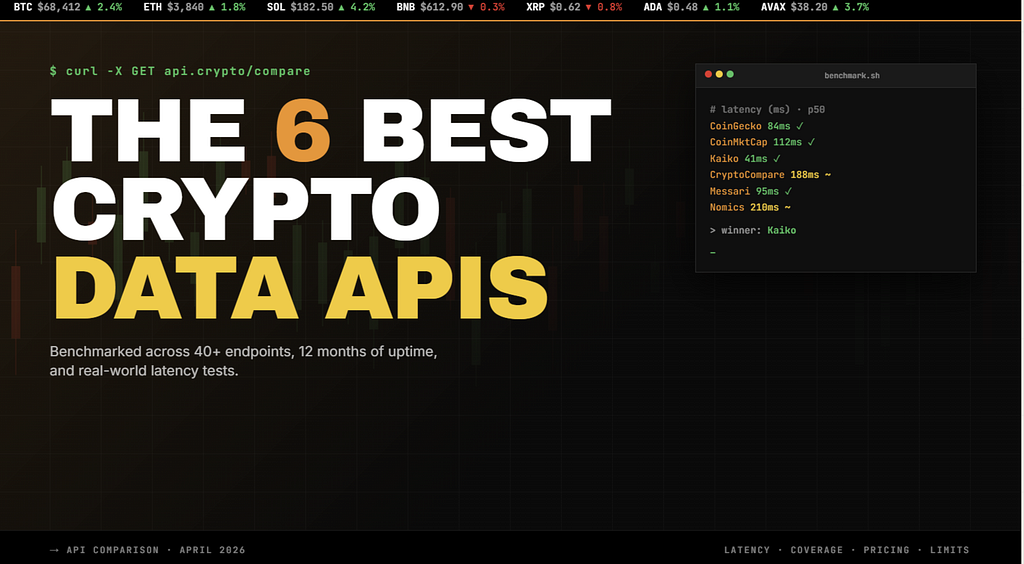
In this comparison, we cover six of the most capable crypto data API providers — CoinStats, Mobula, EODHD, CoinMarketCap, CoinGecko, and CryptoCompare — focusing on data types, real-time capabilities, rate limits, documentation, and pricing.
Let’s start with the one that covers the most ground.
1. CoinStats — The All-in-One Crypto Data & Wallet Layer
Platform: coinstats.app/api-docs
Standout feature: Single integration covering market prices, wallet balances, DeFi positions, and transaction history across 120+ blockchains — plus a native MCP server for AI agents.
Most crypto APIs answer one question well. CoinStats answers all of them.
CoinStats API consolidates market data, wallet balances, DeFi positions, transaction histories, and portfolio analytics into a single endpoint. That matters because most projects end up stitching together a chain-specific RPC node, a market data provider, a DeFi aggregator, and a transaction parser. CoinStats replaces that entire stack.
The platform powers the CoinStats app with over 1M monthly users, and the same infrastructure is available to any developer via API key.
What you get:
Real-time prices, market caps, volumes, and OHLCV charts for 100,000+ coinsWallet balances and transaction histories for any address across 120+ blockchainsStaking, lending, and LP positions across 10,000+ DeFi protocols — auto-detected per walletTickers and trading pairs from 200+ exchanges with consistent response formattingAggregated crypto news, trending topics, and sentiment data
MCP Server for AI agents:
The CoinStats MCP Server exposes the same data through the Model Context Protocol, allowing LLMs and AI agents to query crypto data directly. This works with Claude, Cursor, Claude Code, VS Code, and N8N, among other MCP clients.
That’s a significant differentiator for teams building AI-powered tools in 2025.
What you can build:
Portfolio trackers, trading bots and signal engines, tax and accounting tools, multi-chain wallet explorers, and AI crypto assistants.
Pros:
Widest integration surface: one API key, one schema across 120+ chainsDeFi positions auto-detected — no manual protocol setupMCP server ready for AI agent workflowsFree tier with credit-based pricing (not flat limits)
Cons:
Newer API compared to established players — ecosystem still maturingCredit-based model requires more upfront planning for high-volume useNot the right choice if you only need clean multi-asset historical data (stocks + crypto)
Pricing: Free tier available. Credit-based pricing scaled to endpoint complexity rather than flat monthly limits. Get your API key at openapi.coinstats.app.
Best for: Developers building portfolio trackers, multi-chain explorers, AI agents, or any product that needs wallet + market + DeFi data in a single call.
2. Mobula — Developer-First Onchain Data & Execution Layer
Platform: Mobula Official Site
Standout feature: Stream-based, real-time onchain API with sub-second latency, multi-chain coverage, and a built-in execution layer.
Most trading bot platforms give you a pre-packaged interface and call it a day. Mobula gives you the raw infrastructure to build exactly the bot you want.
Mobula is a real-time onchain data and execution platform for developers building automated trading tools, crypto dashboards, AI agents, and DeFi products. At its core is the Octopus engine — a multi-chain pricing system that tracks assets from major tokens down to newly listed DEX pairs, aggregating prices using volume weighting and liquidity ponderation. Prices update every 5 seconds with no caching, even on free plans.
Data covered:
Token prices, wallet balances, historical PnL, pair trades, pool states, OHLCV dataWallet labels, token security checksExecution layer: route swaps and execute onchain trades programmatically
Mobula supports Ethereum, Solana, BNB Chain, Base, and many more, with a TypeScript SDK and GraphQL alongside the REST API.
Pros:
Blazing fast, no-cache data — prices refresh every 5 seconds on any tierData + execution in one platform — skip stitching together multiple providersBroadest onchain coverage including long-tail tokens and newly listed DEX pairsDeveloper-first: REST, WebSocket, TypeScript SDK, GraphQL, real-world cookbooks
Cons:
Requires coding — no no-code interfaceNo visual strategy builderExecution layer features are relatively recent
Pricing: Free tier with a free API key. Paid plans available via the Mobula dashboard, usage-based — more cost-efficient than flat-subscription competitors for lean bots or early-stage projects.
Best for: Technically proficient developers building custom bots, dashboards, or AI agents who need institutional-grade onchain data including DeFi tokens and cross-chain wallet tracking.
3. EODHD — All-in-One Multi-Asset Data
Platform: eodhd.com
Standout feature: Up to 30 years of historical data across stocks, forex, and 2,600+ crypto pairs under one API.
EODHD is a versatile financial data provider that goes beyond crypto. It covers stocks, forex, ETFs, and crypto under one consistent JSON/CSV API — which makes it the pragmatic choice when you’re building cross-asset tools.
For crypto specifically:
Historical OHLCV with records for major coins going back to 2009Live crypto price quotes via REST and WebSocketFundamental metrics: market cap, diluted valuation, circulating/total/max supply, all-time highs/lowsBulk API endpoints for efficient data ingestionNo-code add-ons for Excel and Google Sheets
Pros:
All-in-one: crypto + equities + FX under a single, consistent APIBest-in-class historical depth — 30 years for equities, full crypto history since Bitcoin genesisExcellent price-to-performance ratio24/7 live customer support and thorough documentation
Cons:
No native on-chain/DeFi metricsNot focused exclusively on crypto — specialists may find other APIs deeper on chain data
Pricing:
Free: 20 calls/day (no credit card required)From $19.99/mo: 100,000 calls/day, end-of-day + live crypto data$29.99/mo: adds real-time WebSocket streaming$99.99/mo: All-in-One (historical, intraday, real-time, fundamentals, news)Enterprise and student (50% discount) plans available
Best for: Developers and analysts building cross-asset tools, backtesting pipelines, or dashboards that need both crypto and traditional finance data from one provider.
4. CoinMarketCap — Industry-Standard Market Data
Platform: coinmarketcap.com/api
Standout feature: Data on 10,000+ assets aggregated from hundreds of exchanges — the reference standard for market cap rankings.
CoinMarketCap is the most recognized name in crypto market data. Its API is the go-to for current prices, rankings, and exchange statistics.
Key data:
Real-time price quotes, market cap, trading volume, and rankings for thousands of assetsGlobal market metrics: total market cap, Bitcoin dominance, total volumeExchange-level data: listings, trading pair metadata, liquidity scoresDerivatives market data (futures, options) on higher plans
Historical data is locked behind paid tiers. The free plan covers only current market data.
Pros:
Industry-recognized data, used by Yahoo Finance and major financial platformsRobust documentation with straightforward RESTful endpointsCovers derivatives and exchange analytics
Cons:
No on-chain metricsHistorical data requires paid upgradeCan become expensive at scale — enterprise tiers are priced for enterprise budgets
Pricing:
Free: 10,000 credits/month (~333 calls/day), 11 core endpointsHobbyist: ~$29/mo — ~50,000 calls/month, more endpointsStartup: ~$79/mo | Standard: ~$199/moProfessional/Enterprise: from $699/mo and up
Best for: Apps that need authoritative market cap rankings and real-time prices for a broad asset universe, especially when credibility of the data source matters to end users.
5. CoinGecko — Broad Coverage & Community Focus
Platform: coingecko.com/en/api
Standout feature: 13,000+ cryptocurrencies tracked including DeFi, NFTs, and community metrics — with one of the best free tiers in the industry.
CoinGecko is often the first choice for developers who want to get something working quickly without a credit card. Its free tier covers most endpoints and has been powering projects and tutorials for years.
Key data:
Real-time prices, market caps, and volumes for 13,000+ assetsHistorical market charts (daily/hourly granularity)Exchange data, trading pairs, categories, and asset contract addressesDeveloper and social metrics: GitHub stats, Twitter followers, Reddit subscribersDeFi protocol data and NFT collections
No WebSocket support — REST only, with polling intervals from 1–5 min (free) to ~30 sec (Pro).
Pros:
One of the best free tiers in the spaceExceptionally wide asset coverage including small-cap and emerging tokensCommunity/developer metrics are unique to CoinGeckoVery easy to integrate — clean documentation, simple GET requests
Cons:
REST only — no WebSocket streamingNot suited for high-frequency or ultra-low-latency use casesPaid plans can get expensive for heavy usage
Pricing:
Free (Demo): ~10–30 calls/min, most endpoints includedAnalyst: ~$129/mo — 500,000 calls/mo at 500 req/minPro: ~$499/mo — 2,000,000 calls/moEnterprise: ~$999/mo+
Best for: Developers who need broad asset coverage on a budget, or analysts who want community and developer activity metrics alongside price data.
6. CryptoCompare — Full Market Data + Sentiment + On-Chain
Platform: cryptocompare.com/api
Standout feature: Price data from 260,000+ trading pairs across 170+ exchanges, combined with news feeds, social sentiment, and basic on-chain metrics in one API.
CryptoCompare is the choice when you want more than just prices. It blends market data with alternative data — news, social sentiment, and some blockchain metrics — making it useful for researchers who want to correlate on-chain activity with price movements.
Key data:
5,700+ coins and 260,000+ trading pairs across 170+ exchanges (CEX and DEX)Real-time quotes, order book snapshots, trade history, OHLCV candlesticksHistorical daily and intraday (minute) data — up to 1 year of minute-level history on enterpriseBlockchain metrics: transaction counts, wallet address data for major chainsNews feeds and social sentiment endpoints
Infrastructure supports up to 40,000 API calls per second in bursts — suitable for demanding real-time dashboards.
Pros:
Enormous trading pair coverage across a wide exchange universeMix of price + news + sentiment + basic on-chain in one integrationHigh-performance infrastructure for real-time applicationsWell-documented with Python client libraries
Cons:
Not as deep on on-chain metrics as dedicated platforms like GlassnodeHistorical minute data beyond 7 days is enterprise-onlyFree tier limits are not explicitly published — less transparent than competitors
Pricing:
Free: non-commercial, API key required (a few thousand calls/day reported)Paid: from ~$80/mo basic to ~$200/mo advancedEnterprise: custom pricing for unlimited usage, custom feeds, white-label
Best for: Quantitative researchers and analysts who want a mid-range provider combining market depth, news/sentiment signals, and basic on-chain context without committing to enterprise pricing.
Side-by-Side Summary
Which One Should You Use?
There’s no single winner — it depends entirely on what you’re building.
Pick CoinStats if you need a single integration covering wallet data, DeFi positions, and market prices across 120+ chains. Especially relevant if you’re building AI-powered tools — the MCP server is production-ready.
Pick Mobula if you’re building automated trading systems that need real-time, no-cache DEX/DeFi data and want the execution layer included.
Pick EODHD if your product spans crypto and traditional finance, and you need decades of clean historical data across asset classes.
Pick CoinMarketCap if your use case requires the industry-recognized market cap reference and exchange-level data with a reliable SLA.
Pick CoinGecko if you’re prototyping fast, working on a budget, or need community/developer metrics alongside prices.
Pick CryptoCompare if you’re a researcher who wants price, sentiment, and basic on-chain data blended in one API at a mid-range price.
The worst outcome is picking one and discovering three months in that it doesn’t cover your actual use case. Start with a clear list of what your product needs to query — then pick accordingly.
Looking for technical content for your company? I can help — LinkedIn · kevinmenesesgonzalez@gmail.com
Top 6 Cryptocurrency Data APIs: Comprehensive Comparison (2026) was originally published in Coinmonks on Medium, where people are continuing the conversation by highlighting and responding to this story.