
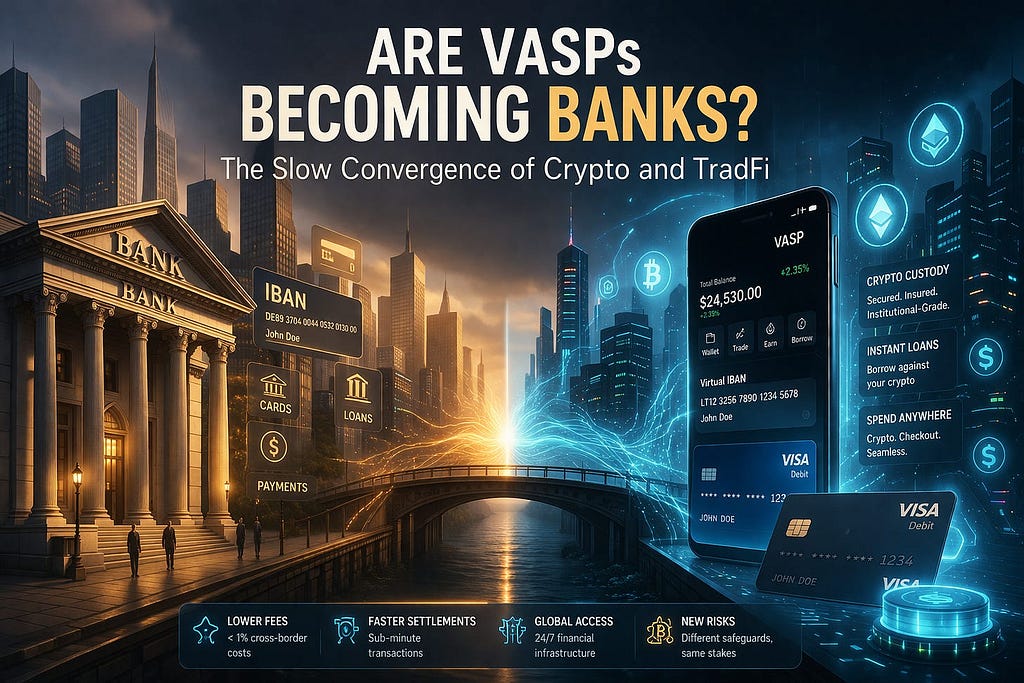
The Great Financial Merging: How Virtual Asset Service Providers Are Swallowing the Banking Stack
Key Insights
The Hybrid Layer: VASPs are no longer just crypto platforms. They now offer IBANs, cards, and credit, effectively operating as “bank-lite” institutions.
Operational Mimicry: With virtual IBANs and card networks, crypto apps now look and behave like neobanks at the surface level.
The Trust Gap: The interface feels familiar, but core protections like deposit insurance and bankruptcy safeguards are often missing.
Reverse Convergence: Banks are adopting crypto infrastructure such as custody and tokenization to stay relevant.
Efficiency Gains: Moving from SWIFT to stablecoin rails can reduce cross-border costs from ~3% to under 1%.
A decade ago, buying Bitcoin felt like a gamble not on price, but on process.
You wired money to an unfamiliar entity and hoped it showed up.
Today, you open an app, get a personal IBAN, tap a sleek debit card, and spend crypto as easily as cash. You can even borrow against your holdings in seconds.
What changed is not just the technology.
It is the institution behind it.
The crypto exchange has quietly evolved into something that looks a lot like a bank.
Context & Problem
For years, crypto and traditional finance operated in parallel worlds.
Banks treated crypto as a risk. Crypto treated banks as gatekeepers.
The result was friction — especially at the point where users moved between fiat and digital assets. This “on-ramp gap” became one of the biggest bottlenecks in adoption.
VASPs emerged to solve that problem. They combined crypto access with familiar financial tools, creating a hybrid model that bridged both systems.
But this evolution introduced a new risk: perception.
Users now interact with VASPs as if they are banks, often without realizing that the legal protections behind those experiences are fundamentally different.
System Breakdown: The Hybrid Journey
So how does a VASP replicate a banking experience?
It is not one feature. It is a stack.
Identity (KYC):
Onboarding mirrors traditional finance. Verification providers like Onfido or Jumio make opening a crypto account feel identical to opening a neobank account.
The Fiat Bridge (vIBANs):
Users receive dedicated virtual IBANs through partners. This allows direct bank transfers into crypto accounts under their own name, removing friction and ambiguity.
Institutional Custody:
Assets are stored in segregated, multi-signature environments. Often supported by insurance providers and institutional custodians, this replaces the early “self-custody or nothing” model.
The Credit Loop:
Crypto becomes collateral. Users lock BTC or ETH and instantly access fiat credit based on real-time loan-to-value calculations.
The Spend Layer:
Through card networks, VASPs convert crypto into fiat at the point of sale. The experience feels seamless, even though multiple systems are working behind the scenes.
Together, these layers recreate the core functions of a bank — without being one.
Deep Dive: The vIBAN Revolution
The real breakthrough is not the card. It is the virtual IBAN.
Historically, banks resisted crypto transfers because they lacked visibility into counterparties.
vIBANs solve this by assigning unique identifiers to each user.
This creates traceability, simplifies reconciliation, and allows VASPs to integrate directly with traditional payment rails.
In effect, crypto platforms no longer sit outside the system. They plug into it.
Key Metrics: The Price of Convergence
MetricTraditional BankingHybrid VASP / StablecoinCross-Border Fees~3%
<1%Settlement Time1–3 daysNear-instantUptimeLimited
hours24/7Regulatory CostHighModerate
The efficiency gains are real.
But efficiency is only one side of the equation.
Risks: The Hidden Cracks
Liquidity Mismatches:
Instant withdrawals depend on external liquidity. In stressed markets, that liquidity can disappear quickly.
The Insurance Illusion:
Most users assume protections similar to FDIC or FSCS. In reality, coverage is often limited to theft, not insolvency.
Volatility Contagion:
Crypto collateral moves fast. Sharp price swings can trigger rapid liquidations, especially during market stress.
These are not edge cases. They are structural risks.
Bull vs. Bear Case
The Bull Case:
VASPs become the financial platforms of the next decade — global, efficient, and built for digital-native users.
The Bear Case:
They evolve into shadow banks — taking similar risks as traditional institutions, but without equivalent safeguards.
Both outcomes can exist at the same time.
Scenario Analysis: The Future of the “Salary Account”
Scenario A: Absorption
Large banks acquire VASPs. Crypto becomes another feature inside existing banking apps.
Scenario B: Replacement
VASPs secure full banking licenses and become primary financial platforms, especially for younger users.
The question is not if convergence happens. It is who controls it.
What Most People Miss
The real shift is not VASPs becoming banks.
It is the definition of a bank changing.
We are moving from banking as an institution to banking as a feature.
In that world, your “account” is just a smart layer deciding where your money should sit — fiat, crypto, or tokenized assets — based on context and behavior.
Key Variables
MiCA (Europe): Brings structured regulation, pushing VASPs closer to financial institutions.
Instant Payment Rails: Faster traditional systems may reduce crypto’s speed advantage.
CBDCs: Could reshape or even replace the fiat bridge role VASPs currently play.
Strategic Impact
For users, this means better access and lower costs.
For regulators, it raises a difficult question: same activity, same risk — should mean same rules.
For banks, the choice is simple: adapt or lose relevance.
Conclusion
The line between a crypto platform and a bank is no longer clear.
VASPs now offer the same surface experience — accounts, cards, credit — but operate on very different foundations.
That gap matters.
Because in finance, the interface builds trust — but the infrastructure defines risk.
We are entering a hybrid era where both systems merge.
Just not on equal terms.
Personal Note
I remember when getting into crypto meant accepting uncertainty at every step.
Today, the experience feels polished, almost indistinguishable from traditional banking.
That progress is real.
But it can also be misleading.
A VASP may look like a bank, but it does not always protect you like one.
And that is the detail most people overlook.
Are VASPs Becoming Banks? The Slow Convergence of Crypto and TradFi was originally published in Coinmonks on Medium, where people are continuing the conversation by highlighting and responding to this story.