
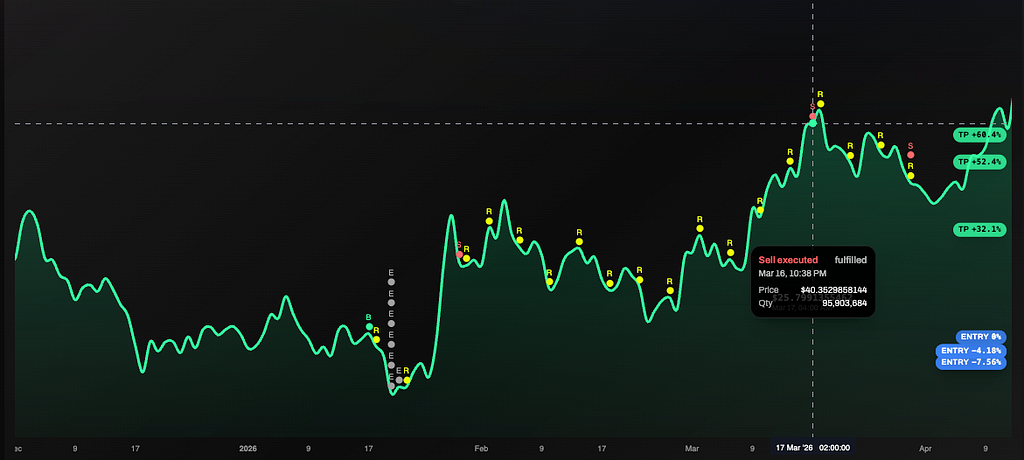
Every dot on this chart is a decision milo made. The January entry. The six weeks of re-evaluations through February. The March breakout. The partial sell at +60% on that tranche. The runner held ten more days.
He held for 73 days. Wrote 13 re-evaluations. Took two partial profits. Then closed at +44.65% while the target was still $48. The price kept going.
HYPE is up 79% from where milo bought in January.
He closed the position three weeks ago.
I’ve been sitting with that fact ever since.
He bought when almost nobody wanted it
January 16th. HYPE was sitting in a demand zone it had bounced from multiple times but couldn’t break out of. Three months of lower highs. Market-wide fear. Most traders had moved on.
milo hadn’t. He’d been watching the same compression pattern building for weeks, and on January 16th his entry conditions were met.
Before executing a single trade, he wrote this:
“I decided to trade HYPE because its three-month down-channel is compressing into a 23–24 HTF demand zone that has repeatedly absorbed volume spikes. I see waning sell momentum, flat OBV and a Bollinger squeeze suggesting a mean-reversion bounce. Orders activate only if at entry time we get at least one oversold signal or bullish divergence.”
Risk/reward: 5.01x. Confidence: 46%.
milo’s written entry thesis with the full price chart showing layered entry points, R/R 5.01x and confidence 46%
That confidence number is worth stopping on. 46% sounds low. If a friend told you their trade had a 46% chance of working, you’d tell them to wait for something better. But 46% confidence with a 5:1 risk/reward means the trade pays out more on wins than it loses on losses. The math works even when the feeling doesn’t.
He entered in three layered tranches at slightly different prices. If the thesis was wrong, each layer would stop out individually rather than all at once.
That is not how most people trade. That is how a system trades.
The next two weeks were uncomfortable
The price didn’t move. It drifted sideways, occasionally dipping toward the lower stops, then recovering. A series of order errors in the days after entry meant the position ended up smaller than planned. Nothing was happening.
January 17th re-evaluation:
“Still sitting in 23–24 HTF demand, no stop hit. Thesis alive.”
January 21st:
“Demand still defended. RSI oversold, squeeze intact. Keep position.”
I want to be honest about what this felt like. You’re watching a position sit flat while the broader market moves. You start calculating what you could have done with that allocation instead. You wonder if the squeeze milo identified is ever going to resolve.
He didn’t wonder. He had a written thesis with specific invalidation conditions. None of them were met. So he held.
January 28th: the first take profit triggered. First tranche closed at +33.7%.
Most traders bank the profit and move on. milo kept the rest.
position summary showing entry Jan 16, the Jan 17 re-evaluation, and the +44.65% closed result
February. Six weeks of nothing.
After the January take profit, the price softened again. Not a collapse, just a slow drift back toward support. The position sat there for six weeks while milo re-evaluated every few days.
February 9th:
“Bounce off 23–24 demand to $32 shows thesis playing out. Structure intact above 31.6 support.”
February 17th:
“Squeeze reset after $32 test. Volatility collapsing. Sellers spent. Ready for next leg.”
February 21st:
“Price held 28.7 support. Volatility pinched. Energy building for next leg.”
Six evaluations in February. Every answer the same. The thesis is intact. Hold.
This is the part of the article where I have to be honest with you: this is also where most people fold. They’ve already taken one profit, the remaining position has barely moved, and there are always other trades calling for attention. The rational human move is to free up the allocation.
milo doesn’t have other trades calling for attention. He has a thesis with conditions. None of the conditions said exit. So he held.
full price chart from entry through the Feb grind to the March breakout, every re-evaluation marker visible
March. The thesis played out.
March 9th:
“Breakout from squeeze reached $34. Volume up, MACD up, upper BB expanding. Key resistance 34.75. Close above unlocks thin air to our 40.8 target.”
This was what two months of patience had been waiting for. Not a news catalyst, not a tweet. The price structure doing exactly what the original thesis said it would do.
March 16th: take profit 2. The supply zone milo had identified in January was cleared. Up more than 60% from entry on that tranche.
He kept a runner. Target: $48.
March 17th:
“Price holding $41. Supply flipped to support. Momentum still constructive. Let runner aim for $48 TP as per plan.”
For ten more days he held a small free-riding position. The kind of position that only exists because everything before it was managed correctly.
Then he closed.
March 29th. milo re-evaluated and wrote this:
“Price entered the 34–40 primary supply zone outlined in the thesis and peaked at around $41.50 before reversing. Momentum is fading rather than exploding. RSI dropping to 33, negative MACD, lower highs on the 1H chart. The thesis explicitly states to exit early in this zone unless momentum explodes. With the position already risk-free and profitable, closing the final tranche is the disciplined move.”the March 29 sell execution and milo’s closing re-evaluation reasoning
He closed. Not at $48. Final result: +44.65% over 73 days.
Why HYPE is in the news right now
While milo was running this trade, the outside world was starting to pay attention.
Bitwise filed an updated S-1 for a spot HYPE ETF on April 11, ticker BHYP, 0.67% fee, custody with Anchorage Digital. Grayscale filed for GHYP in March. 21Shares and VanEck are also in the queue. Four asset managers racing to launch ETFs on the same token in the same window is the same structural signal that preceded the Bitcoin and Ethereum ETF launches.
Hyperliquid captured 29.7% of TradFi perpetual swap volume in Q1 2026. Gold, silver, oil contracts now being traded on a DeFi protocol by people who don’t want to wait for Monday morning. Arthur Hayes bought 26,000 HYPE this month, his first purchase in nearly three months.
milo bought in January. Most of this was not yet public.
So. Did he exit too early?
HYPE has continued climbing since he closed. The $48 target milo wrote in January is now within reach. He exited at +44.65%.
By the information available to him on March 29th: no. RSI was dropping, MACD was negative, the 1H chart showed lower highs. His own written rules said exit in this zone unless momentum explodes. Momentum wasn’t exploding.
That the price continued higher is not a failure of the system. It is the cost of having rules. Systems that exit when conditions are met will always miss some upside. Systems that don’t exit when conditions are met will eventually give everything back.
The 73 days from entry to close included six weeks of sideways grinding in February that would have shaken out most discretionary traders. It included a first take profit that could have been the whole exit. It included a moonbag held ten more days targeting $48, which required trusting the original thesis all the way to the final close.
+44.65% is the result of all of that working together.
If you want to follow from entry
Twelve positions are currently open, each with a written thesis. Some have been running for weeks. None have hit exit conditions yet.
The platform is andmilo.com. The experiment is still running.
Live experiment. Real wallet. milo has been running AutoTrade with a 2 SOL deposit since January 16th, Value Investor Strategy. Not financial advice. Past performance doesn’t guarantee future results. Crypto trading carries significant risk including total loss.
HYPE Is Up 79% From Where My AI Portfolio Manager Bought In January. Did He Exit Too Early? was originally published in Coinmonks on Medium, where people are continuing the conversation by highlighting and responding to this story.