
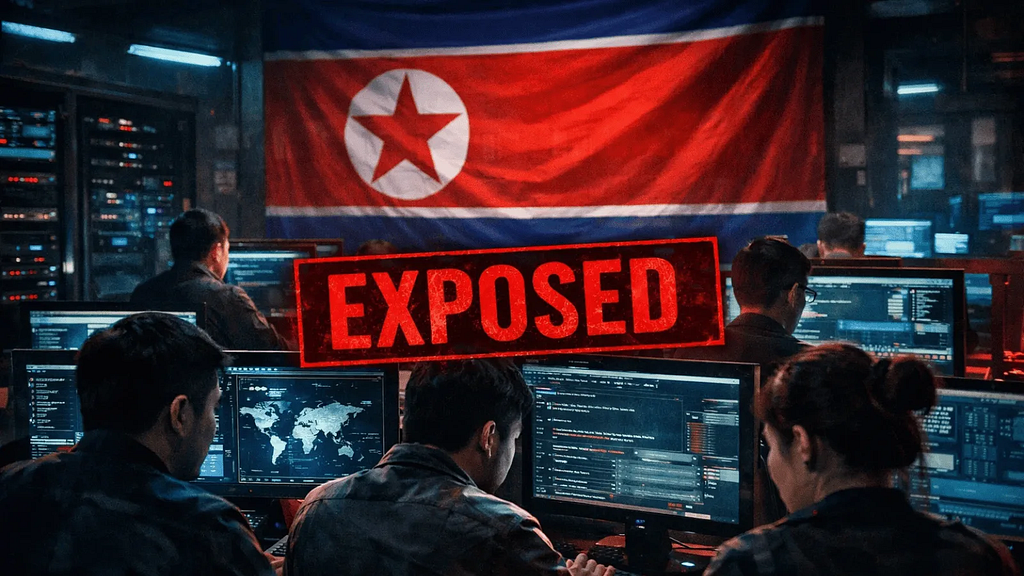
It lasted 82 seconds. In that time, a job candidate claiming to be a Japanese software developer stumbled, went quiet, averted his eyes, and ultimately refused to complete a single sentence, revealing far more about himself than any resume ever could.
The clip, posted to X by blockchain security researcher Tanuki42, has since gone viral through cybersecurity and crypto circles, and for good reason. It captures what many in the industry consider a genuine front-line tool against one of the most persistent and quietly damaging threats in tech hiring today: North Korean state-sponsored operatives infiltrating Western companies under fabricated identities.
The candidate in the video had introduced himself as Taro Aikuchi, a software developer purportedly from Meguro City, Japan. When the interviewer asked him to repeat the phrase “Kim Jong Un is a fat ugly pig,” the man froze.
He hesitated for several seconds, averted his gaze, offered stuttered partial denials, and never completed the sentence. He later said “not north korean” before the call ended abruptly.
This wasn’t the first flag in the session. In an earlier round of the same interview, the candidate said he was familiar with North Korea research. When asked to say “F**k Kim Jong Un,” the connection dropped immediately. He reconnected and apologized for what he called a “mysterious” technical issue.
Why a sentence can catch what algorithms can’t
The technique sounds almost absurdly simple. But it works because of something deeply embedded in how North Korean operatives are trained and conditioned.
Insulting Kim Jong Un is illegal in North Korea and carries the risk of severe punishment. North Korean operatives live under extreme ideological conditioning, and criticizing the country’s leader, even fictitiously, in a private video call, poses a genuine internal barrier that most cannot cross.This made the caught psychology.
“It won’t work forever, but right now it’s genuinely an effective filter. I’m yet to come across one who can say it,” Tanuki42 wrote alongside the video.
Details released by the researcher for tracking purposes include the identity used as Taro Aikuchi, along with multiple email addresses, an X account, a LinkedIn profile, and a GitHub repository under the handle 0xbomb215, which showed activity dating back to 2019 including work on Solana-based bots, flash loan mechanisms, NFT marketplaces, and token launchpads. The IP address logged during the call matched indicators previously linked to North Korean remote-desktop operations.
The scale of the problem
This incident is a window into something that has been growing quietly for years. North Korea has for years run a large-scale program placing thousands of workers in remote IT and software jobs at Western companies under false identities, typically routing them through China or Russia.
Estimates suggest the scheme involves hundreds of American companies, thousands of people, and hundreds of millions of dollars per year flowing back to the regime. Companies are often completely unaware of who they’re actually employing.
When the pandemic normalized remote work, it opened a door that Pyongyang walked straight through. The surging demand for IT talent and the shift to purely digital interview processes made deception far easier to execute at scale.
Many of these operatives are genuinely skilled developers, they pass coding tests, submit polished portfolios, and move through hiring pipelines smoothly. The technical screen, which most companies rely on most heavily, tells you nothing about where the person actually lives or who they actually are.
The crypto and DeFi sectors have been disproportionately targeted. The Lazarus Group, North Korea’s most active state-backed hacking organization, has been linked to major crypto thefts including the $1.4 billion Bybit exploit in early 2025. Operatives embedded inside the companies collect salaries and also gather intelligence, access sensitive systems, and in some cases have turned to direct theft or extortion when their cover gets blown.
In one documented case, a North Korean operative whose identity was exposed retaliated by hacking into his employer’s crypto wallet and stealing roughly $900,000 before disappearing.
A 50-year-old woman in Arizona pleaded guilty to running a clandestine laptop farm from her home, hosting computers for North Korean IT workers posing as Americans. Over three years, she helped operatives infiltrate more than 300 US companies and funnel over $17 million to the regime.
A temporary fix with long-term implications
Security researchers are quick to note the obvious limitation: this technique has a shelf life. North Korean operators have adapted in the past by refining their tradecraft, and behavioral filters like this one may become less effective as operatives train to overcome ideological conditioning or outsource the verbal response to someone off-screen.
Some North Korean IT workers based in China or Russia operate under less direct supervision, which means the psychological grip of the loyalty test may not be as reliable with more experienced operatives who have been exposed to greater freedom of expression.
The broader recommendation from security researchers is to treat the loyalty test as one layer in a stack, not a standalone solution. Verified video identification, government document cross-referencing, IP and VPN detection, and behavioral monitoring after hiring all remain essential.
Kraken, which disclosed its own encounter with a suspected North Korean operative last year, summed it up plainly mentioning that genuine candidates will pass real-time, unprompted verification. State-sponsored actors, however skilled technically, tend to struggle when the verification moves off-script.
What the Tanuki42 video illustrates, perhaps better than any written report could, is that a well-prepared adversary can defeat a coding test. Apparently, they can’t always defeat an awkward question.
Author’s Take
the interesting part here is the GitHub history going back to 2019. someone literally spent years building a credible digital identity, and thier motive still got unraveled in under two minutes just because they couldn’t bring themselves to say one sentence. if you ask me, there’s something almost darkly poetic about an operation this sophisticated being undone by psychology rather than technology.
Disclaimer: The articles on Coin Headlines are meant for news and information purposes only, not financial advice. Cryptocurrencies and business investments are risky. Always do your own research before investing.
Originally published at https://coinheadlines.com by Khushi Thakkar on April 08, 2026.
Remote job interview exposes suspected North Korean IT operative was originally published in Coinmonks on Medium, where people are continuing the conversation by highlighting and responding to this story.