
Jamal.O April 7, 2026 TSN Blockchain
The MIK Consensus: Where Mining Meets Identity and Knowledge
Imagine a forest where every tree not only competes for sunlight but also shares nutrients through an underground mycelium network. That’s how I envision MIK — our consensus mechanism that transforms traditional blockchain validation into something far more organic and resilient.
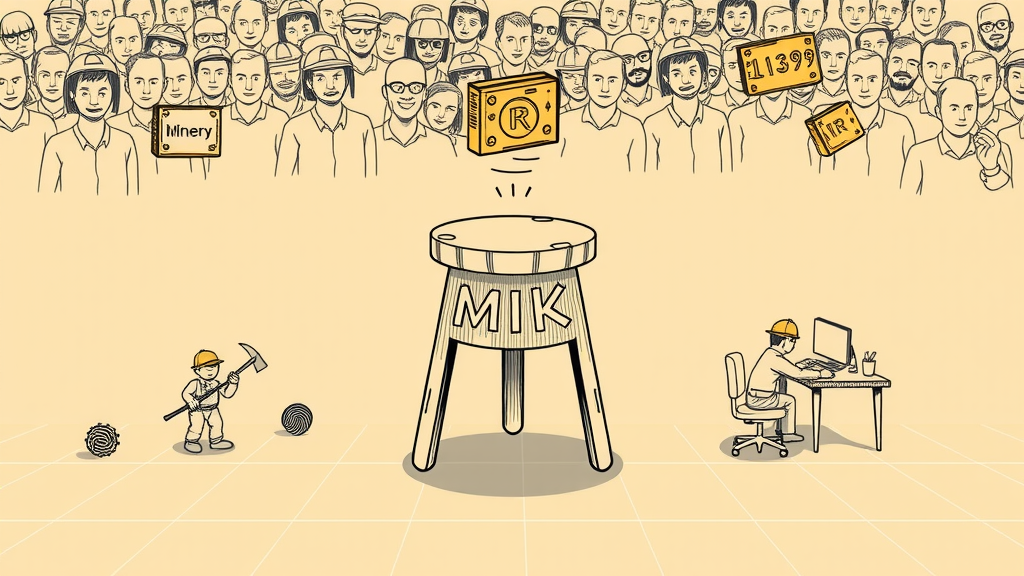
The Three Pillars of MIK
Most blockchains force you to choose: security or accessibility, decentralization or efficiency. MIK refuses this false dichotomy by weaving three complementary forces into a single, elegant system.
Mining: Yes, we use Proof-of-Work, but not your grandfather’s energy-hungry algorithm. Poseidon2 — our hash function optimized for zero-knowledge circuits — makes mining accessible to anyone with a laptop. No ASICs, no mining pools, no centralization of hash power. Just you, your node, and the network.
Identity: Here’s where it gets interesting. Every node builds an identity score based on consistent participation. Think of it as the network developing trust in you over time. The longer and more reliably you validate, the more weight your voice carries. But unlike traditional identity systems, this happens without exposing who you are — your pseudonymity remains intact.
Knowledge: This is our reputation layer. Nodes that consistently validate correctly, propose valid blocks, and maintain good network behavior develop a knowledge score. It’s like the network’s immune system — nodes that demonstrate understanding of the protocol’s rules gain influence, while malicious actors find themselves isolated.
The Symphony of Consensus
What makes MIK beautiful isn’t just these three components — it’s how they interact. Mining prevents Sybil attacks through computational work. Identity prevents long-range attacks by making it expensive to recreate history. Knowledge ensures that the most valuable participants have the greatest say in network evolution.
The whole is greater than the sum of its parts. MIK isn’t just hybrid consensus — it’s emergent consensus, where security properties emerge from the interplay of simple rules.
Why This Matters
In a world where quantum computers threaten classical cryptography and centralized mining pools threaten decentralization, MIK offers a path forward. Post-quantum signatures protect against future threats. Accessible mining protects against centralization. Identity and knowledge protect against nothing-at-stake attacks that plague pure PoS systems.
We didn’t build MIK to be another consensus mechanism. We built it because the future demands something different — something that acknowledges that true security comes not from any single mechanism, but from the delicate balance of many.
The forest doesn’t survive because each tree is strong. It survives because the network between them is stronger.
Jamal.O
The MIK Consensus: Where Mining Meets Identity and Knowledge was originally published in Coinmonks on Medium, where people are continuing the conversation by highlighting and responding to this story.