
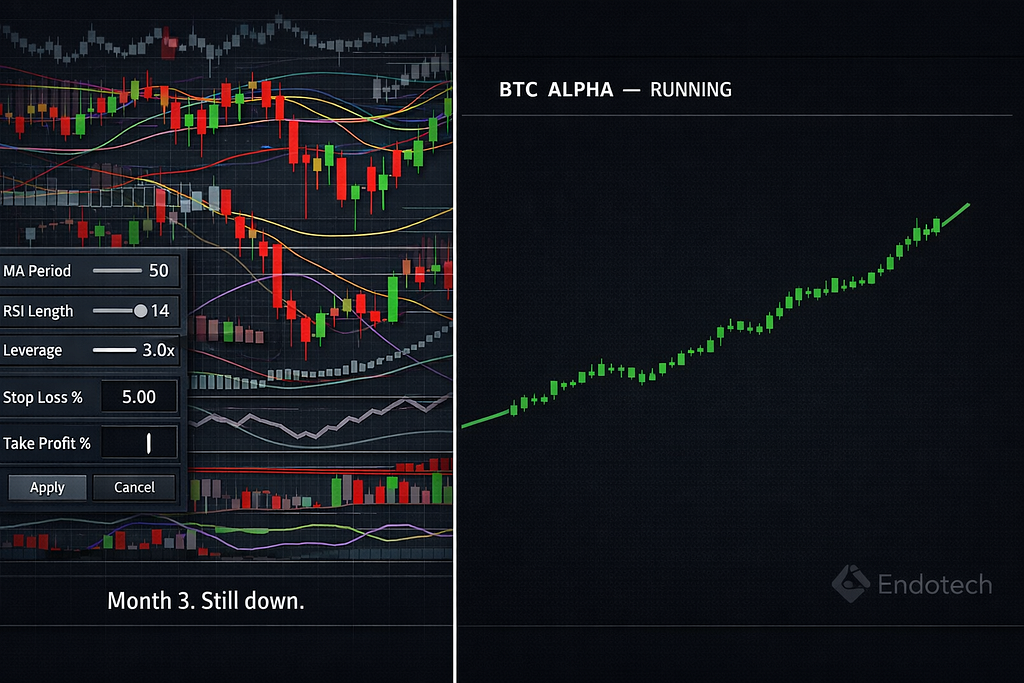
The bot did everything I told it to. That was the problem.
Let me start with something most bot comparison articles will not tell you.
I was not bad at using 3Commas. I watched the tutorials. I read the documentation. I spent hours in the settings finding the right grid spacing, the right take profit percentages, the right trailing parameters for my BTC/USDT pair. I was genuinely trying to do it right.
Six months later I was down 11% on a pair that had gone up 34% in the same period.
The bot did not malfunction. It did not have a bug. It executed my strategy flawlessly, exactly as configured. That was the problem. My strategy was wrong — and the bot had no way of knowing that.
The Fundamental Misunderstanding About Trading Bots
Most people who try retail trading bots have the same misunderstanding I had. They think the bot is the intelligence. It is not. The bot is the execution. You are the intelligence.
When you configure a 3Commas grid bot, you are making predictions. You are predicting the price range the asset will trade in. You are predicting the volatility profile. You are predicting whether the market is in a trending or ranging regime. You are making the same decisions a quantitative trader makes — you are just making them with a web interface instead of a Bloomberg terminal.
If you could make those predictions correctly and consistently, you would not need a bot. You would already be a profitable trader.
This is not a criticism of 3Commas specifically. Their platform is well built, their interface is clean, and their customer support is responsive. The problem is the model — and the model is the same across every retail bot platform. You bring the strategy. The bot brings the execution.
For the full breakdown of why this model fails for most retail traders, read why most crypto trading bots lose money.
What My 6 Months With 3Commas Actually Looked Like
Months 1–2: Optimism
The bot was running. Trades were executing. The grid was filling in both directions. I felt like a quantitative trader. I had alerts set up. I was monitoring the dashboard. I was learning.
The account was roughly flat after fees.
Month 3: The first regime change
Bitcoin broke out of the range I had configured my grid for. The bot kept placing orders inside the grid while the price moved outside it. I watched my unrealized losses grow as BTC trended strongly upward and my bot sat waiting for a pullback that took three weeks to arrive.
I adjusted the parameters. The bot adapted to the new configuration and started trading again.
Month 4: The second regime change
The market turned. My newly adjusted grid — optimized for the uptrend — was now buying all the way down as BTC corrected. DCA bot logic kept accumulating at lower prices. I was averaging down into a declining asset.
I adjusted the parameters again.
Months 5–6: The grind
I was spending more time managing the bot than I would have spent just trading manually. The entire point of automation was to remove the daily decision-making. Instead I had replaced it with weekly parameter adjustments and constant second-guessing.
When I tallied everything after six months — trades, fees, slippage, the opportunity cost of capital tied up in underperforming configurations — I was down 11% on a pair that had appreciated 34%.
What I Switched To and Why
I had been researching Endotech for a few months before I made the switch. My hesitation was the same as most people: the claims sounded too good. 163% average annual returns. Zero losing years in 8 years. PhD founder. Institutional track record.
I spent a week trying to find the scam. I read the ScamAdviser flagging, the negative Trustpilot reviews, the forum threads. I checked the founder’s Wikipedia page, her academic publications, the Finance Magnates article about her previous company exit.
What I could not find was any evidence of funds being misappropriated, any accounts being drained, or any withdrawal restrictions. The full Endotech AI review covers everything I found in detail.
The thing that finally convinced me was the custody model. The Endotech AI connects to your Bit1 Exchange account via a trade-only API key. It can execute buy and sell orders on your behalf. It cannot withdraw funds. It cannot transfer assets. Your USDT stays in your own named wallet on the exchange at all times.
After FTX I was not giving custody to anyone. This solved that.
3Commas vs Endotech — The Honest Comparison
Who designs the strategy:
3Commas — you do. You set every parameter.
Endotech — PhD-built algorithms developed over a decade of institutional trading. You set nothing.
How the system handles market regime changes:
3Commas — it does not. Your static grid runs regardless of whether the market is trending or ranging. You adjust manually when it stops working.
Endotech — over 100 AI modules classify market regimes in real time and adapt strategy accordingly. This is the single most important difference.
Fee model:
3Commas — $29 to $99 per month subscription regardless of whether you make money or lose money.
Endotech — zero subscription fee on the VIP Retail tier. Performance fee only on profitable trades. If the AI loses, you pay nothing.
Account minimum:
3Commas — no hard minimum but grid bots work poorly below $1,000.
Endotech on Bit1 — no minimum deposit requirement.
Custody:
3Commas — trade-only API, funds stay on your exchange.
Endotech — same. Both are safe on this point.
Time required:
3Commas — significant. Parameter optimization, regime monitoring, regular adjustment. It is a part-time job if you do it properly.
Endotech — zero after initial setup. The AI handles everything.
For the complete side-by-side breakdown see the full Endotech vs 3Commas comparison.
The Fees Will Eat You Alive on Small Accounts
This deserves its own section because it is the thing most bot comparison articles skip entirely.
3Commas Pro is $59 per month. On a $1,000 account that is a 5.9% monthly overhead before you make a single profitable trade. Your bot needs to generate almost 6% monthly just to break even on the software cost.
On a $500 account it is worse. On a $300 account it is absurd.
Endotech’s VIP Retail tier charges 0% subscription and a 50% performance fee on profits. On a month where you make nothing, you pay nothing. On a month where the AI generates 10% on your $500 account — $50 profit — you pay $25 in performance fees and net $25.
That $25 net on a $500 account beats the 3Commas model where you are paying $59 regardless of results.
For the full fee math see Endotech fee structure explained.
What I Wish I Had Known Before Month 1
The honest version of this article is simple: retail trading bots are tools for quantitative traders. If you have the skill to design a profitable strategy, they are excellent execution tools. If you do not — and most retail investors do not, including me — you are paying a subscription to faithfully execute your own mistakes.
Institutional AI removes you from the strategy equation entirely. You are not the pilot anymore. You are the passenger. And the pilot has a decade of institutional flight hours.
That is not a comfort for everyone. Some people want control. If you enjoy the process of building and testing strategies, 3Commas is genuinely a good platform for that. If what you actually want is for your capital to grow without becoming a full-time trader, the model is wrong.
For anyone in the second category — the step-by-step setup guide walks through the full connection process. The retail bots vs institutional AI breakdown covers the structural differences in more depth than this article does.
Is automated crypto trading safe is also worth reading before connecting anything — the custody model question is the most important one to answer before you commit capital to any automated system.
This article is for informational purposes only and does not constitute financial or investment advice. Cryptocurrency trading carries substantial risk of loss. Past performance of Endotech strategies does not guarantee future results. The 3Commas experience described reflects one user’s results and is not representative of all users. Always conduct your own due diligence.
I Ran a 3Commas Grid Bot for 6 Months Then Switched to Endotech AI — Here’s the Honest Difference was originally published in Coinmonks on Medium, where people are continuing the conversation by highlighting and responding to this story.