
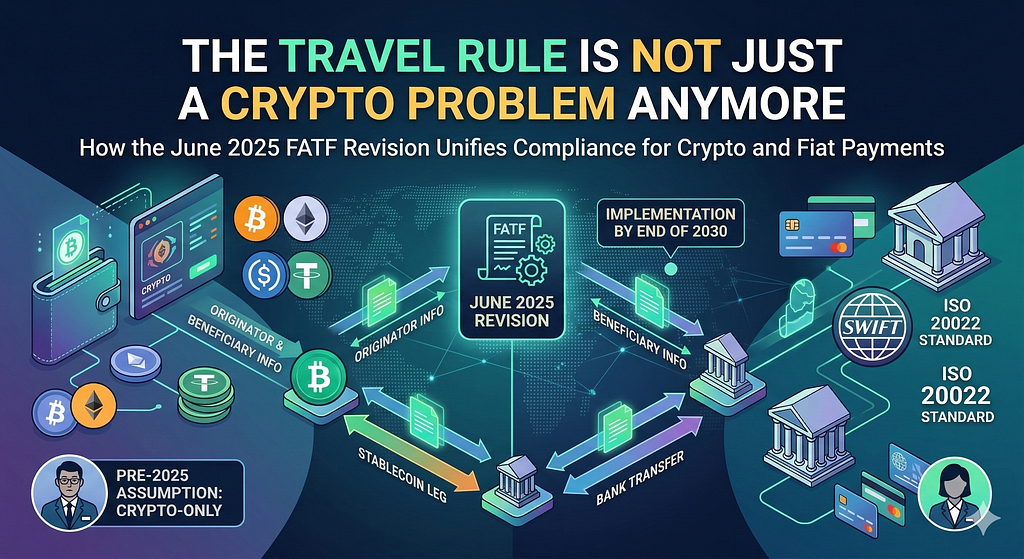
When most people hear “Travel Rule,” they think crypto exchanges. KYC checks. Compliance teams at token startups scrambling to figure out how to share customer data with counterparties. For a long time, that picture was mostly accurate. That assumption changed in June 2025.
What Changed in June 2025
FATF agreed to a significant revision of Recommendation 16 at its June 2025 Plenary meeting. The changes are designed to increase the safety and security of cross-border payments and better detect financial crime. The revised requirements take effect by end of 2030.
Four changes stand out. The payment chain is now defined more clearly, with responsibilities starting at the institution that receives the customer instruction. Standardised information requirements now apply for peer-to-peer cross-border transfers above USD or EUR 1,000. Beneficiary verification is now a requirement, not just a recommendation. And the revised rule is designed to work within ISO 20022, the standard that now governs all cross-border SWIFT payments, not just crypto transfers.
Why This Matters Beyond Crypto
A growing number of businesses use stablecoins as part of their cross-border payment flow. A marketplace might accept USDC from a buyer in one country, convert to local currency, and pay a seller via bank transfer in another country. In this flow there are two legs. The stablecoin leg triggers virtual asset Travel Rule requirements. The fiat leg triggers ISO 20022 payment transparency requirements. Both require originator and beneficiary data. If your compliance stack only covers one of them, you have a gap.
What the Numbers Actually Show
According to the FATF Best Practices on Travel Rule Supervision report, 85 of 117 surveyed jurisdictions that have not prohibited VASPs have passed or are actively passing Travel Rule legislation. But there is a gap between legislation passing and implementation being complete. The same report notes significant variation in how rigorously the Travel Rule is being enforced, particularly for data exchange between VASPs using different protocols.
What Businesses Should Do
If your business handles stablecoin transactions as part of a cross-border payment flow, map which legs of your payment chain are subject to which requirements. Then ask your payment provider which Travel Rule protocol they support, what they do when a counterparty cannot provide the required data, and how they document compliance efforts for regulators.
If your business is entirely in traditional fiat payments, the June 2025 revision still matters. The direction of regulation is toward more complete party information in every payment, not less.
Conclusion
The Travel Rule was always a fiat payments concept. The extension to virtual assets in 2019 made it a crypto compliance issue for a few years. The June 2025 FATF revision closes that chapter. The Travel Rule is now a cross-border payment standard that applies to any business moving money across jurisdictions, regardless of the rails it uses. Businesses with stablecoin payment flows need to ensure both legs are covered. Businesses in traditional fiat payments need to understand that the same transparency requirements are arriving through ISO 20022. The regulatory trajectory is consistent. The compliance stack needs to reflect it.
For a complete breakdown of Travel Rule requirements by jurisdiction, the June 2025 FATF changes, and practical implementation guidance, read: The Travel Rule for Cross-Border Payments: 2026 Guide
The Travel Rule Is Not Just a Crypto Problem Anymore was originally published in Coinmonks on Medium, where people are continuing the conversation by highlighting and responding to this story.