
When people hear “crypto token,” they think of price charts.
Volatility.
Speculation.
Market caps.
Hype cycles.
But strip away the noise, and a token is something far more interesting.
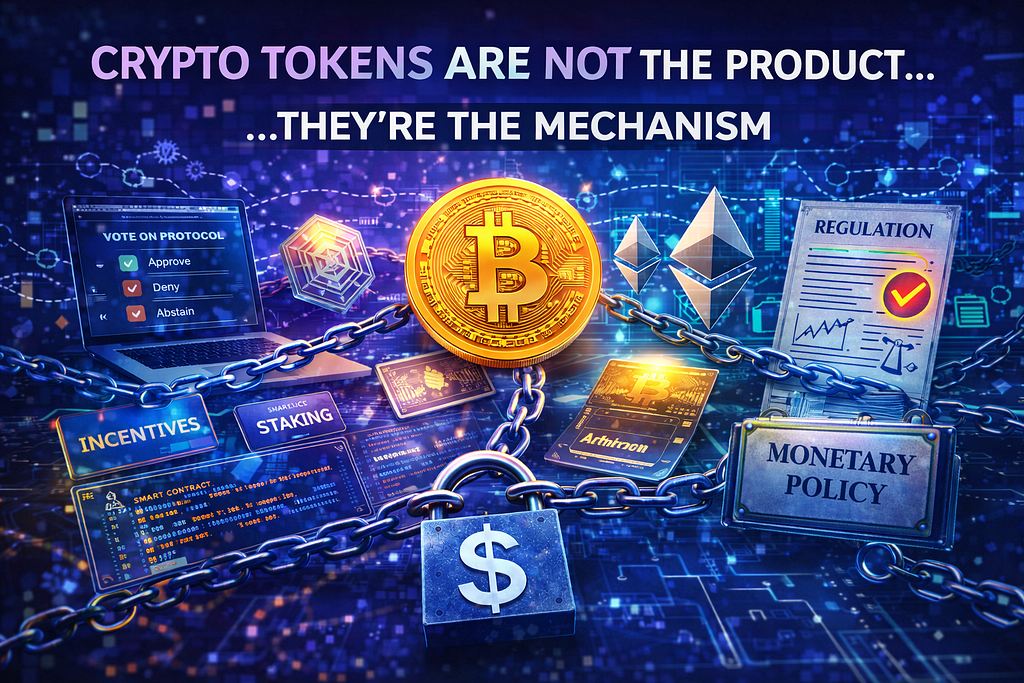
Image is Generated by ChatGPT
It’s a programmable unit of value.
And like any financial instrument, its real impact depends on how it’s designed and why it exists.
The Early Illusion
The early crypto era made tokens look simple.
Create a token.
List it.
Build a community.
Watch demand grow.
But the founders who survived learned quickly:
A token without utility becomes noise.
A token without structure becomes risk.
A token without governance becomes fragile.
Crypto tokens aren’t magic.
They’re economic systems in code.
What a Token Actually Represents
At its core, a crypto token can represent:
OwnershipAccessIncentiveGovernance powerNetwork participationDigital scarcity
The power lies in programmability.
Unlike traditional assets, tokens can embed logic:
Vesting schedulesSupply capsEmission curvesStaking rewardsVoting rights
But programmable doesn’t mean stable.
Designing tokenomics is closer to monetary policy than product design.
And monetary policy mistakes compound.
A Pause for Builders
If you’re considering launching a token, ask yourself:
Is the token solving a structural problem or creating temporary excitement?
Tokens should answer a clear question:
What coordination problem does this solve?
Because tokens are tools for alignment.
They align users, developers, validators, and investors around shared incentives.
Without alignment, tokens drift into speculation.
Utility vs Liquidity
One of the most misunderstood dynamics in crypto is the tension between utility and liquidity.
Utility demands stability.
Liquidity invites volatility.
If your token powers transaction fees, governance, or staking, wild price swings disrupt usability.
But if your token is highly tradable, market forces may dominate over product needs.
Balancing these forces is not easy.
Too much emphasis on price and product suffers.
Too little liquidity and ecosystem participation slows.
Tokens sit at the intersection of markets and mechanics.
Governance: Power in Code
Many crypto tokens include governance rights.
Token holders vote on:
Protocol upgradesTreasury allocationsEmission changesNetwork parameters
On paper, it’s decentralized democracy.
In practice, governance introduces complexity:
Low voter participationConcentrated ownershipCoordination delaysProposal fatigue
Governance tokens don’t eliminate power structures.
They reshape them.
Founders must design carefully to avoid unintended centralization.
Incentives Can Backfire
Tokens are often used to bootstrap growth.
Reward early adopters.
Incentivize liquidity.
Attract developers.
Incentives work until they distort behavior.
If rewards are too generous:
Users farm rewards instead of building value.Liquidity leaves once incentives drop.Ecosystem becomes transactional.
Tokens amplify incentives.
And amplified incentives can produce short-term growth but long-term instability.
Economic design matters as much as technical design.
The Security Layer
Crypto tokens also introduce security considerations.
Smart contracts must be audited.
Supply mechanisms must be transparent.
Admin privileges must be clear.
A single vulnerability can:
Freeze fundsDrain liquidityDestroy trust
Unlike traditional fintech systems, blockchain transactions are often irreversible.
That finality demands discipline.
Security isn’t optional in token ecosystems.
It’s foundational.
Regulation Is Catching Up
Crypto tokens increasingly operate under regulatory scrutiny.
Questions arise:
Is the token a security?Does it represent investment expectation?Are disclosures adequate?Are AML processes in place?
Regulation doesn’t eliminate innovation.
But it forces clarity.
Tokens that blur purpose risk legal instability.
The strongest token projects articulate:
What the token doesWhat it does not representHow it’s distributedHow it’s governed
Clarity builds durability.
Where Tokens Actually Shine
Despite volatility and noise, tokens unlock unique possibilities:
Borderless value transferPermissionless participationTransparent supply modelsComposable financial primitivesGlobal developer coordination
Tokens remove intermediaries.
But they also remove safety nets.
Self-custody increases autonomy and responsibility.
Decentralization increases resilience and complexity.
The Real Shift
Crypto tokens aren’t just financial instruments.
They’re coordination tools.
They allow strangers across the world to participate in shared systems.
They embed economic rules directly into infrastructure.
But infrastructure without discipline collapses.
Tokens don’t guarantee decentralization.
They enable it if designed carefully.
What Mature Token Builders Understand
Teams that build sustainable token ecosystems:
Focus on long-term utility over short-term hypeDesign gradual emission schedulesAlign incentives with real usagePrioritize security auditsCommunicate transparently
They treat tokens as economic infrastructure not marketing campaigns.
Because once issued, tokens become permanent parts of public markets.
And public markets are unforgiving.
Closing Thought
Crypto tokens are not inherently revolutionary.
Nor are they inherently risky.
They are instruments.
And instruments reflect the intentions of their design.
The future of tokens won’t be decided by price charts.
It will be decided by whether they solve real coordination problems — sustainably.
If this reflection helped you think differently about crypto tokens beyond speculation, feel free to clap so others exploring blockchain systems can discover it.
And I’d genuinely love to hear:
Do you see tokens primarily as financial assets or as coordination mechanisms?
That distinction may define the next phase of crypto innovation.
Crypto Tokens Are Not the Product. They’re the Mechanism. was originally published in Coinmonks on Medium, where people are continuing the conversation by highlighting and responding to this story.