
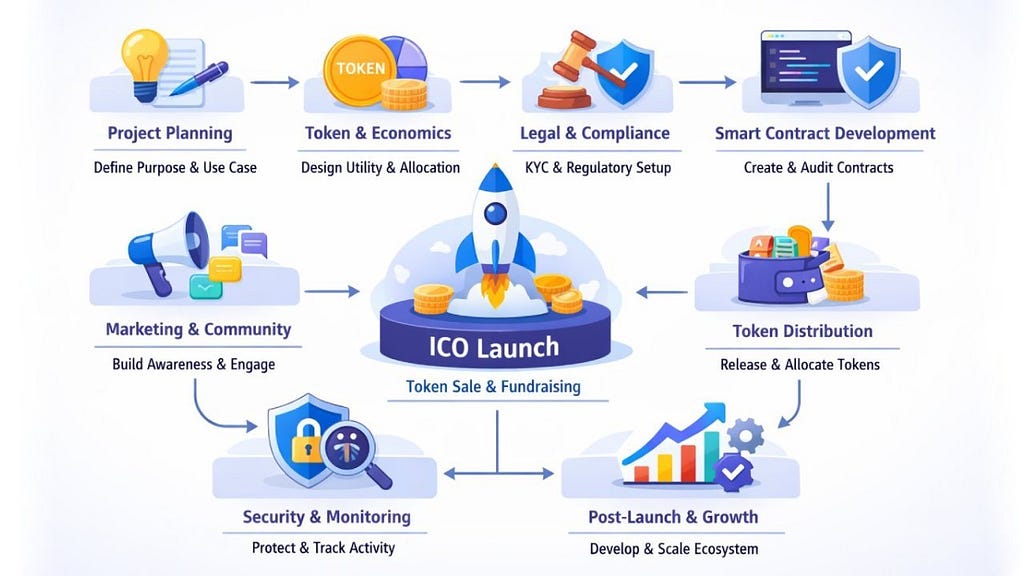
A Practical Guide to Launching an ICO Successfully
Launching an Initial Coin Offering (ICO) is a complex undertaking that goes far beyond issuing a token and opening contributions. A successful ICO requires strategic planning, technical precision, legal awareness, and disciplined execution across multiple stages. Many ICO failures can be traced not to a lack of funding or ideas, but to weak preparation, unclear token utility, security oversights, or unrealistic expectations.
This practical guide explains how to launch an ICO successfully, focusing on real-world considerations rather than hype. It covers each phase of the ICO lifecycle from early planning and token design to technical deployment, sale execution, and post-launch responsibilities providing a structured framework that projects can adapt to their specific goals and constraints.
How Success Is Measured in ICOs
Before discussing execution, it is important to define what “success” means in the context of an ICO. Success is not limited to hitting a funding target. In practice, a successful ICO typically demonstrates:
✦A clearly defined use case and token utility
✦A secure and transparent fundraising process
✦A fair and sustainable token distribution model
✦Strong participant confidence and engagement
✦Operational readiness beyond the token sale
Viewing an ICO as the starting point of an ecosystem, rather than a one-time fundraising event, is essential for long-term viability.
Phase 1: Pre-ICO Planning and Foundation
Defining the Project Scope
Every ICO begins with a problem statement. Teams must clearly articulate:
✦The problem being addressed
✦Why decentralization adds value
✦Who the intended users are
Projects that skip this step often struggle to justify token relevance later.
Evaluating Whether an ICO Is the Right Model
Not all projects benefit from an ICO. Founders should evaluate whether:
✦A token is essential to the system’s function
✦Token-based incentives improve participation
✦Decentralized governance is required
If a token exists only to raise funds, the ICO is unlikely to sustain momentum.
Phase 2: Token Design and Tokenomics
Defining Token Utility
Token utility should be practical, not abstract. Common utility models include:
✦Access to platform features
✦Payment for protocol services
✦Governance and voting rights
✦Incentives for contributors and validators
Clear utility improves adoption and reduces speculative volatility.
Supply Structure and Allocation
✦Tokenomics design typically includes:
✦Total supply cap
✦Initial circulating supply
✦Allocation percentages (public sale, team, ecosystem, treasury)
✦Vesting and lock-up schedules
Over-allocation to insiders or short vesting periods often erode trust.
Incentive Alignment
A well-designed token aligns incentives across all participants. This means:
✦Users benefit from using the token
✦Contributors benefit from long-term growth
✦The project treasury supports sustainability
Misaligned incentives are a common reason ICO ecosystems fail after launch.
Phase 3: Legal and Regulatory Preparation
Regulatory Classification
Different jurisdictions classify tokens differently. Tokens may be viewed as:
✦Utility tokens
✦Governance tokens
✦Financial or security-like instruments
Understanding how a token may be interpreted is critical for structuring the sale.
Participant Restrictions and Compliance
Many ICOs implement safeguards such as:
✦KYC/AML checks
✦Geographic participation restrictions
✦Contribution limits
These measures reduce regulatory risk and increase operational clarity.
Phase 4: Technical Architecture and Infrastructure
Selecting the Blockchain Network
Blockchain selection impacts cost, scalability, and user experience. Key considerations include:
✦Transaction throughput and latency
✦Network fees
✦Developer tooling
✦Ecosystem maturity
The chosen network should support the project’s expected usage patterns.
Infrastructure Components
A typical ICO infrastructure includes:
✦Token smart contracts
✦Sale (crowdsale) contracts
✦Wallet integrations
✦Backend services and APIs
✦Frontend dashboards
Each component must work together seamlessly.
Phase 5: Smart Contract Development
Token Contract Design
The token contract defines:
✦Token supply rules
✦Transfer logic
✦Minting or burning conditions
It forms the core of the ICO and the broader ecosystem.
Sale Contract Logic
The sale contract handles:
✦Contribution acceptance
✦Token allocation
✦Hard cap and soft cap enforcement
✦Time-based sale phases
Automating these rules minimizes human error and improves transparency.
Security Best Practices
Security considerations include:
✦Reentrancy protection
✦Input validation
✦Overflow and underflow safeguards
✦Emergency pause mechanisms
Smart contracts are immutable, making pre-launch accuracy essential.
Phase 6: Testing and Audits
Internal Testing
Testing should simulate real-world scenarios, including:
✦High-volume transactions
✦Edge cases and failure states
✦Timing-related issues
Comprehensive testing improves reliability and confidence.
Independent Security Audits
External audits identify:
✦Vulnerabilities
✦Logical inconsistencies
✦Optimization opportunities
Audits are a standard requirement for responsible ICO launches.
Phase 7: User Experience and Transparency
Investor Dashboards
Dashboards typically show:
✦Contribution history
✦Token allocation
✦Sale progress
Clear visibility reduces confusion and support overhead.
Communication Channels
Consistent updates before and during the sale help manage expectations and reduce misinformation. Transparency is a core trust-building factor.
Phase 8: Pre-Launch Execution
Whitelisting and Access Control
Whitelisting helps:
✦Verify eligible participants
✦Control contribution limits
✦Manage compliance requirements
This step prepares the system for public participation.
Final Configuration and Deployment
Before launch, teams must:
✦Deploy final contract versions
✦Lock configuration parameters
✦Test live interactions
Once deployed, changes are limited or impossible.
Phase 9: ICO Launch and Sale Management
Sale Activation
At launch, the sale contract becomes active, enabling contributions and automated token distribution.
Key operational considerations include:
✦Network congestion
✦Transaction confirmation delays
✦Monitoring unusual activity
Prepared teams respond quickly to technical issues.
Real-Time Monitoring
During the sale, monitoring focuses on:
✦Funds raised
✦Token distribution accuracy
✦Contract behavior
Real-time visibility helps manage risk and maintain stability.
Phase 10: Post-ICO Responsibilities
Token Distribution Finalization
After the sale:
✦Unsold tokens may be burned or reallocated
✦Vesting schedules activate
✦Treasury funds are secured
This phase closes the fundraising cycle.
Liquidity and Ecosystem Preparation
While approaches vary, post-ICO preparation often includes:
✦Liquidity planning
✦Technical readiness for integrations
✦Ongoing token management
Token launch is the beginning of ecosystem execution.
Governance and Community Integration
Many projects introduce governance mechanisms after the ICO, such as:
✦Voting systems
✦Proposal frameworks
✦Contributor incentives
Governance shifts control gradually from the core team to the community.
Common Challenges in ICO Launches
Unrealistic Expectations
Overpromising timelines or features damages credibility. Conservative planning builds trust.
Security Oversights
Even small vulnerabilities can lead to severe losses. Security discipline is non-negotiable.
Poor Token Design
Weak utility or inflationary models undermine long-term value.
Understanding these risks helps teams avoid common pitfalls.
Measuring ICO Success Beyond Fundraising
Success metrics may include:
✦Participant retention
✦Token usage rates
✦Governance participation
✦Ecosystem growth
Long-term indicators matter more than short-term fundraising totals.
How ICO Launches Have Evolved
Modern ICOs differ significantly from early models. Trends include:
✦Greater transparency
✦Phased fundraising
✦Community-driven governance
✦Improved technical standards
These changes reflect a more mature blockchain environment.
Best Practices for Launching an ICO Successfully
Key takeaways include:
✦Start with a clear, justified token use case
✦Design fair and sustainable tokenomics
✦Prioritize security and testing
✦Maintain transparency at every stage
✦Treat the ICO as the start of execution, not the end
Disciplined planning increases the likelihood of long-term success.
Conclusion
Launching an ICO successfully requires more than technical execution or fundraising ambition. It demands a balanced approach that integrates product vision, token economics, legal awareness, security practices, and operational readiness.
By following a structured, practical framework from early planning and token design to post-launch governance projects can reduce risk and build stronger foundations for sustainable growth. In an evolving blockchain ecosystem, ICOs that emphasize clarity, discipline, and responsibility are better positioned to create lasting value beyond the token sale itself.
A Practical Guide to Launching an ICO Successfully was originally published in Coinmonks on Medium, where people are continuing the conversation by highlighting and responding to this story.