
Bitcoin (BTC) fell back towards the $68,000 mark after a brief push over the $70,000 mark on Sunday. The flagship cryptocurrency crossed $69,000 and reclaimed $70,000 thanks to a relief rally on the back of soft US CPI inflation data. However, momentum waned after it reached an intraday high of $70,774 as traders brace for a week of macroeconomic events, including the core PCE inflation report and Fed minutes from the January FOMC meeting.
As a result, Bitcoin fell to a low of $68,141 on Monday before moving to its current level of $68,536, down over 3% in the past 24 hours. The decline pushed the broader cryptocurrency market into bearish territory as well, with Ethereum (ETH) slipping almost 6%, while Ripple slumped over 10% to $1.46. The overall crypto market cap is down 3.13% at $2.34 trillion.
Michael Saylor Signals Bitcoin Buy Despite Downturn
Strategy executive chairman Michael Saylor has hinted at another Bitcoin purchase despite the ongoing market downturn. Saylor posted Strategy’s Bitcoin accumulation chart on Sunday, hinting at its impending 99th BTC transaction. The company’s last Bitcoin purchase was on February 9, when it bought 1,142 BTC for around $90 million. The purchase took Strategy’s stash to 714,644 BTC, valued at around $49.3 billion at current prices. The company has continued accumulating Bitcoin, defying speculations that it could pause its purchases or even dump a portion of its Bitcoin holdings during the ongoing downturn.
Digital asset treasury companies, including Strategy, have been under duress since the October 2025 liquidation event. Several treasury companies registered a sharp decline in stock prices as their mNAV fell below 1. Digital asset treasury companies with an mNAV of over 1 can access finance and stock issuance to fund further purchases. On the other hand, companies with an mNAV value below 1 have trouble accessing capital as market participants price them below the value of their holdings.
Stablecoin Yields Not A Threat To Banks: White House Crypto Advisor
White House crypto advisor Patrick Witt believes banks must not consider stablecoin yield as a threat. The ongoing debate over stablecoin yields has become a major hurdle in passing the CLARITY Act. Witt stated that crypto service providers sharing yield with customers does not undermine the traditional banking industry, calling the disagreements “unfortunate.” The White House crypto advisor stated that banks can offer stablecoin products to their customers, adding that several banks are applying for OCC bank charters to provide such products. Witt also believes banks will eventually find opportunities to leverage stablecoin products and expand their business, rather than view them as threats.
Bitcoin (BTC) Price Analysis
Bitcoin (BTC) briefly crossed the $70,000 mark over the weekend on the back of soft US CPI inflation data. However, with traders wary about the strength of the latest relief rally, the flagship cryptocurrency lost momentum and dropped back towards the $68,000 mark. As a result, the price fell 1.43% to a low of $68,020 before settling at $68,792. BTC is marginally up during the ongoing session, trading around $68,852.
BTC’s decline dragged the broader market lower as well, with Ethereum (ETH) down over 4% and Ripple (XRP) down nearly 8% over the past 24 hours. Solana (SOL) returned to bearish territory as well after a brief reprieve, down 4.46% at $86. Analysts highlighted that the market’s performance was particularly disappointing against the backdrop of weak US CPI data, which kept hopes of a rate cut alive. CPI growth slowed to 2.4% year-on-year in January, down from 2.7% in December. The slowdown reinforced market expectations of a 25-basis-point rate cut by the Federal Reserve this year. While BTC did rally from $66,000 to $70,000 on the back of the numbers, it failed to establish a foothold. Vikram Subburaj, CEO of Giottus Exchange, stated,
“Risk appetite stayed selective, and macro cross-currents kept traders defensive. In derivatives, the market continues to behave as if it is ‘de-leveraging first, asking questions later.’ Rallies have struggled to hold, and dips are being bought only selectively near obvious levels.”
Markets are now bracing themselves for a macro-heavy week, with the release of the core personal consumption expenditures price index (PCE), the Federal Reserve’s preferred inflation gauge. Traders are also keeping an eye out for the minutes of the January Fed meeting. Dessislava Laneva, Nexo dispatch analyst, stated,
“PCE inflation, the Fed’s preferred measure, will be closely monitored for confirmation that price pressures are moderating, particularly after CPI showed only gradual disinflation and inflation remains above the 2% target. Markets will assess both the monthly momentum and year-on-year trend for implications for the policy path.”
To make matters worse, Bitcoin could be heading for its worst Q1 in eight years, with market data showing the flagship cryptocurrency down over 22% since the beginning of the year. BTC began the year trading around $87,700 but has declined to its current level of around $68,000. According to CoinGlass data, this puts it on track for its worst Q1 since the 2018 bear market, when it fell nearly 50%. However, analysts like Daan Trades Crypto stated that Q1 is generally known to be volatile, and volatility does not tend to translate over further down the line.
“The first quarter of the year is known for its volatile nature. So it’s safe to say, whatever happens in Q1 does not generally translate over further down the line, according to the historical price action.”
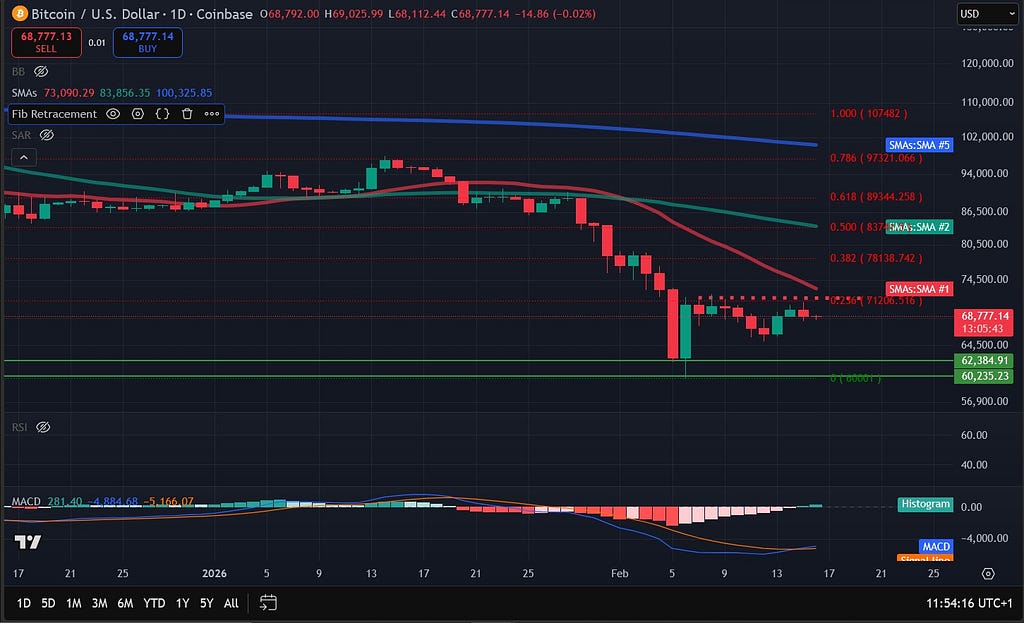
Bitcoin (BTC) saw significant price volatility on February 5 as selling pressure intensified. As a result, the flagship cryptocurrency plunged below the $70,000 mark and settled at $62,791. Selling pressure persisted on February 6 as the price fell to a low of $60,000 before rebounding to reclaim $70,000. Price action was mixed over the weekend, with BTC registering a marginal decline on Monday. Sellers retained control on Tuesday as the price fell almost 2% to $68,803. BTC retreated further on Wednesday, dropping 2.59% to $67,024.
Source: TradingView
Volatility returned on Thursday as buyers and sellers struggled to gain control. Sellers ultimately gained the upper hand as BTC fell 1.22% to $66,208. Despite the overwhelming bearish sentiment, the price recovered on Friday, rising nearly 4% to $68,812. Price action was mixed over the weekend, with BTC rising 1.42% on Saturday and falling 1.43% on Sunday. The flagship cryptocurrency is marginally down during the ongoing session, trading around $68,711.
The MACD shows market momentum shifting from bearish to bullish. However, BTC must reclaim the resistance at the 0.236 Fibonacci level to confirm the reversal.
Disclaimer: This article is provided for informational purposes only. It is not offered or intended to be used as legal, tax, investment, financial, or other advice.
Bitcoin Price Analysis: BTC Falls Back After Brief $70,000 Sojourn was originally published in Coinmonks on Medium, where people are continuing the conversation by highlighting and responding to this story.