
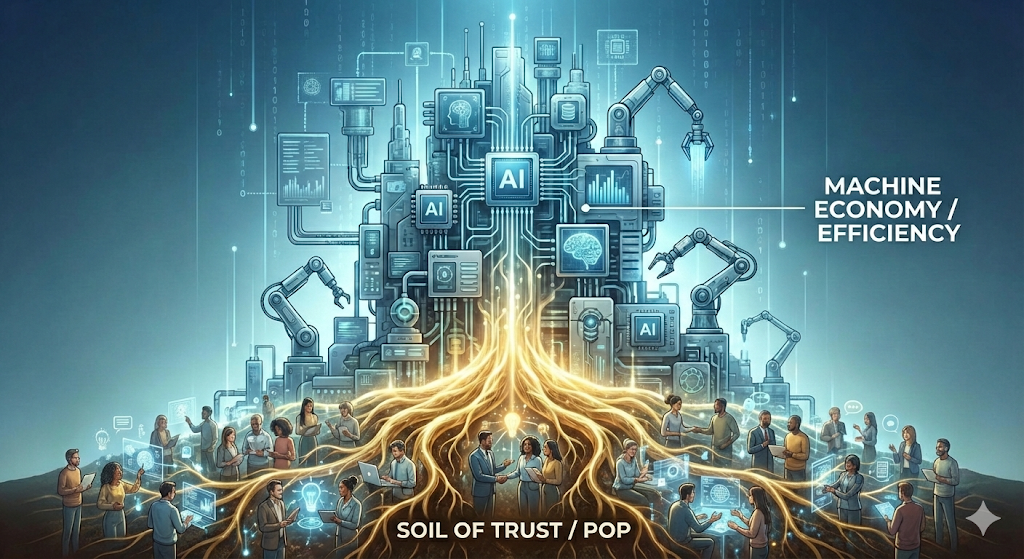
[The Post-Labor #2] Why Human Qualification Matters More Than Efficiency in a Machine Economy
In Part 1, we established that the economic agent has already expanded into a three-axis reality: Human, Robot, and AI.
Machines & AI Hold the Wallet: The End of Human Monopoly
But here is the chilling reality — our current financial system is suffering from systemic atherosclerosis.
Legacy infrastructure, built on physical IDs and bureaucratic human-in-the-loop approvals, is fundamentally incapable of sustaining daily life in 2026.
When machines operate at millisecond intervals, human authorization becomes friction — not safety.
So what makes the InterLink Dual-Token System different? The answer lies in the inevitable evolution toward POP (Proof of Personhood).
⚠️ The End of “Capability Competition”: The Fall of POW and POS
For decades, value was assigned to capability — how much one could produce and how efficiently it could be done.
In 2026, that paradigm has collapsed.
Take NVIDIA’s AI factories as a prime example: these massive clusters of Blackwell-architecture chips are no longer just hardware — they are “Intelligence Foundries” producing cognitive labor at a scale and cost no human can match.
When high-level reasoning and technical skill are mass-produced like plastic toys, the market value of individual human effort inevitably spirals toward zero.
This reality renders traditional consensus models obsolete.
Proof of Work (POW) is governed by brute computational force. In a three-axis economy, a human miner is effectively bringing a knife to a nuclear standoff against ASIC-level automation.
Proof of Stake (POS) is governed by capital accumulation. Once AI agents begin generating yield 24/7 with near-zero friction, they will inevitably dominate stake ownership — concentrating governance in systems no longer anchored to human participation.
If we remain within these frameworks, humans do not merely lose the competition.
They lose the seat at the table.
🔄 The Structural Pivot: POP as the Human Layer
This is why the focus of value must shift from what is being done to who is participating.
If the NVIDIA Blackwell era has commoditized intelligence into an infinite supply, then the only remaining scarcity is human identity.
We can no longer derive value from “capability” when a server farm can out-think a thousand PhDs for the price of a few kilowatts. To survive this shift, we must move beyond the output-driven economy.
POP is not a defensive barrier against machines; it is a qualification layer that machines cannot counterfeit. We no longer compete with machines in the arena of execution.
Instead, humans provide the “Soil of Trust” — a foundation of verifiable presence, continuity, and accountability — upon which machine efficiency can safely operate.
Soil of Trust. Photo by Land O’Lakes, Inc. on Unsplash
💎 Hyper-Inflation of Skill vs. The Scarcity of “Being”
In a world saturated with deepfakes and autonomous bots, proof that a real human is behind a connection becomes the ultimate luxury.
It is the only asset that cannot be devalued by an algorithm.
If machines have mastered the art of production, then humans must hold the keys to legitimacy.
While POW and POS funnel value into the machine-dominated realms of raw power and capital, POP redirects that value back to the verified human participants who serve as the network’s soul.
This is more than a technical shift;
it is the structural foundation that allows humans to employ AI and robots — rather than be displaced by them.
🎫 InterLink: The Ticket to the Human Layer
In this context, InterLink’s ITLG is more than a token.
It functions as a qualification instrument — a ticket into the human governance layer that sits above the machine economy.
The critical question is how human value is protected from contamination by machine-speed volatility.
This is why the Dual-Token (ITLG / ITL) architecture is not a design preference, but a structural necessity.
By separating the Anchor of Trust from the Fluid of Utility, InterLink ensures that human judgment governs qualification and access, while machines optimize execution and efficiency.
🔜 Continue to Part 3
In the machine economy, money is no longer a reward for work. It is a filter for participation.
And only systems that can prove who belongs will survive.
About the Author
Done.T is a Web3 analyst specializing in the InterLink ecosystem.
He unpacks the underlying logic of the Human Node economy, translating complex system design into actionable, data-driven insights for a global audience.
Reference
🔗 [Chapter 3. The Evolution — The Macro Thesis]
Disclaimer: This article provides a strategic analysis of InterLink’s publicly available infrastructure and documentation.
It is not financial advice. Readers should conduct their own due diligence.
The Architecture of Coexistence: Why “Dual” Is the New Blood was originally published in Coinmonks on Medium, where people are continuing the conversation by highlighting and responding to this story.